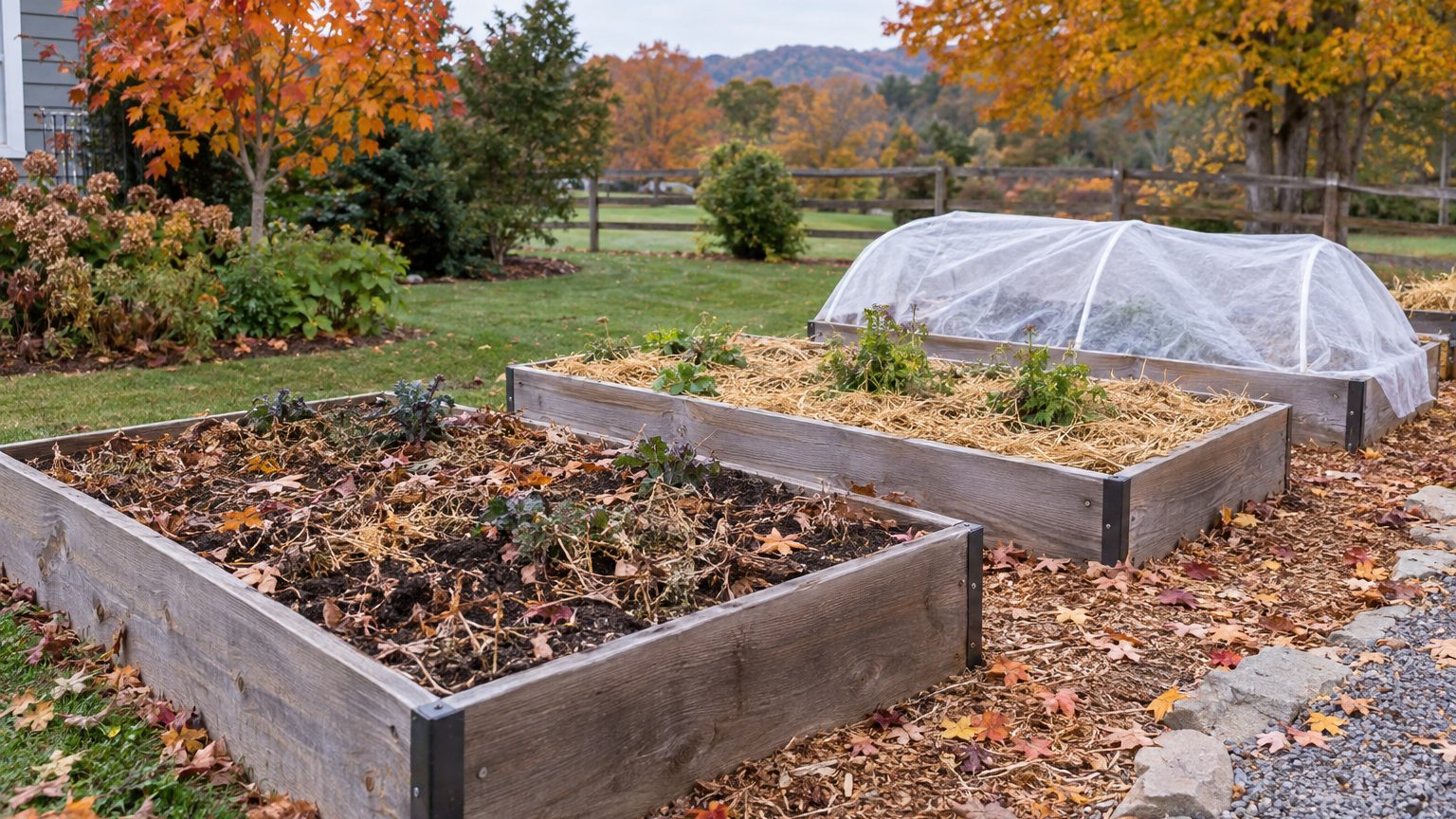

Raised-bed soil can freeze fast, so winterizing comes down to two jobs: clear out what is finished, then cover the soil so it is never left bare. Mulch or a living cover crop will do the covering. First, look up your own first frost date and have your mulch or cover-crop seed on hand before it arrives.
Clear it, feed it, cover it

Remove the spent plants, pull any diseased plant out roots and all, then cover the bed. South Dakota State University Extension gives that advice for diseased plants in its fall cleanup guide. Iowa State University Extension and Outreach explains why the covering matters: “the soil in raised beds can freeze quickly causing more stress to the roots of these plants.”
Clear what is finished
Kansas State University Research and Extension (Johnson County) tells gardeners to “remove all plant material from the garden, with the exception of winter vegetables or cover crops.” So everything that is not a winter vegetable or a cover crop comes out. That means dead tomato vines, bean stalks, squash leaves and any fruit left rotting on the soil. Pull the plants up by hand where the soil is loose. Where a root ball resists, cut the stem at the base and lift the roots with a trowel or fork.
Take the hardware out at the same time: tomato cages, trellis netting, plant tags and drip line.
Diseased plants get a stricter rule
A plant that showed leaf spots, wilt or rot during the season is not handled like the rest. South Dakota State University Extension says to remove it roots and all, which means digging out the root system instead of cutting the stem at the soil line. Leftover diseased tissue is what carries trouble into next year’s crop. Your county extension office can tell you how to dispose of it locally.
Let your frost date set the schedule
There is no calendar date that fits every bed, because the right moment depends on your weather. Look up the first and last frost dates by state, then adjust for your own yard. Clear the bed before that first frost so the cleanup does not happen on frozen ground. Readers in Canada should follow Canadian guidance wherever it differs from the US sources quoted here.
Mulch after the ground freezes
Wait for the freeze
The eXtension Ask Extension service puts it plainly: “In a typical raised bed (or even just regular bed) it is good to mulch after the ground freezes.” The mulch goes down on cold soil, so you can’t schedule it by the calendar. Push a trowel into the top of the bed. If it will not go in, the ground has frozen and the bed is ready. If you want the full range of materials and techniques, our guide to mulching covers them.
How deep, according to three extension sources
The depth advice is not uniform. Each source below speaks to a slightly different situation, so read the table as a range of guidance rather than one rule.
| Source | What it says | Situation |
|---|---|---|
| eXtension Ask Extension (garlic in a raised bed) | Cover the entire bed with a minimum of four inches of mulch | Garlic planted in a raised bed |
| Penn State Extension | A good four inches of straw or shredded leaves | Fall-planted garlic |
| NC State Extension (Wilkes County Center) | 3 to 6 inches of mulch for winter protection | Winterizing raised garden beds generally |
Do not average those figures into one number. Two of them are written for garlic and set a floor of four inches. NC State’s Wilkes County Center recommends a wider band of 3 to 6 inches for raised beds in general. If you live somewhere with long, hard winters, your county extension office can tell you where in that band to land.
What to spread
Penn State Extension names straw or shredded leaves, and both are cheap. Iowa State University Extension and Outreach, in its guidance on managing fallen leaves, describes a leaf layer as “an extra layer of protection for the crown and root system of perennials, bulbs, or tender shrubs.” That makes the leaves from your own yard a sensible choice for any bed that holds those plants.
Or sow a cover crop
A cover crop is the alternative to mulch, and it keeps the soil from sitting bare. Kansas State University Research and Extension (Johnson County) treats cover crops as an exception to its clear-everything rule, listing them next to winter vegetables as the only plant material that can stay in the garden.
What this means for the bed
Choose one covering per bed. If you sow a cover crop, the living plants are the covering, so you clear the old crop, sow, and leave the bed. If you mulch, you clear the old crop, wait for the freeze and spread. Doing both at once is a decision about layers that these sources do not address, so keep it simple.
Where the sources stop
None of the extension sources used for this page gives a seeding window or names a species. Both depend on your region and your frost date. Get that information from your county extension office before you buy seed, since a cover crop sown too late behaves very differently from one sown with time to establish. Our cover crops page is the place to start on what the different kinds do, and you should still confirm the local timing with extension.
A cover crop suits a bed you do not plan to disturb until spring. Mulch suits a bed holding garlic, perennials or bulbs that you want protected. Pick according to what is growing in the bed, not by which sounds easier.
The frame, garlic and perennials
Check the frame
Winter is hard on the wooden sides of a raised bed, because wet and cold sit against them for months. Run your hand along each board while the bed is empty and press any dark or soft spot. Oregon State University Extension notes that “redwood and cedar are more expensive but resist decay, so they last longer.” If a board is failing, that is worth knowing when you replace it. Replacement is a spring job for most people, but it is easier to spot rot now, while the bed is clear.
Garlic and perennials stay in
Plants that overwinter are the second exception to clearing the bed. Garlic goes into a raised bed in autumn, and the mulch figures above come from guidance written for it. Perennials, bulbs and any tender shrubs in a bed follow the leaf-mulch advice from Iowa State.
Feed the soil while it is empty
Finished compost is the usual way to add organic matter to a bed. These sources give no amount for it, so follow what the bag or your county extension office says, and add it before the mulch goes on.
Common questions
Can I leave the dead plants in the bed over winter?
Not as a rule. Kansas State University Research and Extension (Johnson County) says to remove all plant material except winter vegetables and cover crops. Plants that had disease should come out roots and all, per South Dakota State University Extension.
Can I use fallen leaves as mulch?
Yes, shredded. Penn State Extension lists shredded leaves alongside straw for a good four inches over fall-planted garlic. Iowa State University Extension and Outreach describes leaves as extra protection for the crown and roots of perennials, bulbs and tender shrubs.
Does my wooden frame need winter treatment?
The sources used here give no winter treatment for the frame. Oregon State University Extension says redwood and cedar resist decay and last longer than cheaper wood, so inspect the boards and plan replacements around that.
I garden in Canada. Do these figures apply?
Treat them as a starting point. The mulch depths come from US extension offices, so where Canadian guidance differs for your province, follow the Canadian advice and check with a local source.
Rules and recommendations change, so confirm current guidance with your county extension office before acting.