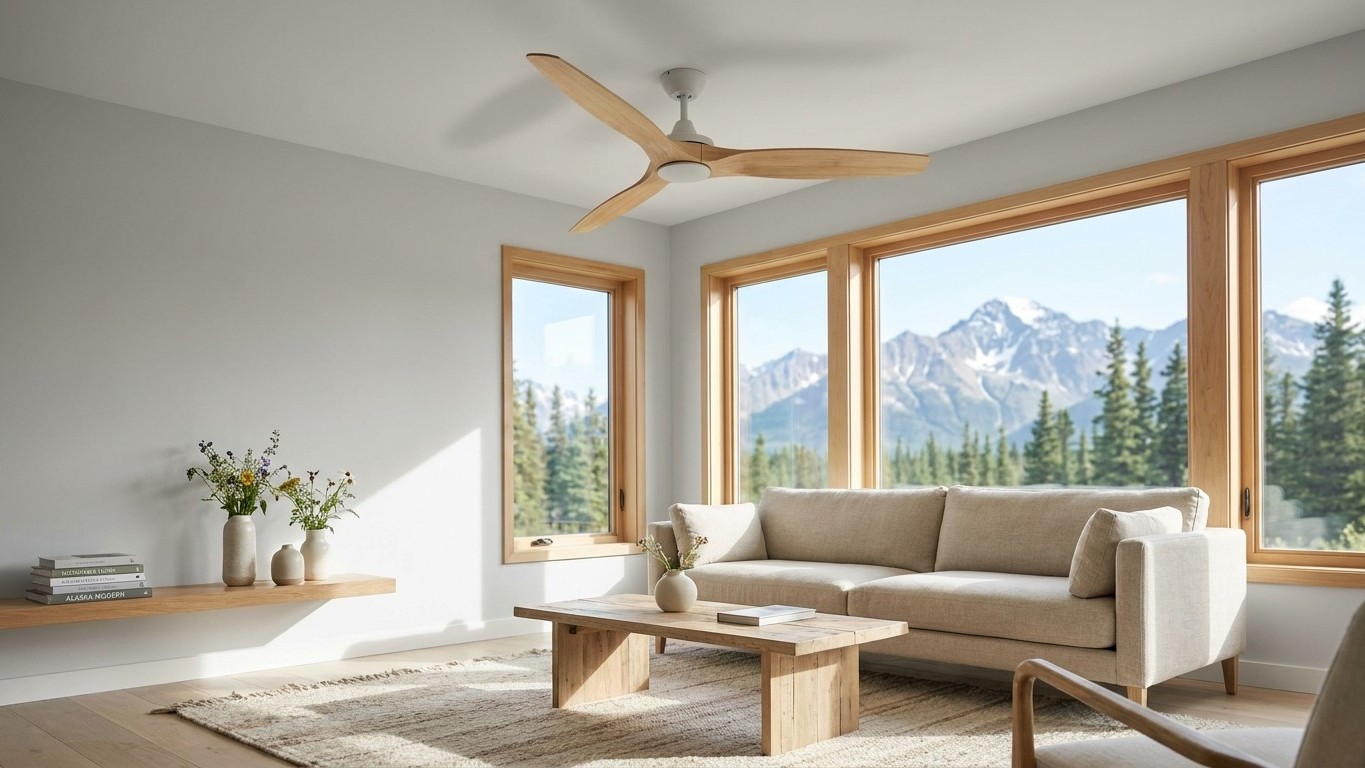

South Dakota homes cool mostly with central air. 76% of homes run a central air-conditioning unit, and 92% have some form of air conditioning at all. The remaining share runs window units, wall units or mini-splits, and more than two-thirds of the state’s houses still lean on ceiling fans to stretch the AC’s reach.
What homes in South Dakota actually cool with
The U.S. Energy Information Administration’s Residential Energy Consumption Survey puts a fine point on it: 92% of South Dakota homes use air-conditioning equipment of some kind, 76% of homes use a central air-conditioning unit, and 19% use an individual unit, meaning a ductless mini-split, a window or wall unit, or a portable. Ceiling fans show up in 68% of homes, which tells you something too: even in a central-air state, a lot of households are still managing airflow the old-fashioned way on the shoulder-season days when running the compressor feels like overkill.
That 19% figure matters more than it looks. It is not a leftover or a rounding error, it is the share of the state actually cooling room by room rather than house by house. In some states that individual-unit share is the entire story, homes with air conditioning but almost none of it central, usually in places with older housing stock or apartments that were never built with ductwork. South Dakota is not that kind of state. Three-quarters of its homes are running a whole-house system, and the individual-unit share is a real but secondary piece of the picture, likely concentrated in older farmhouses, additions, and apartment units where running new ductwork never made sense.
What’s installed follows what was affordable and practical when the house went up, not what a homeowner would choose today. A lot of South Dakota’s housing stock already had forced-air furnace ductwork for winter heat, and once that ductwork exists, adding a central cooling coil is a far smaller step than starting from zero with a mini-split. That is likely the biggest reason central air dominates here: the state’s heating needs built the infrastructure, and cooling rode along on it.
None of this is a recommendation for what any one household should have. A share is a snapshot of what got installed across thousands of houses over decades, not a verdict on what works best in a given room, garage conversion, or rental unit where ductwork was never an option.
How much cooling the year actually asks for
The heat-load number for South Dakota comes from NOAA’s Climate Normals at the Sioux Falls reference station: 13.8 days a year reach 90°F or higher. That is a count of days, not an average temperature, and it is measured at one station, not averaged across the whole state. It is the number that matters for cooling demand because it captures how often a house actually needs the compressor working hard, rather than the sort of mild afternoon a ceiling fan and an open window can handle.
Under 14 days a year at 90°F or above is a modest heat load compared to the country’s hotter regions, where triple-digit-plus counts of 90-degree days are routine. So here is the interesting part: South Dakota’s equipment mix and its heat load do not track each other in the way you might expect. A state with a fairly moderate number of scorching days still runs central air in 76% of its homes, a rate you’d more readily associate with a state baking through a long, hot summer.
That mismatch is the tell. It confirms that what got installed in South Dakota followed the furnace, not the thermometer. Central heating systems needed ductwork to survive brutal Dakota winters long before summer air conditioning was a given feature, and once that ductwork was in the walls, adding central cooling was the path of least resistance regardless of how many days actually crossed 90°F. A milder heat load didn’t push homeowners toward window units the way it might in a region that never needed forced-air heat in the first place. The equipment mix here is a heating-driven decision that cooling simply inherited.
Wet heat or dry heat, and what it changes
Summer rainfall at the same reference station averages about 10.8 inches across June, July and August, out of 27.9 inches for the full year. Broken down by month, June brings 4.23 inches, July, the driest of the three, still brings 3.25 inches, and August comes in at 3.34 inches. That is a fairly even spread through the season rather than one soaked month and two dry ones, and even the driest month clears three inches. Read plainly, that puts South Dakota summers on the wetter side rather than the parched, arid pattern found in the Southwest.
This is rainfall, not humidity. The figure measures precipitation falling from the sky, not how much moisture sits in the air on a still July afternoon. But rainfall does connect to how hard an air conditioner has to work in a different way than most people assume. An air conditioner does two jobs at once: it lowers the temperature, and it pulls moisture out of the air as humid air passes over the cold evaporator coil and condenses. Removing that moisture takes run time. A unit that shuts off the instant the thermostat number is satisfied never runs long enough to finish the drying part of its job, which is exactly what an oversized unit does. In a dry climate that shortfall barely matters, because there’s little moisture to remove in the first place. In a wetter one, it’s the difference between a room that feels comfortably cool and one that feels cold and clammy at the same temperature.
Given a summer with rain most weeks and a heat load that isn’t extreme, the priorities here run in a specific order:
- Favor longer, steadier run times over short bursts, since the moisture-removal part of the job needs time on the clock, not just a quick temperature drop.
- Set the fan to auto rather than a continuous “on” setting, so the coil can stay wet long enough to keep pulling humidity out between cooling cycles.
- Resist sizing up “for extra margin.” A unit that’s too big for the room hits its setpoint fast, cycles off, and never runs long enough to dry the air properly.
Sizing a room unit, from the published chart
ENERGY STAR publishes a straightforward starting chart for sizing a room air conditioner, matching square footage to the cooling capacity needed:
| Area to be cooled (sq ft) | Capacity needed (BTU/hr) |
|---|---|
| 100 up to 150 | 5,000 |
| 150 up to 250 | 6,000 |
| 250 up to 300 | 7,000 |
| 300 up to 350 | 8,000 |
| 350 up to 400 | 9,000 |
| 400 up to 450 | 10,000 |
| 450 up to 550 | 12,000 |
| 550 up to 700 | 14,000 |
| 700 up to 1,000 | 18,000 |
| 1,000 up to 1,200 | 21,000 |
| 1,200 up to 1,400 | 23,000 |
This chart is a starting point for a single room unit, a mini-split head, or a window unit, published by ENERGY STAR. It is not a method for sizing a central system. A central air conditioner needs a proper load calculation that accounts for insulation, window area, orientation, and ductwork, not a square-footage lookup. That distinction matters especially here, given that 76% of South Dakota homes run central systems and a much smaller share depends on room units. Where this chart earns its keep is in that 19% running individual equipment, and in any central-air household adding a supplemental window unit or mini-split head to an addition or a bonus room the main system doesn’t reach well.
Bigger is not safer here or anywhere. An oversized room unit cools the air fast, shuts off, and never runs long enough to pull humidity out, leaving the room cold on the thermometer but clammy to the skin, exactly the outcome a wetter summer makes more noticeable.
What actually needs looking after here
With three out of four South Dakota homes running central systems, duct condition and filter habits carry more weight here than in a state built on window units. ENERGY STAR’s maintenance guidance is specific and worth following to the letter rather than loosely: “Inspect, clean, or change air filters once a month in your central air conditioner, furnace, and/or heat pump.” That’s once a month, covering all three pieces of equipment together, not a seasonal chore reserved for the furnace alone.
Skipping that habit costs more than a dirty filter suggests. ENERGY STAR notes that “Airflow problems can reduce your system’s efficiency by up to 15 percent.” A system can be mechanically sound, correctly sized, freshly serviced, and still underperform if airflow is choked by a filter nobody’s looked at since spring.
For the central systems that dominate this state’s housing stock, ducts are the other blind spot. ENERGY STAR is direct about the scale of the problem: “In a typical house, however, about 20 to 30 percent of the air that moves through the duct system is lost due to leaks, holes, and poorly connected ducts.” That is air conditioned at real cost and lost into an attic or crawlspace before it ever reaches a vent, which is a bigger factor in a central-air-majority state like South Dakota than it would be somewhere running mostly window units with no ductwork to leak from at all.
A seasonal pass covering the basics goes a long way before the first 90-degree stretch hits:
- Check or replace the filter, then put a monthly reminder in place rather than waiting for a visible sign it needs it.
- Walk accessible ductwork for obvious gaps, disconnected sections, or crushed runs, particularly in an unconditioned attic or crawlspace.
- Confirm outdoor central units and window units both have clear airflow around them, free of grass clippings, leaves, or stored items blocking intake.
For equipment-specific steps, the guides in this site’s heating and cooling hub cover central systems, mini-splits, and window units in more depth than a general overview can.