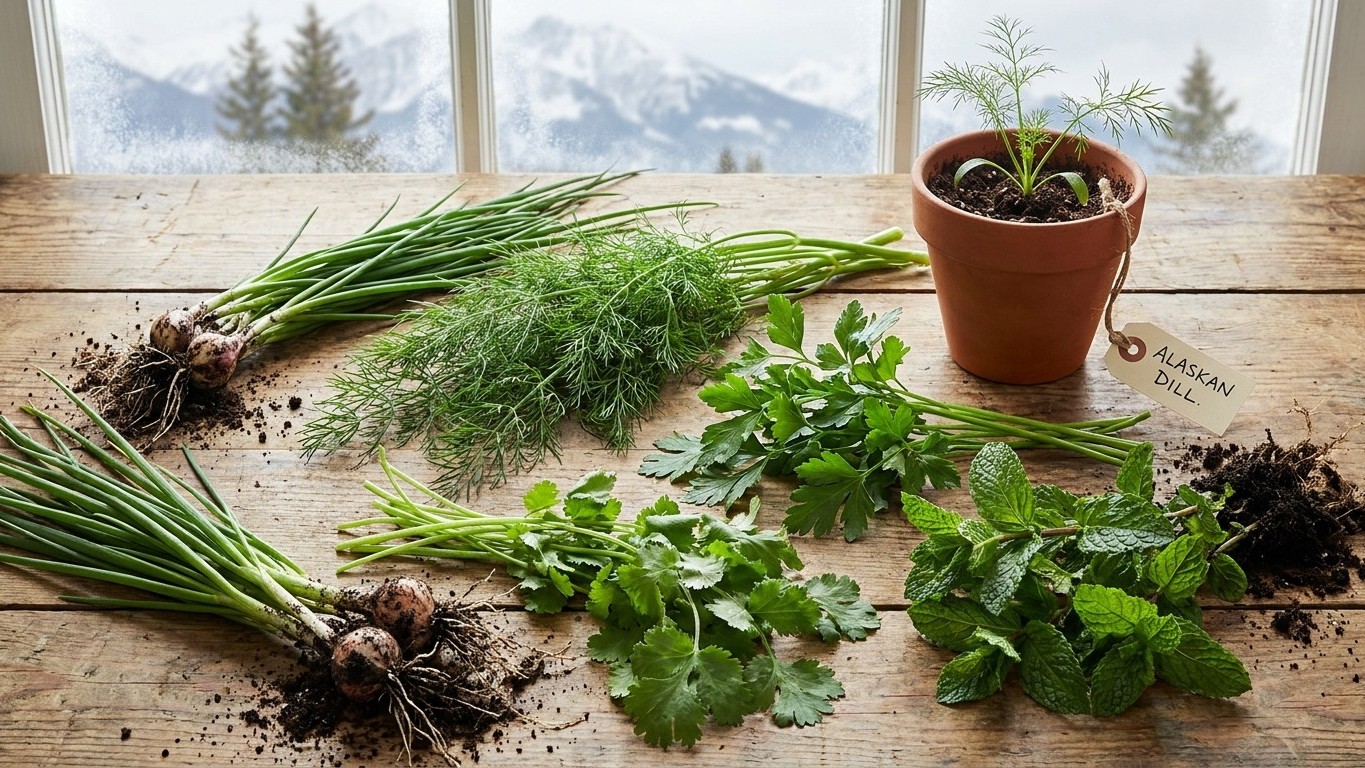

Idaho gardeners do best focusing on herbs that finish fast and tolerate cold snaps: chives, dill, cilantro, parsley, thyme, and oregano. In the valley floors, basil and rosemary can work too, but the choice depends heavily on which part of this large, elevation-varied state you’re gardening in.
The short answer for Idaho
Start with the frost window at the state’s main reporting station, Boise: last spring frost falls between April 23 and May 7, and the first fall frost arrives between October 7 and October 21. That’s a season of roughly five months in the valley floor, generous by Idaho standards, but a figure that only applies where you’re as low and as warm as Boise itself.
Given that window, fast annual herbs are the safest bet almost anywhere in the state. Cilantro, dill, and parsley germinate and mature quickly enough to fit inside even a compressed mountain season, and they tolerate the cool nights that show up even in July at elevation. Chives are about as forgiving as an herb gets: they shrug off a late frost and keep producing until the first hard freeze in fall.
Perennial herbs are where the answer splits by location. Oregano and thyme are Mediterranean natives that need reliably cold-hardy roots, and both perform well in the Boise area’s 7a-7b conditions, where the coldest month’s average daily minimum sits at 25.4°F. That’s a mild figure for a state this far north, and it’s specific to the low Snake River valley, not the mountains ringing it. Sage is nearly as tough and handles Idaho’s dry summers better than most perennial herbs, since it evolved for scrubby, low-rainfall ground not far off from what southern Idaho offers.
Basil belongs on the list only if you treat it as a warm-season annual and time it to the frost dates above. It hates the 40-degree nights that show up in Idaho even in June at higher elevations, so gardeners above the valley floor often get better results starting it indoors and setting it out well after the average last frost has passed, rather than trusting the calendar date alone.
Rosemary is the one herb worth flagging as a maybe. It’s rated hardy only to about USDA zone 7, which puts it right at the edge of what Boise can support in the ground, and out of reach for most of the rest of the state. Treat it as a container herb you bring indoors for winter unless you know your specific spot matches Boise’s mildest microclimate.
What will not work here

The Idaho fact that breaks the most plans is the state’s hardiness range: 3b to 7b. A zone 3b winter can bring extreme minimum temperatures far colder than anything the Boise coldest-month figure of 25.4°F suggests, and any herb rated for zone 6 or warmer, planted in the ground and left unprotected, is gambling on a winter that doesn’t arrive. Rosemary, bay laurel, and lemon verbena fall into this trap constantly: they read as classic “kitchen herb garden” plants in every seed catalog, but catalogs are written for a national audience, not for a state where half the map sits two or three zones colder than the reference city.
Long-season herbs are the second failure point, and it has nothing to do with cold tolerance. French tarragon and true French lavender need a full, warm growing season to establish a root system strong enough to survive winter dormancy. In a mountain valley where the frost-free window can run far shorter than Boise’s roughly five months, these plants often get cut off before they’ve built the reserves to make it through their first winter, even in a spot that’s nominally within their hardiness range.
Idaho’s summer climate creates its own filter, separate from the cold. Much of the state runs hot and dry from July through August, and herbs that need consistently moist soil, cilantro and parsley in particular, bolt to seed fast when watered on a once-a-week schedule that might suit a lawn. Cilantro especially reads high heat as a signal to flower immediately, cutting the harvest window down to a few weeks instead of a full season.
What Idaho does not generally have to fight is humidity-driven disease. Powdery mildew and other fungal problems that plague herb gardens in the Southeast are less common here because the air itself is dry across most of the state. That means tight spacing is a smaller risk in Idaho than it would be in a humid region, but it also means gardeners can’t lean on rainfall the way growers elsewhere do. Drip irrigation or deep, infrequent watering does more for herbs here than daily light sprinkling, which barely reaches root depth before it evaporates.
What changes across Idaho
A hardiness spread of 3b to 7b is not a rounding error, it’s close to the full range the USDA map uses for the entire Mountain West. That range is built on one variable, the average annual extreme minimum temperature, and it means a herb that overwinters reliably in one Idaho county can die outright fifty miles away and a few thousand feet higher.
The general pattern follows elevation and river valleys. Low ground along the Snake River, where Boise sits, runs milder and closer to the 7a-7b end of the range, which is why the frost dates and the 25.4°F coldest-month figure cited above apply there and not statewide. The Panhandle, the mountain valleys of central Idaho, and high-elevation towns run much colder, closer to zone 3b or 4a, with shorter frost-free windows and winter minimums well below what Boise ever sees.
That spread changes what “perennial” means depending on where you garden. A thyme or oregano bed that comes back reliably every spring near Boise may need heavy mulch, a raised bed, or container treatment brought indoors in a colder pocket of the state. Chives and mint are hardy enough to shrug off most of this range, which is part of why they show up on so many Idaho garden recommendations regardless of location.
Rather than guess which end of that range applies to a given yard, use the USDA Plant Hardiness Zone Map directly and look up the specific address or zip code. The statewide range and the reference city, Boise, are what the dated figures rest on. It cannot tell an individual reader which zone number applies to their own garden, and no state-level page honestly can.
Where to check this for your own county
The University of Idaho Extension is the source built for exactly this gap between statewide figures and one specific yard. County offices publish planting calendars adjusted for local frost dates and elevation, not the statewide averages used above.
Two things are worth pulling up specifically. The first is the local planting calendar for your county, since it will reflect actual frost timing at your elevation rather than the Boise-area dates cited earlier in this piece, which can run weeks off in either direction depending on where you are. The second is the list of herb and vegetable varieties the extension office has trialed locally. Idaho’s extension network tests varieties for the same climate stress described above, drought tolerance, bolt resistance, and cold survival, under real regional conditions rather than a seed catalog’s national average claims.
A county-level recommendation will always beat a statewide one, and that’s how the information is structured. This article works from figures tied to a single reference station and a hardiness range that spans most of the Mountain West’s zone spectrum. A county extension office works from your actual elevation, your actual soil, and years of trial data specific to growers near you. If the two sources disagree, the county source is the one to trust.
It’s also worth checking whether your county office runs a master gardener hotline or plant clinic, since many Idaho counties do. That’s often the fastest way to get a straight answer about whether a specific herb, rosemary being the most common question, has any realistic chance of overwintering outdoors at your particular address.
Checking this against your own garden
Every date and figure above is a regional average, and your own garden will tell you more than any of them once the season starts. Soil warmth is the first and most reliable signal for herb seeds, especially heat-loving ones like basil. Press a finger a couple of inches into the bed; if the soil still feels cool and slightly damp-cold rather than neutral, seeds will sit and rot before they germinate, regardless of what the calendar says about the last frost having passed.
Watch the first true leaves on anything you’ve direct-sown. The initial pair that emerges from a germinating seed are seed leaves, not the plant’s actual foliage, and they can appear even in soil too cold for real growth. The first true leaves, shaped like the mature plant’s leaves, are the sign that the seedling has moved past that fragile window and is actually growing rather than just surviving on stored energy.
For perennial herbs coming out of winter, the tell is new growth at the base or along old woody stems. Thyme, oregano, and sage that made it through winter will show small green shoots low on the plant within a few weeks of soil warming, even if the top growth looks dead. No new growth by the time nearby deciduous trees have leafed out is a fair sign the plant didn’t survive, and it’s worth replacing rather than waiting.
These three checks, soil feel, true leaves, and base regrowth, tell you more about your specific microclimate than any statewide frost date ever will, because they measure what’s actually happening in your soil instead of an average drawn from a weather station that might be a considerable elevation away from your own backyard.