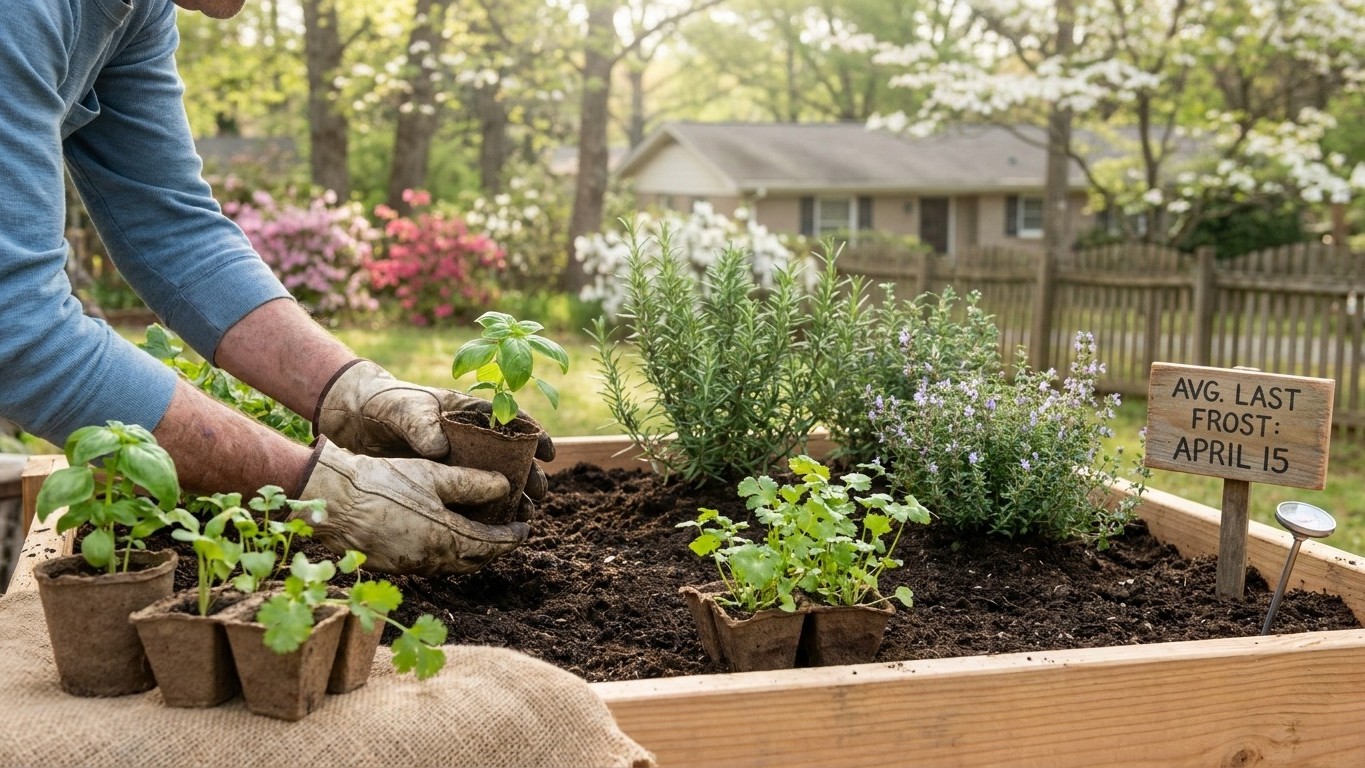

Idaho’s frost dates set the outer edges, but the calendar itself is a probability, not a promise. In Boise, tender herbs go in the ground between April 23 and May 7; hardy perennials can start weeks earlier. Everywhere else in the state, subtract days for elevation and add a wide margin for how long that answer actually holds.
The short answer for Idaho
Basil, cilantro, dill, and other tender annual herbs go outside after the last spring frost window for the reference station in Boise: April 23 to May 7. That’s not a single date, it’s a band built from NOAA’s 1991-2020 Climate Normals, and it marks the period when the probability of a 32F freeze falls between 30% and 70%. Plant at the early edge and you’re accepting real frost risk. Plant at the late edge and you’re trading a couple weeks of growing time for safety. Neither choice is wrong; they’re just different bets.
Hardy perennial herbs work on a different clock. Chives, oregano, thyme, and sage tolerate a light frost, so many Idaho gardeners set out nursery starts a week or two before that April 23 opening, especially in a protected bed against a south-facing wall. Started from seed indoors, these same herbs typically need six to eight weeks under lights before that transplant date, which pushes the sowing task back into late February or early March for anyone gardening in the Boise valley.
What the frost dates are really measuring
The fall side of the calendar matters just as much. First fall frost at the Boise station arrives between October 7 and October 21, using the same 30-70% probability band. That gives a season window of roughly 153 to 181 days, depending on which edge of each band you use, and that range only applies to this specific low-valley station. It is not a statewide number.
One more fact does real work here: the coldest month’s mean daily minimum in Boise is 25.4F. That’s not the record low, and it’s not a monthly average, it’s the typical overnight low during the coldest stretch of winter. It’s the number that decides whether a perennial herb survives outdoors at all, and it’s why rosemary, borderline in mild climates, is often grown as an annual or brought indoors for winter across most of Idaho.
Put together: tender herbs follow the April-to-October window above, sown or transplanted after the spring band closes. Hardy perennials can push both edges by a week or two, and survive the winter, and only where that 25.4F figure holds. Where it’s colder, and much of Idaho is, treat that survival question as open until proven locally.
What will not work here
A short season defeats slow herbs before they ever get established. Idaho’s frost-free window in the Boise valley tops out around 181 days at its most generous, and that’s the mild end of the state. Herbs that need a long runway from seed, such as parsley or slow-germinating perennial lavender, often don’t reach a harvestable size if they’re direct-sown after that April 23 opening. The fix isn’t a different herb, it’s starting those specific ones indoors weeks before the transplant date so the outdoor clock only has to cover the fast-growing part of their life.
A hot, dry summer punishes anyone watering on a weekly schedule. Southern Idaho’s growing season runs through some genuinely dry, high-evaporation stretches, and shallow-rooted herbs like cilantro and basil show it fast: cilantro bolts to seed within days of a heat spike, and basil wilts hard between waterings if the soil dries past the root zone. Mediterranean herbs (thyme, oregano, sage) actually prefer that dry stretch and rot faster from overwatering than they wilt from underwatering. The mismatch that fails most often in Idaho gardens is treating a moisture-loving herb and a drought-tolerant one the same way in the same bed.
The cold pocket problem
The 25.4F coldest-month minimum is a Boise number, and Boise is the mild floor of this state, not its typical garden. Herbs marketed as hardy perennials in seed catalogs, rosemary especially, are often rated for winter lows well above what much of Idaho actually sees once you leave the valley floor. Planting one in open ground and expecting it back next spring is the single most common disappointment reported by Idaho herb growers, and it isn’t a growing mistake, it’s a mismatch between the plant’s rated hardiness and the local winter.
Close spacing isn’t the state’s main risk the way it is in humid regions; Idaho’s dry air keeps foliar disease pressure low. But that same dryness means herbs planted too close still compete hard for scarce soil moisture, and a bed that looks fine in June can show stunted, stressed plants by August once the driest weeks hit.
What changes across Idaho
Idaho spans USDA hardiness zones 3b through 7b, a spread that covers everything from short, brutal mountain winters to relatively mild valley floors. That’s not a rounding error, it’s close to the full range the USDA system uses for the northern half of the country, packed inside one state’s borders. There is no single Idaho answer to when frost arrives or how cold winter gets; the reference numbers in this article describe Boise, and Boise sits at the milder end of that range.
A gardener in the northern Panhandle or up in a mountain valley should expect the whole calendar to compress. Spring frost tends to linger later into the season, fall frost arrives sooner, and the gap between them, that 153-to-181-day window in Boise, shrinks accordingly, sometimes sharply. Elevation does the same thing even within southern Idaho: gain a thousand feet of elevation and the last spring frost date typically pushes later while the first fall frost pushes earlier, squeezing the growing season from both ends.
The practical shift for anyone gardening at altitude or in the north: treat tender annual herbs as a shorter-season crop, start more of them indoors rather than direct-sowing, and assume perennial herb survival is less certain than the Boise numbers suggest, not more. Containers that can be moved into a garage or unheated porch for winter are a common workaround where in-ground survival is doubtful.
The USDA Plant Hardiness Zone Map is the tool built for that lookup, and it’s worth checking by address rather than assuming the county-level average applies to a specific low spot or hilltop.
Where to check this for your own county
Everything above describes Idaho at the state level, anchored to one reference station in Boise. That’s useful for understanding the shape of the season, but it isn’t a substitute for a county-level recommendation, and a county recommendation will beat it every time it’s available.
The University of Idaho Extension service publishes exactly that kind of local detail, and it’s the right next stop. Two things are worth looking for specifically once there. First, a county-level planting calendar, since frost dates and season length in, say, a Panhandle county or a high-elevation eastern Idaho county will differ meaningfully from the Boise numbers. Second, a list of herb varieties that local extension agents have actually trialed in that county’s conditions, which matters more than a seed packet’s generic hardiness claim.
Extension offices also tend to know which perennial herbs reliably overwinter in their specific service area and which ones locals treat as annuals despite what the label says. That’s the kind of ground-truth detail no state-level climate normal can provide, because it comes from repeated seasons of local observation rather than a 30-year weather average.
Treat this article as the starting frame: the probability band, the season length, the winter-low number that decides perennial survival. Treat the county extension office as the correction layer that adjusts all of it for wherever the actual garden sits.
Some gardeners also time this by the Moon: when to plant herbs by the moon, as almanac tradition rather than fact.
Checking this against your own garden
None of the dates above beat what the soil and the plants are actually doing in a specific yard. Three signs are worth checking before trusting a calendar date over what’s in front of you.
Soil warmth by feel is the simplest one. Push a finger a couple of inches into the bed; if it feels cool and slightly damp rather than cold and wet, most tender herb seed will germinate. If it still feels cold to the touch well after the calendar says it should be planting time, the local microclimate is running behind the reference station, and it’s worth waiting rather than forcing the date.
Weed growth is a free thermometer. Common early spring weeds like chickweed and henbit sprouting and growing actively is a reliable sign that soil temperatures have climbed enough for germination generally, herbs included. Their absence, even once the calendar window has opened, usually means the ground hasn’t caught up yet.
For anyone with perennial herbs already established, watching how fast new growth breaks dormancy in spring says more about that specific spot than any frost date. A sage or thyme plant pushing new leaves noticeably earlier or later than a neighbor’s, a few blocks or a few hundred feet of elevation away, is showing the real local pace of the season, and that pace is the number worth planting around.