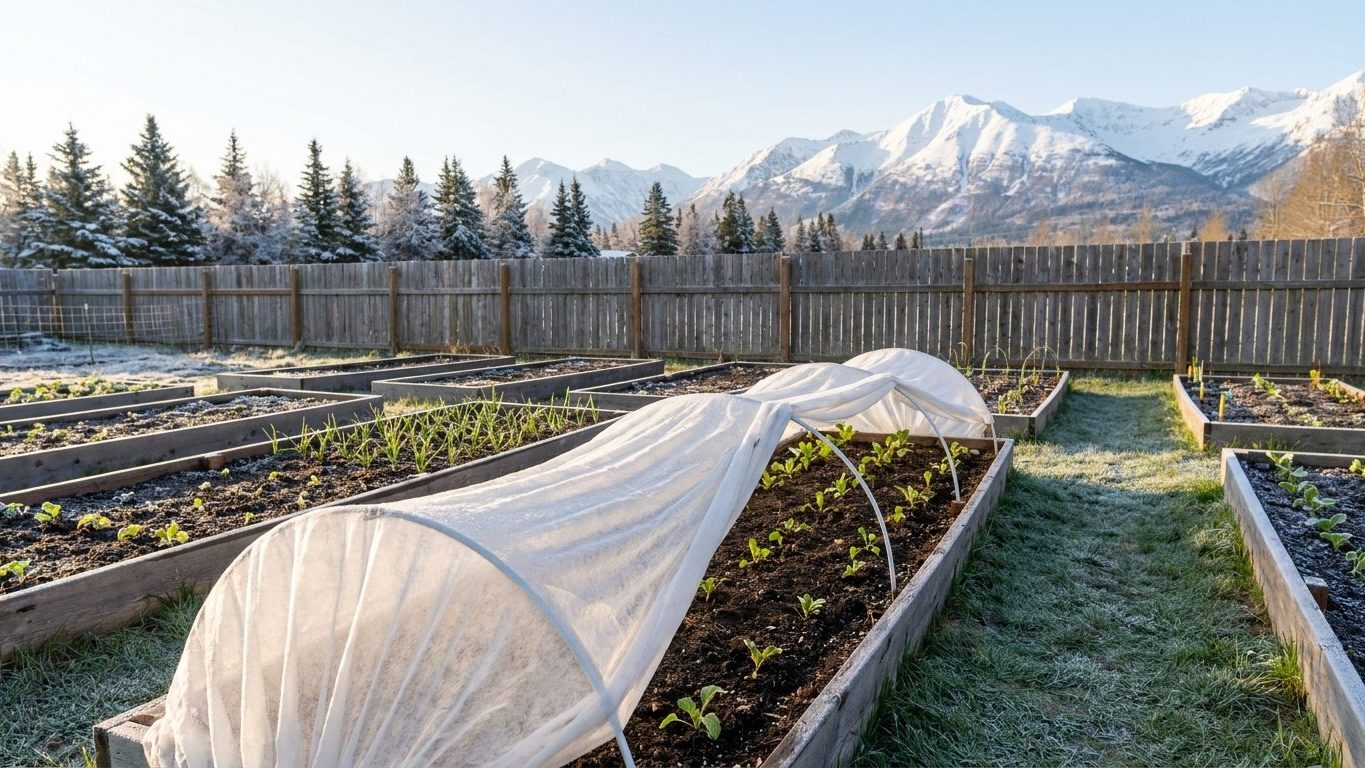

Cover a New Brunswick garden when the forecast low drops near freezing. That can happen into late May, and it returns by early October. For a warmer start, lay covers over the beds a week or two before planting. For a later finish, have them ready by mid-September. The sections below show where that window sits and how far it shifts across the province.
The short answer for New Brunswick
Cover tender plants on any night from planting until the first week of June when the forecast low is near 0 °C (32 °F), and start covering again in mid-September. At Moncton, Environment and Climate Change Canada puts the mean last spring frost at May 23 and the mean first fall frost at October 2, using the 1981-2010 normals. The reference station has about 132 frost-free days between those two dates.
Both dates are means, which makes them the midpoint of a window. In one year out of two, the last spring frost falls later than May 23. In one year out of two, the first fall frost arrives earlier than October 2. Treat May 23 as the midpoint of a frost window, not a safe date, and keep the covers within reach for another two weeks.
The Moncton normals also come from 1981 to 2010, so recent seasons may sit a little differently. The dates are a place to start, and your own forecast does the real work. A short list of triggers covers most situations:
- Spring, before planting: cover beds one to two weeks ahead to warm the soil.
- Spring, after planting: cover on nights when the forecast low is near freezing, and uncover in the morning once it warms.
- Fall, early: put hoops in place by mid-September, so a cover can go on within minutes when a cold night is forecast.
- Fall, late: keep hardy greens and roots covered through repeated frosts, and add a second layer when nights turn harder.
Forecast lows are measured at a weather station, not in your garden. On a clear, calm night, low spots and open ground can frost when the forecast says 2 or 3 °C. When the sky is clear and the wind has dropped, cover anyway.
The full approach to stretching the season, including how much each method buys you, is laid out in Extending the Growing Season in New Brunswick. For a comparison of hoops, fabric, tunnels and cold frames, see Which Season Extenders Work in New Brunswick.
What will not work here
Waiting for the first frost before reaching for a cover fails with tender crops. Tomatoes, peppers, basil and beans can be damaged in a single frosty night, and the mean first frost of October 2 means half of all years bring it sooner. The fall cover goes on before the cold night, not after it.
Planting by the calendar date does not work either. With about 132 frost-free days at the reference station, there is little slack for slow, heat-hungry crops. Melons, long-season sweet corn and sweet potatoes need the whole window plus warm nights, and a cover in June cannot make up for a cool summer. Choose early varieties, and use covers to hold heat in the soil at the start and the end, since the middle of the season is already short.
Thin row cover does not carry plants through the winter. The mean daily minimum of the coldest month at Moncton is -13.9 °C (6.9 °F). A light fabric adds only a few degrees of protection, so it will not overwinter anything that cannot already take hard cold. Winter storage under a cover works for plants that are hardy to begin with, and even then a heavier structure with a layer of mulch does better than fabric.
Snow is a second problem. Hoops with light fabric or thin plastic can sag or collapse under wet snow, which is common in a New Brunswick November. Take fabric off the hoops before heavy snow is forecast, or build the frame sturdy enough to shed it.
Leaving covers on in sun fails in the opposite direction. On a bright spring day, a sealed plastic tunnel can overheat seedlings within a couple of hours, even when the air outside is cool. Lift the ends or open the sides by mid-morning. Squash, cucumbers and melons also need the cover off once they flower, so bees can reach the blossoms.
A last one: covers cannot create daylight. By late fall at 46 degrees north, days are short and the sun is low, so lettuce and spinach under a cover mostly hold their size instead of growing. Sow early enough that the crop is close to harvest size by the time growth slows, and treat the cover as a cold storage unit after that.
What changes across New Brunswick
Moncton sits in Canadian hardiness zone 5a, according to Natural Resources Canada’s 1991-2020 normals for the reference city. That is the Canadian system, built from seven climate variables, and it does not convert to a USDA zone. Natural Resources Canada says plainly that there is no simple conversion between the two systems.
That zone belongs to one city, and a province is never one garden. Northern and upland districts run weeks behind the Moncton frost dates, so a gardener there should expect the last spring frost to come later and the first fall frost to come earlier. A shorter window means covers go on earlier in the fall and stay on later in the spring, and the slowest crops are not worth the effort.
To find your own zone, look up your municipality on Natural Resources Canada’s Plant Hardiness Site. The map is the right tool because it reflects where you actually live. Within a single zone, your own yard still varies: a south-facing wall may warm weeks ahead of a shaded corner, and a hollow at the bottom of a slope collects cold air on still nights.
Where to check this for your own county
Your local agricultural office has the information that fits your county best. The provincial agriculture department is the best place to look in New Brunswick. Agriculture and Agri-Food Canada is the federal department and a reliable starting point for horticulture and climate information. Search there, or through the provincial department, for two things.
The first is a local planting calendar. It should list sowing and transplant windows by crop, and ideally by region of the province. The second is a list of varieties that have been trialled in your area, which tells you which ones ripen in a short season. Look for early tomatoes, quick-maturing peppers and cold-hardy greens that someone has actually grown in conditions like yours.
Ask a local office, or a nearby grower’s association, whether covers or tunnels are recommended for your area and what the typical frost dates look like. Garden centres and community gardens in your own town often know the practical dates better than any average. When a local source gives you a different date from the ones above, go with the local one.
Checking this against your own garden
What you see in your own beds outranks every date here. Three observations will tell you more than any average, and none needs an instrument.
Soil warmth by feel. Push your bare hand a few inches into the bed and hold it there for a minute. If the soil feels cold enough to make your hand ache, seeds will sit and transplants will stall. A bed that warms earlier than the one beside it is a spot for early crops, and a bed that stays cold under a cover is probably shaded or sitting in wet ground.
The first male flowers on squash. Male blooms open first, a few days ahead of the females. When they show, you know the plant has settled in and the season is moving. They are also the signal to take covers off during the day, so bees can work the flowers. If yours open a week ahead of a neighbor’s, your garden is the warm one.
The first true leaves. The first pair of leaves on a seedling are seed leaves. The true leaves come next, and they look different, usually with the shape and texture of the mature plant. When those appear, the seedling is photosynthesizing on its own and can take light hardening off. A slow arrival of true leaves under a cover points to a cool spot or too little light. If they come quickly, the spot is warm and you can plant the next batch sooner.
Common questions
Is May 23 a safe date to plant tender crops without a cover in New Brunswick?
No. May 23 is the mean last spring frost at Moncton, so frost falls later than that in about half of all years. Plant on that date with a cover ready, and expect to use it on at least a few nights through early June. Farther north or at higher elevation, the safe date comes later still.
How much protection does a row cover give?
A lightweight row cover adds a few degrees. That is enough to take the edge off a night near freezing, but it will not rescue tender plants in a hard freeze. Heavier fabric or a double layer gives more, and a tunnel or cold frame with a mulch layer gives more again.
Can covers carry a garden past October 2?
Hardy greens and root crops can keep going well past the mean first fall frost under a cover, but they grow slowly once days shorten. Tomatoes, peppers and beans will not benefit much, since cold nights and short days slow them down even when frost is kept off. Plan on harvesting the tender crops by the time the first hard frost is forecast.
When should I take the covers off in spring?
Take them off during the day once the forecast low stays well above freezing and the plants are growing. Take them off earlier for squash, cucumbers and melons once flowers open, so pollinators can reach them. Keep the covers close for another week or two in case a late cold night is forecast.