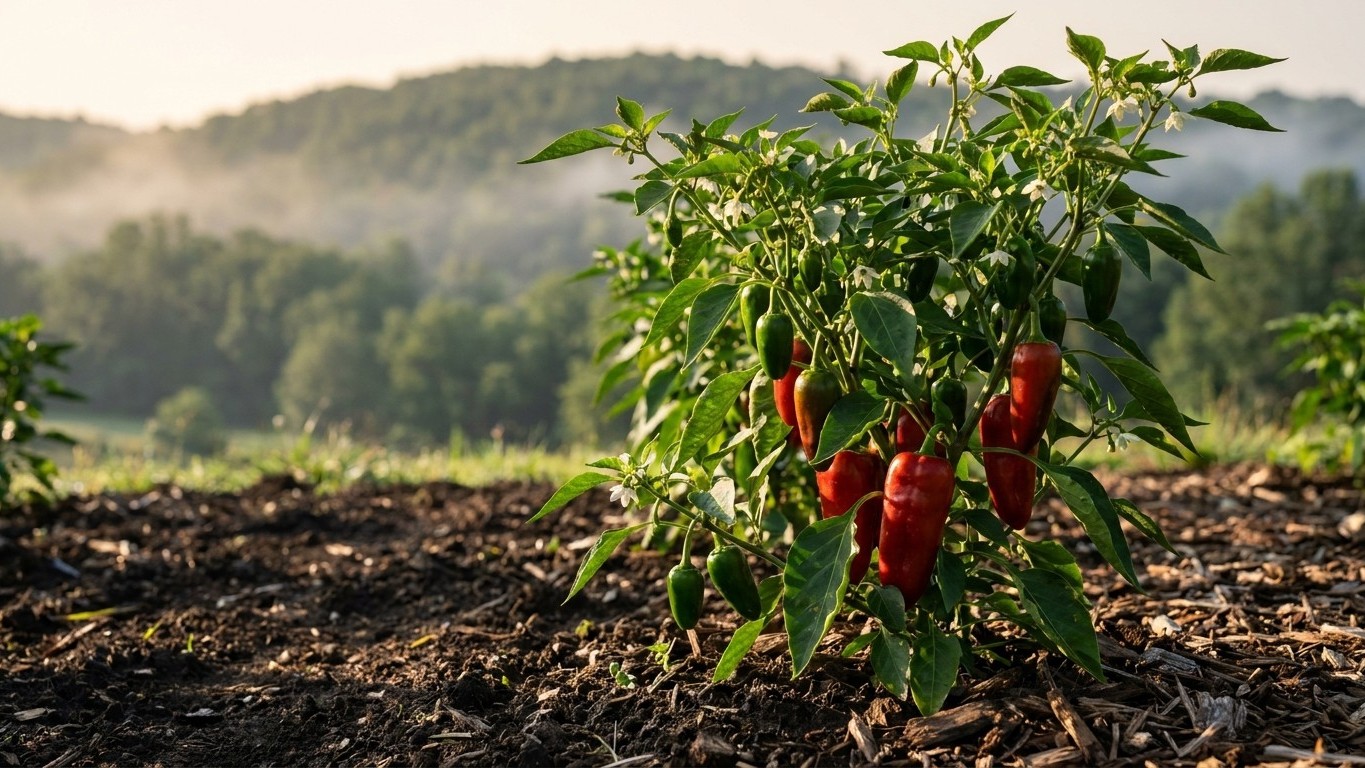

No published list names the insects that eat pepper in Nunavut. The territory has no county extension network and no documented pest roster for home pepper plants. What a grower can do is sort the problem by timing and symptom: the 8 to 10 weeks of indoor seedling life, the weeks after transplanting, and the stretch from flowering to harvest.
Which pests attack pepper in Nunavut
Any insect name offered here would be borrowed from southern gardens, so it would be a suspect rather than a diagnosis. The better approach is to sort by how an insect feeds and ask which kinds can plausibly reach a pepper plant in the territory.
Which kinds of pests can reach a pepper plant here?
Three feeding habits cover nearly everything a pepper can suffer: chewing insects that leave holes or ragged edges, sap-feeding insects that weaken new growth and leave sticky residue, and soil dwellers that attack roots. Sap feeders and soil dwellers have the easiest route in. They ride along on purchased transplants, in bagged potting mix, or on other houseplants. Chewing insects usually need a connection to outdoor vegetation, which is thin on much of the tundra.
Which pests can you rule out?
Insects that live on trees and shrubs, such as bark borers and leaf-rolling caterpillars of woodland species, have no reason to be on a pepper. Pests that depend on large commercial fields of grain or corn are also unlikely, since a few pepper plants are not a field. If someone tells you a forest or field pest is eating your peppers, ask for the evidence before you act.
What does the climate rule in and out?
At the Rankin Inlet A station, Environment and Climate Change Canada’s normals record 0.0 days a year at or above 32 °C, and only 0.03 days a year above 30 °C. Heat-loving insect outbreaks are therefore not the usual worry. The concern for a pepper plant is the cool end: fruit set fails when nights fall below 13 °C (55 °F), according to Utah State University Extension. A plant stressed by cold nights is also a weaker plant, so when a leaf looks damaged, the weather is a suspect alongside any insect. Plan around the 8 to 10 weeks indoors that transplants need before they go out, because that is where most insect problems begin. For the wider picture of the crop, see Growing Peppers in Nunavut.
When each one shows up, and what it does first
Timing is easier to follow if you anchor it to the plant rather than the calendar. At Rankin Inlet A the mean last spring frost is June 19, the midpoint of a window, so in one year out of two the frost falls later. Stations in northern or upland districts run weeks behind it. Transplants go out only after frost, once the soil reaches 60 °F (about 16 °C), so the outdoor clock starts late and the indoor clock starts well before.
What shows up during the indoor weeks?
Sap feeders and soil dwellers are the likeliest early arrivals. The first sign is rarely an insect. It is a leaf that curls or puckers, a sticky shine on leaves or on the shelf under the tray, or a seedling that wilts although the soil is damp. A wilting seedling in moist soil points toward the roots. Sticky leaves and curled new growth point toward sap feeders. Look at the undersides of leaves and the growing tip, where small insects collect first.
What shows up in the first weeks after transplanting?
Chewing damage appears next, if it appears at all. The first symptom is small holes or notched edges on lower leaves, and sometimes a young stem cut or gnawed near the soil. Holes that appear overnight on a plant that was intact the day before suggest an active feeder. Old holes with dried, browned rims suggest earlier damage, or wind or handling. Check a new transplant every few days for the first two or three weeks outside, because a small problem found early is easy to handle by hand.
What shows up around flowering and fruit?
Harvest comes 70 to 85 days after transplanting, according to Clemson Cooperative Extension, and fruit needs 35 to 45 days from flowering. During that stretch, damage turns from leaves to flowers and fruit: buds that drop, pits or tunnels in the fruit wall, or soft spots with frass inside. Buds dropping with no insect in sight often come from nights below 13 °C (55 °F), so watch your own nights before blaming an insect. Nighttime minima vary by site and cannot be guessed from the latitude. For the ripening end, read When to Pick Peppers in Nunavut, and Why the Fridge Ruins Them.
Telling the damage apart from everything else
Cold, thirst, nutrient shortage, disease, and a rough hand with a watering can all leave marks that look like insect feeding at first glance. The table below gives the sign that separates each from the others. It names no cause for your garden, because that takes a sample or a photo seen by someone who knows local conditions.
| What you see | Possible cause | What settles it |
|---|---|---|
| Ragged holes, notched edges | Chewing insect, or wind and handling | Insect damage has frass or an insect nearby; mechanical tears are clean and follow leaf folds |
| Sticky leaves, curled new growth | Sap-feeding insect | Small insects or shed skins on leaf undersides, and residue on surfaces below |
| Wilting that recovers overnight | Water stress | Push a finger into the soil to the second knuckle; dry soil and quick recovery after watering point to thirst |
| Wilting in damp soil | Root problem, insect or disease | Lift the plant gently and look at the roots for chewing, rot, or dark, soft tissue |
| Yellowing of older leaves, even pattern | Nutrient shortage | The pattern is the same on both sides of the plant and no insects are present |
| Dropped buds, no fruit set | Cold nights or insect feeding | Compare with your own overnight lows; look inside dropped buds for tunnels |
| Dark patches or spots with rings | Disease | Spots that spread outward on leaves and have no insect; a sample is needed |
The mistake that costs the most is treating before identifying. Treating a cold-stress or watering problem as if it were an insect wastes time in a short season and can add stress. Take a clear photo of the whole plant and one close-up of the damage, and bring a sealed sample if you can. Choosing varieties that suit a short season also reduces stress on the plant, as laid out in Pepper Varieties That Ripen in a Nunavut Season.
What actually works here, and what is a waste of time
On a short season, most of what works is physical and done before damage starts. Inspect every plant before it enters your growing space, and keep new plants apart from the others for a while. Pests often arrive on a nursery transplant or in a bag of mix, so catching them at the door is the cheapest control there is. Wash your hands and tools when moving between plants.
A floating row cover, set over transplants on the day they go out and sealed at the edges, blocks flying insects and holds some warmth. A screened vent or door on a greenhouse does the same job. Put the barrier on at transplanting, not after the first holes appear, because covering a plant that already has insects under it traps them with the plant. Lift the cover on calm, warm days for airing, and ask an advisor whether it should come off at flowering for your setup.
Hand removal works for the small number of plants a northern grower keeps. Check the undersides of leaves, remove damaged leaves, and drop what you find into soapy water. Keep the soil from staying wet, since constant dampness favors root problems and attracts fungus-feeding insects.
What does not work is just as clear. Spraying without a diagnosis misses the cause when the problem is cold or water. Home mixtures of unknown strength can burn leaves already weakened by cool nights. Planting late in the hope that insects will have moved on cuts the days available to ripen fruit. Stacking several remedies at once leaves you unable to tell which one, if any, helped. For anything beyond physical control, ask an advisor what is registered and allowed for food plants where you live.
Where to check this for your own county
Nunavut has no counties and no county extension offices. The closest equivalent is a horticulture or agriculture advisor reachable through the territorial government, or the extension service of a neighboring jurisdiction that will take a photo and a description. Utah State University Extension’s pepper guide and Clemson Cooperative Extension’s pepper factsheet are good references for how the plant behaves, covering fruit set, transplant timing, and harvest.
Conditions vary a great deal inside the territory. The frost date of June 19 and the heat counts come from the Rankin Inlet A airport station, which sits outside the settlement and reads differently from the neighborhoods around it. Communities elsewhere in Nunavut run weeks behind or ahead, and territory-wide records do not tell you what is living in one garden, one greenhouse, or one bag of potting mix.
The most useful step is a record. Write down the day you transplanted, the lowest night temperature you saw each week, and the date damage first appeared. Add a photo of the whole plant and a close-up of the damage, and keep a sealed sample if it is safe to do so. Send these to an advisor along with the name of your settlement, before you spray anything.
Common questions
Do insects eat pepper plants in Nunavut at all?
They can, especially on indoor transplants and in a greenhouse, where insects arrive on purchased plants or potting mix. Few species are documented for home pepper plants in the territory, so identification needs a photo or sample reviewed by an advisor.
Is a hole in a pepper leaf always an insect?
No. Wind, handling, and tears along leaf folds can look like feeding. Insect holes tend to come with frass, a visible insect, or fresh edges that turn brown over a few days. A clean tear without those signs is more likely mechanical.
Can cold nights look like pest damage?
Yes. Pepper fruit set fails when nights fall below 13 °C (55 °F), and buds that drop or flowers that fail to set can be mistaken for insect work. Check your own overnight lows.
When should I cover pepper plants to keep insects out?
On the day you transplant, after frost and once the soil has reached 60 °F (about 16 °C). Covering after damage begins can trap insects with the plant. Seal the edges, air the plants on calm warm days, and ask an advisor when to remove the cover at flowering.