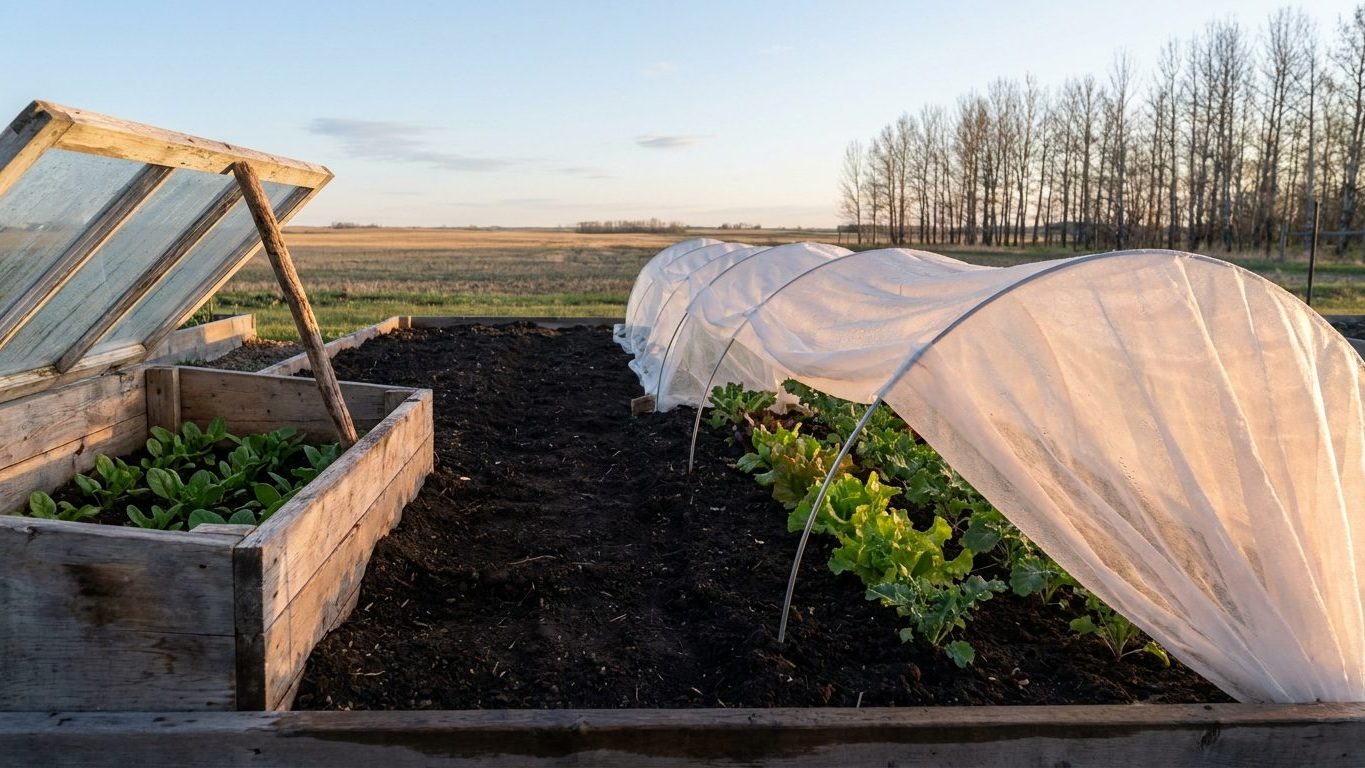

Floating row cover over hoops does the most for the least money in New Brunswick. A cold frame comes second, and black plastic is worth adding for heat-loving crops. Each one buys a few weeks at the edges of the season, not a different climate. The Moncton reference station sits at 46.11 degrees north. It has a mean last spring frost of May 23 and a mean first fall frost of October 2, so the covers work with a short season.
The short answer for New Brunswick
Lightweight row cover laid over wire or plastic hoops is the best first purchase, and a cold frame is the best second. Black plastic mulch earns its place only under crops that need warm soil, such as melons, peppers and eggplant. For a wider look at the whole toolkit, start with Extending the Growing Season in New Brunswick.
The reference station has about 132 frost-free days between the mean last spring frost of May 23 and the mean first fall frost of October 2. Both dates are means from the 1981-2010 Canadian climate normals for Moncton. In one year out of two the last frost falls later than May 23. In one year out of two the first fall frost arrives earlier than October 2. Treat each date as the middle of a window, and keep a cover within reach on both sides of it.
Covers work by trapping heat the soil gave off during the day and by cutting wind. A lightweight fabric holds off a light frost by a few degrees. Heavier fabric gives more protection but also more shade. Clear plastic over a low tunnel warms the air more than fabric does, but it has to be vented on sunny days. Winter is a different matter. The mean daily minimum of the coldest month is -13.9 °C, and the reference city sits in Canadian hardiness zone 5a. Season extenders here are tools for spring and fall, not for growing salad in January.
| Extender | Best job | Limit |
|---|---|---|
| Lightweight row cover on hoops | Frost cover for transplants and fall crops; insect barrier | Stops a light frost only |
| Low tunnel with clear plastic | Early sowings of hardy greens, peas and spinach | Needs venting; snow can flatten it |
| Cold frame | Hardening off; spring and fall greens | Small area; must be opened daily |
| Black plastic mulch | Warming soil for melons, peppers, squash | No frost protection on its own |
| Water-filled sleeves or cloches | Single early tomato or pepper plants | One plant each; slow to set up |
Knowing which tool to own is half the job. Knowing the night to put it on is the other half, and When to Cover Your Garden in New Brunswick covers that.
What will not work here
Which crops can a cover not rescue in New Brunswick?
Long-season crops with little margin are the first casualties. Winter squash that needs most of the summer, watermelon, sweet potatoes and big-fruited tomatoes all want warm nights as well as warm days. About 132 frost-free days at Moncton is a modest budget, and in half of years the frost arrives earlier than October 2. A cover adds a few degrees and a couple of weeks at the margins. It cannot warm a cool July night. For those crops, short-season varieties matter more than any fabric.
Sowing seed into cold soil under plastic in March or April is another dead end. The plastic warms the top inch or two slowly, and seed that sits in cold, wet ground rots before it sprouts. Waiting a week for the soil to warm usually beats an early sowing by two weeks.
Planting tender transplants on May 23 under a single layer, then walking away, also fails often. That date is the mean, so frost lands after it in about half of years. Keep the cover on hand for the first two weeks of June.
What fails in a New Brunswick winter?
Unheated plastic cannot beat a coldest-month average low of -13.9 °C. Hardy greens such as spinach and kale can sit under a tunnel and stay edible, but they stop growing. At 46.11 degrees north, daylight shrinks to under nine hours around the December solstice, and plants make almost no new leaf in those conditions. Harvest what matured before the short days arrived.
Structures fail in ordinary ways too. A shallow hoop collapses under wet, heavy snow, so use steeper bends, set the hoops closer together, and knock snow off after each storm. Clear plastic closed on a sunny spring day can scorch seedlings in an hour. Fabric left on squash or cucumbers through flowering keeps pollinators out and the fruit never sets. An unanchored cover will also end up in the neighbor’s yard, so pin the edges with soil, boards or sandbags.
What changes across New Brunswick
The Moncton numbers describe one place. The reference city is in Canadian hardiness zone 5a, according to Canada’s Plant Hardiness Site from Natural Resources Canada. That system is built on seven climate variables, and it does not convert to a USDA zone. A Canadian zone can overlap many USDA zones, so a US reader should not match them up by number. The province also spans more than one Canadian zone, so no single answer fits everyone. The map for your own municipality is the place to read it.
Northern and upland districts run weeks behind Moncton, and the frost dates move with them. In practice, a gardener in the north or on higher ground should shift in four ways:
- Push spring planting dates later by a couple of weeks, then add a cover on top of that.
- Choose heavier row cover for frost nights instead of the lightest fabric.
- Favor crops that finish quickly, such as radishes, lettuce, spinach and bush beans.
- Start fall crops earlier, because the first frost can arrive well before October 2.
Latitude matters too. The 46.11 degrees north belongs to Moncton. Day length is what tells onions to bulb and slows fall crops as autumn deepens, and it shortens faster the farther north you go. A reader near the northern edge of the province should check their own latitude.
Coastal sites often avoid the sharpest frosts a little longer, while inland valleys can collect cold air on clear nights. These local differences can be as large as the gap between zones.
Where to check this for your own county
Start with Agriculture and Agri-Food Canada, the federal department, and follow its links to New Brunswick’s provincial agriculture department. That is the closest thing to a state extension service for this province. Two things are worth looking for there. One is the local planting calendar for your area, with frost dates from the weather station nearest you. The other is the vegetable varieties trialled in your county, since a variety that matures well in a trial plot near you is safer than one chosen from a seed catalog alone.
A county recommendation beats a provincial one, and that includes the dates in this article. The Moncton figures come from a single station and from 1981-2010 normals. US gardeners comparing notes should know that the American figures on this site cover 1991-2020, so the periods differ.
Local growers and farm-market vendors are a free resource. They know which fields frost first and how early their own tunnels can go up. A few questions at a market stand often answer more than a table of dates.
Checking this against your own garden
Your own observations outrank every date above. Three are worth watching each spring.
Soil warmth by feel. Push your hand into the bed to about the depth of your knuckles. If the soil feels cold and damp, wait. If the bed under black plastic feels clearly warmer than the bare ground next to it, you have a warm patch, and it can host heat lovers a week or more ahead of the rest of the garden.
The first male flowers. Squash and cucumber plants open male flowers before female ones. When the males appear a week or two earlier on one side of the yard, that side is warmer, and you can pull covers off there sooner.
The first true leaves. Seedlings show a pair of seed leaves first, then the first true leaves. If true leaves are slow to appear under a cover, the spot is cool or too shaded. If they come fast, the spot can carry earlier sowings next year. Frost on a low corner of the lawn while the rest stays clear tells you where cold air pools. Keep tender plants out of that corner.
Common questions
What is the cheapest season extender for New Brunswick?
Lightweight row cover on hoops. A roll of fabric and a few lengths of wire cover a whole bed, and the same material protects spring transplants and fall greens.
Can I grow tomatoes outdoors in New Brunswick with season extenders?
Yes, with early varieties and a cover ready for late May and early October nights. Black plastic warms the soil first, and water-filled sleeves protect early plants. Full-size late varieties are a gamble.
Is May 23 a safe planting date for tender crops?
It is the mean last spring frost at the Moncton station. In one year out of two the last frost falls later than that, so keep a cover handy into early June.
Can a cold frame grow food through a New Brunswick winter?
It can hold hardy greens that matured in fall, but little grows once daylight drops below nine hours. Expect to harvest from it in fall and again in early spring.