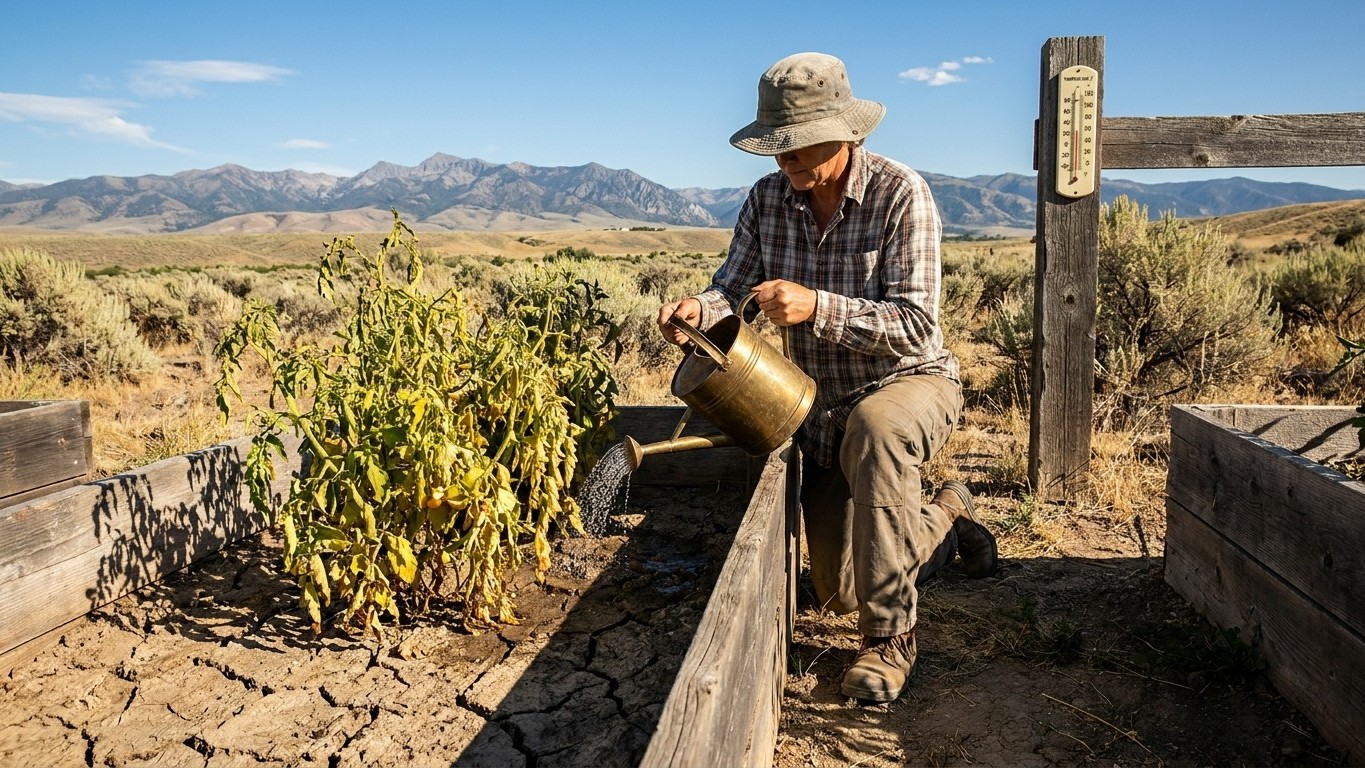

Idaho gardens live and die by two things: heat and how little rain shows up when it matters most. The state’s climate normals give a clear signal on summer heat, and the growing-season dates set the boundaries. What they don’t hand you on a platter is a single rainfall number for the whole state, and that’s because Idaho doesn’t have one. Here’s what the actual data says, and what to do with it.
What the climate asks of you

Start with the number that rules out any illusion of an easy summer: 47.5 days a year reach 90F or higher at the Boise reference station, based on NOAA’s 1991-2020 Climate Normals. That’s not a heat wave. That’s a season. Nearly seven weeks of 90-degree-plus days means soil moisture doesn’t just decline through the summer, it gets pulled out fast, and a garden bed left on its own for even a few days in July can go from moist to dust.
What the verified data for this page does not include is a specific inch-by-inch rainfall figure for June, July, and August. That’s worth saying plainly rather than papering over: Idaho spans low, dry valleys and high, wetter mountain country, and a single statewide rainfall number would be misleading no matter which one you picked. The USDA Plant Hardiness Zone Map puts the state across zones 3b to 7b, a spread that wide only happens when elevation and local geography are doing most of the work on climate, precipitation included. A garden in a low valley near Boise and a garden in a mountain community two hours away are not living under the same sky, even if they’re in the same state.
That range matters practically. If you garden in one of Idaho’s low-elevation valleys, expect the driest stretch of the year to land squarely in mid-summer, when the 90-degree days are stacking up and evaporation is doing its worst. If you’re higher up, your season is shorter on both ends but the summer dry spell still shows up, just under cooler air. Either way, the arithmetic behind “how much water does a bed need” doesn’t change with elevation. A vegetable or flower bed wants roughly an inch of water a week, delivered or supplemented, to keep roots from stressing. What changes by elevation and soil is how much of that inch you’re going to have to carry yourself instead of waiting on the sky.
Soil texture pushes the same lever a second time. Idaho’s valley soils run from sandy loam near river terraces to heavier ground with more clay content further from waterways, and the difference isn’t cosmetic. An inch of water sinks straight through sandy ground and is gone within a day or two. That same inch sits in clay for a week or more. A gardener on sandy, well-drained soil in a dry Idaho summer isn’t watering once a week, they’re watering every second or third day, because the ground simply won’t hold what it’s given.
How much, how often
The rule that holds regardless of where in Idaho you garden: water deep and infrequently, not shallow and often. A quick daily sprinkle wets the top inch of soil and trains roots to stay near the surface, exactly where the day’s heat bakes them hardest. A deep soak every few days pushes moisture down six inches or more, which is where roots want to be living once the 90-degree days start piling up.
The test for when to water isn’t a calendar, it’s your soil. Push a finger two inches into the ground near the base of a plant, or use a trowel to check just below the surface. If it’s dry at that depth, water. If it’s still cool and moist, wait. This single habit does more to prevent both drought stress and root rot than any schedule pinned to the wall.
- Check soil moisture at two inches deep before turning on a hose or timer, using a finger or trowel rather than guessing from the surface.
- Water at the base of the plant, in the morning, so moisture reaches roots before the day’s heat sets in and foliage dries before evening, which cuts down on fungal problems.
- On sandy soil, water more often in shorter sessions — every two to three days during Idaho’s hottest stretch, because sandy ground can’t hold a week’s worth of moisture no matter how much you give it at once.
- On heavier, clay-leaning soil, water less often but more deeply, and never water or work the soil while it’s already wet, clay compacts under those conditions and roots can drown in standing moisture instead of stretching down for it.
- Treat mid-summer as irrigation season, not rain season, especially in low valley locations where the driest stretch of the year lines up with the highest count of 90-degree days, nearly seven weeks of them at the Boise reference station alone.
The frost dates bookend how long this watering routine actually needs to run. At the Boise reference station, the last spring freeze typically falls somewhere between April 23 and May 7, and the first fall freeze lands between October 7 and October 21. That’s the frame for a full growing season in a lower valley, figure roughly five months of active watering demand, with the heaviest need stacked into the middle third of it. Gardeners at higher elevations should expect a tighter window on both ends, since Idaho’s higher ground runs colder and the frost-free stretch shrinks accordingly.
Restrictions and rules
Watering restrictions are common across the western United States, and Idaho is no exception in places where municipal or irrigation-district water supplies come under pressure during dry, hot stretches. Rules vary by city, by water provider, and by year, which means there’s no single statewide answer worth repeating here as if it were fixed. What can be said with confidence: a location where the driest part of summer lines up with the highest concentration of 90-degree days, as it does in many Idaho valleys, is exactly the kind of place where local water providers are more likely to impose scheduled watering days, time-of-day limits, or outright bans on certain uses during peak demand.
Before setting an irrigation timer or planning a summer watering routine, check directly with your local water utility or irrigation district. Rules can include which days of the week outdoor watering is allowed, restrictions on watering during daylight hours, or limits tied to drought declarations that can change mid-season. None of that is guesswork you want to do with a plant’s root system on the line. If you’re unsure where to start, the University of Idaho Extension service, reachable through uidaho.edu/extension, is a reliable point of contact for questions about local water rules as well as soil and planting guidance specific to your part of the state.
Using less
Cutting water use in an Idaho garden isn’t about doing less for your plants, it’s about making the water you do give them go further. A few techniques do most of the work, and they’re worth treating separately rather than lumping together, because each one saves water in a different way.
- Mulch, two to three inches deep, around beds and under shrubs. It slows evaporation from the soil surface directly, which matters most during the stretch of the year when 90-degree days are frequent and the sun is pulling moisture out of open ground fast.
- Drip irrigation instead of overhead sprinklers. Water goes straight to the root zone instead of evaporating off leaves or drifting on wind, which in a state with long dry summer stretches means less water lost before it ever reaches the plant.
- Group plants by water need, rather than by looks alone. A bed mixing drought-tolerant natives with thirsty annuals means one or the other is always getting the wrong amount, and in a climate with a real dry season, that mismatch shows up fast as stressed plants on one side of the bed.
- Add organic matter to the soil, especially on sandy ground that drains too fast to hold a useful reserve of moisture. Compost worked into the top several inches improves water-holding capacity over a season or two, cutting down how often you need to water at all.
- Rain barrels, where local rules allow them. The math is straightforward: an inch of rain falling on a thousand square feet of roof yields roughly 600 gallons of runoff. In a low Idaho valley where mid-summer rain is scarce and the driest month can bring next to nothing, a barrel fills mostly in spring and fall and sits low or empty through the peak of the season, exactly when you need it most. That doesn’t make it useless, it makes it a supplement for spring establishment and fall watering rather than a summer solution on its own.
Common questions
How often should I water my garden in Idaho during summer?
Check soil moisture at two inches deep rather than following a fixed calendar. On sandy soil expect to water every two to three days during the hottest stretch of summer, when the region regularly sees days above 90F. On heavier, clay-leaning soil, watering once a week deeply is usually enough, since that soil holds moisture far longer than sand.
Are there watering restrictions where I live in Idaho?
Possibly, and they vary by city and water district rather than following one statewide rule. Given how often Idaho’s summer combines low rainfall with a high count of 90-degree-plus days, check directly with your local water utility or irrigation district before assuming your normal watering schedule is unrestricted.
What’s the growing season length for an Idaho garden?
At the Boise reference station, the last spring freeze typically falls between April 23 and May 7, and the first fall freeze between October 7 and October 21, giving a lower-valley growing season of roughly five months. Higher elevations across the state, which reach USDA zones as cold as 3b, have noticeably shorter seasons on both ends.
Does a rain barrel actually help in a dry Idaho summer?
It helps most in spring and fall rather than at the peak of summer. An inch of rain on a thousand square feet of roof produces about 600 gallons, but during Idaho’s driest summer stretch, when 90-degree days are frequent, that rain simply isn’t falling often enough to keep a barrel full when demand is highest.