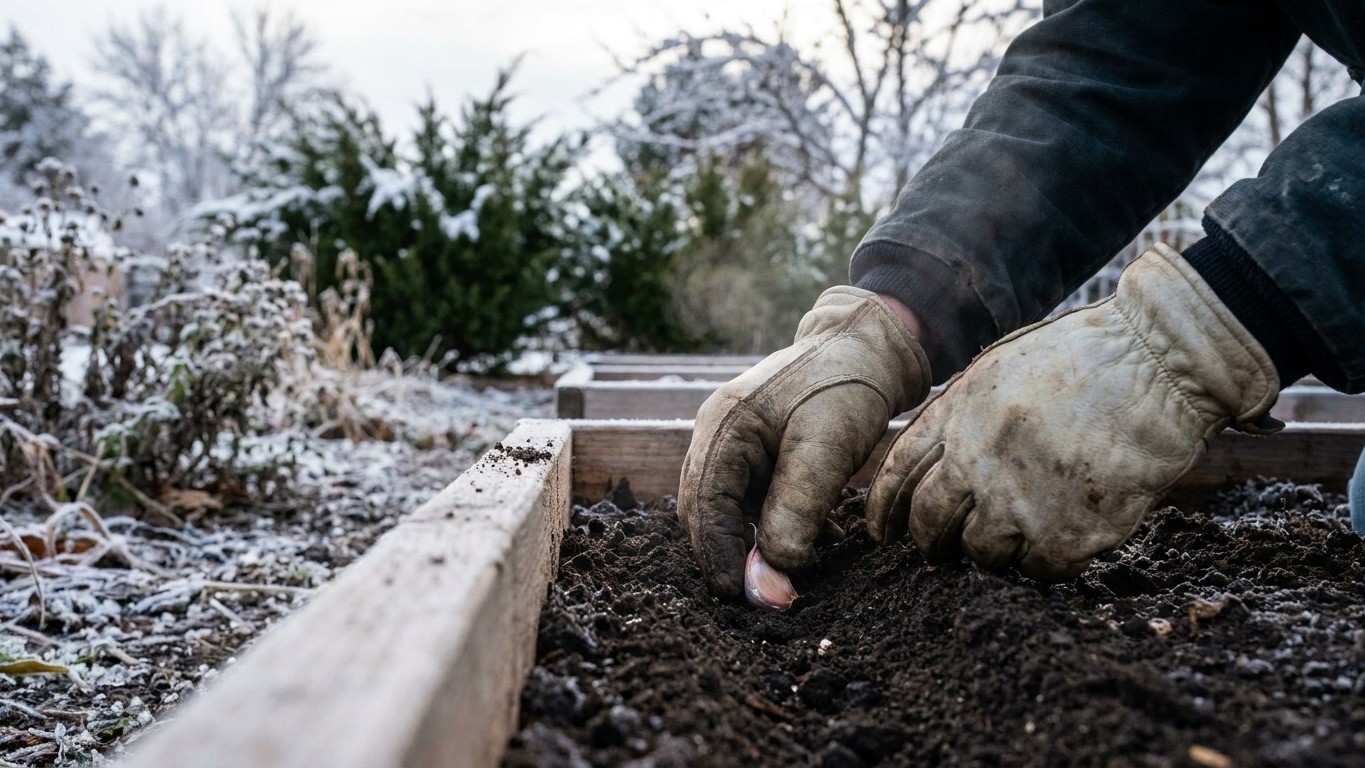

By December, the question of what to plant outdoors in Idaho has already been answered by the weather itself. The garden’s growing season is closed statewide, and in most of the state it closed a month or more ago. What’s left is narrower and more deliberate: garlic and shallots in ground that hasn’t frozen solid, cold frames, dormant bare-root plantings, and crops forced indoors for the table.
What goes in the ground in December

Soil temperature, not the calendar, decides what can go into the ground, and by December that decision has already been made almost everywhere in Idaho. NOAA’s 1991-2020 climate normals put Boise’s first fall frost between October 7 and October 21. That’s the low-elevation reference point for the state, and it’s the mildest one Idaho has. Boise sits at the warm end of Idaho’s USDA hardiness range, which runs from zone 3b up to 7b. Most of the state sits higher and colder than that reference city, so if Boise’s ground is already cooling toward frozen by early winter, the mountain valleys and northern counties got there weeks before it.
So the plain answer for December, statewide, is that nothing goes into open, unprotected ground as a new planting. That’s not a gap in this guide, it’s the actual condition of the season. Anyone reading a seed packet timeline in December and thinking about direct-sowing lettuce or peas outdoors is working against frozen or near-frozen soil, not against bad luck.
What’s still legitimate this month is narrower but real. Garlic and shallots can still go into the ground in spots where the soil hasn’t locked up, typically lower valleys during a mild stretch, pushed in before a hard freeze sets and mulched heavily right after. Cold frames and low tunnels extend the season for hardy greens that were already established before winter, not for new seedings. Bare-root fruit trees and cane fruits can be planted while fully dormant if the ground is workable, though in most of Idaho that window is closing or closed by December. And indoors, this is prime time for forcing: rhubarb crowns and chicory roots brought in from the garden or cold storage, kept dark and cool, will push tender growth for the kitchen while the outdoor garden sits idle.
What to start under cover
Counting backward from the local frost window is the only arithmetic that matters here, and December sits at the wrong end of it for most seed starting. Boise’s last spring frost falls between April 23 and May 7. Work back from that date the way you would for any transplant: heat-loving starts like tomatoes and peppers typically need roughly six to eight weeks indoors before they go out after frost risk passes, while alliums started from seed often need closer to ten to twelve weeks. Run either of those backward from a late April or early May frost date and you land in January or February, not December.
That means December is, for most of the state, too early to start the spring garden under cover. Seed indoors now and you’re likely to end up with leggy, rootbound plants sitting in small pots for weeks longer than they should, stretching toward whatever light they can find and losing vigor before they ever see real soil. The opposite mistake, starting too late, isn’t this month’s risk; it’s next month’s.
What legitimately belongs under cover in December is food for right now, not the spring crop. Sprouts and microgreens on a windowsill or under simple grow lights turn around in a week or two and don’t care what the frost window looks like. Forcing chicory or rhubarb, as mentioned above, is really a form of “starting under cover” too, just with roots instead of seeds. Save the seed-starting calendar for the turn of the year, when the arithmetic actually points toward December’s outdoor targets instead of past them.
What is ready to pick
Outdoors, December in Idaho gives up little. That’s the honest state of things, not a failure of planning. Anything still standing unprotected in the garden either survived a hard freeze because it’s genuinely cold-hardy or it didn’t survive at all.
Under snow or heavy mulch, overwintered kale and leeks can still be dug out and are often sweeter after cold exposure, since many brassicas convert starches to sugars as a frost response. Getting to them means clearing snow and loosened mulch, not fighting frozen ground with a shovel. A cold frame with hardy greens planted well before winter, spinach, mâche, some tougher lettuces, can keep producing light pickings through December if it’s been managed for airflow and hasn’t been smothered by snow load.
Indoors, sprouts and microgreens are the most reliable “harvest” this month, ready inside a couple of weeks from seed with no outdoor risk involved at all. The other job worth doing now is a walk-through of the root cellar, garage, or basement where squash, potatoes, and onions are stored. Check squash for soft spots or a sweet, fermenting smell near the stem end, sort out any potato that’s gone soft or sprouted heavily, and pull onions that have started to go papery-soft at the neck. One rotting squash left in a bin will take its neighbors down with it faster than most gardeners expect.
The jobs that matter this month
December earns its place on the calendar through the work that has a real deadline attached, even with nothing new going into the ground.
Pruning, ordering, and planning
Dormant pruning of fruit trees and cane fruits is a December-through-late-winter job, and doing it while the plant is fully dormant matters: cuts made now don’t trigger the tender new growth that a late-winter warm spell can provoke, and it’s far easier to see the tree’s actual structure without leaves in the way. This is also when seed catalogs make their move, and ordering early isn’t just habit, it’s practical. Popular varieties, especially for short-season growers at Idaho’s higher elevations, do sell out before spring. Sketching next season’s crop rotation now, while last season’s results are still fresh, beats trying to reconstruct it from memory in March.
Soil, tools, and storage
Any patch of ground that’s still workable is worth testing and amending with compost or aged manure, since nutrients and organic matter have all winter to integrate before spring planting. A compost pile that’s gone dormant with the cold benefits from an occasional turn on a mild day to keep the decomposition process from stalling completely. Tools are easiest to clean, oil, and sharpen now, before the rush of spring makes it feel like an afterthought. Raised beds, fencing, and cold frame frames that took damage over the growing season are far simpler to repair without a crop in the way. And the stored-crop check described above isn’t a one-time task; a weekly pass through the storage area catches problems before they spread.
What not to do in December
The classic December mistake in Idaho is trusting a mild afternoon over the actual soil. A stretch of unusually warm days can make the air feel like spring, but the ground several inches down is still cold or frozen, and any warm-season seedling or transplant put out on the strength of that feeling will sit in cold, wet soil that does nothing for root growth and everything for rot.
A related error is uncovering mulched beds or wrapped perennials too early after that same mild spell. Idaho winters run on freeze-thaw cycles, and pulling back protection because a few days felt warm just exposes crowns and roots to the next hard freeze, which is rarely far behind. Mulch and frame covers earn their keep by staying put through the whole cold stretch, not by coming off at the first thaw.
Feeding nitrogen this month is also working against the season rather than with it. Dormant plants aren’t building new growth, so nitrogen applied now either leaches away with winter moisture or, worse, prompts a flush of tender new growth on something like a fall-planted shrub right before a freeze kills it back. Fertility work belongs earlier in fall or later at the start of active spring growth, not in the dead middle of winter.
The broader mistake is applying a Boise-based sense of timing to the whole state. What passes for a “mild spell” in the Treasure Valley can still be a hard freeze in a mountain valley or across the higher terrain that makes up most of Idaho.
Checking this against your own county
Everything above is a statewide starting point, and Idaho is too varied for a single month-by-month calendar to fit every garden in it. Elevation alone can shift a frost window by weeks, and the difference between the state’s warmer southern valleys and its colder northern and mountain regions is real, not marginal. The hardiness range spans from zone 3b to zone 7b, and where a specific garden falls in that range changes almost every date in this guide.
The most reliable next step is checking those numbers against a local source. The University of Idaho Extension publishes county-level guidance and planting calendars built for Idaho’s specific regions rather than a single statewide average.
Common questions
Can garlic still be planted in Idaho in December?
Yes, but only where the ground hasn’t frozen solid. In milder valley spots, garlic and shallots can still go in during a workable stretch, followed by a heavy mulch layer to protect them through the rest of winter.
Is it too late to start seeds indoors for spring in December?
For most transplants, yes. Counting back from Boise’s last spring frost window of April 23 to May 7, most seed-starting schedules land in January or February, not December. Starting now often produces leggy, rootbound seedlings by the time it’s safe to transplant.
What can still be harvested from an Idaho garden in December?
Outdoors, very little. Overwintered kale and leeks under snow or mulch, and greens in a maintained cold frame, are the main exceptions. Indoors, sprouts and microgreens fill the gap reliably.
Why shouldn’t nitrogen fertilizer go down in December?
Dormant plants aren’t using it for growth. It either washes away with winter moisture or triggers tender new growth on something like a shrub right before a freeze damages it, so fertility work is better timed for early fall or active spring growth.