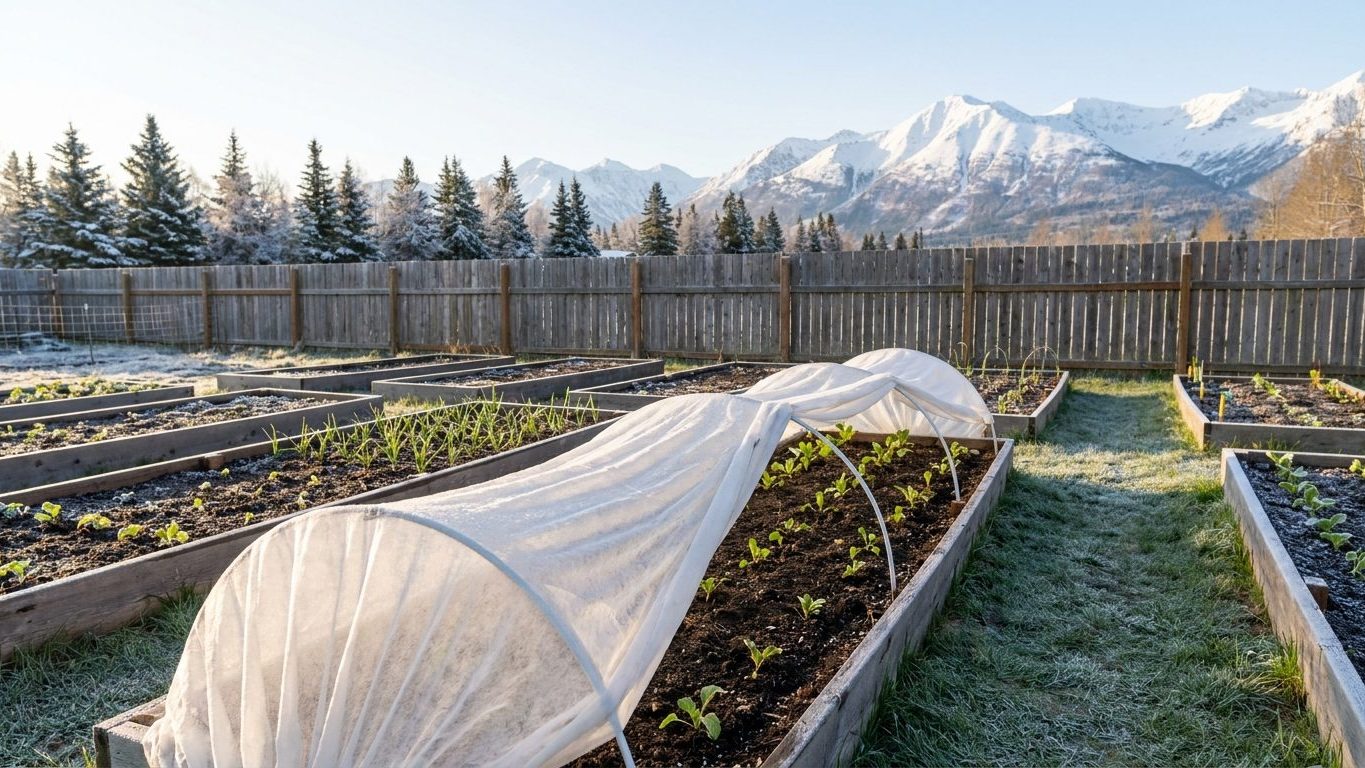

Cover tender plants on nights the forecast calls for 32°F or lower, not on a fixed calendar date. In Idaho that rule plays out in two windows, one in spring and one in fall, and the dates shift a lot with where you garden. This page gives the Boise-valley reference dates, explains what fails at higher elevations, and points you to the county source that should overrule it.
The short answer for Idaho
Expect to cover most often between April 23 and May 7 in spring and between October 7 and October 21 in fall. Those are the reference dates for Boise, drawn from the NOAA NCEI 1991-2020 Climate Normals for station USW00024131. Each is the 30-70% probability band for a 32°F freeze, which makes them odds rather than a promise. Inside either window, a frost on any given night is somewhere between a long shot and a coin flip that tips the other way.
The band exists because a freeze is not an on/off switch. In spring, the 30% end of the band is the date after which a freeze is getting less likely. The 70% end marks where it is still more likely than not. Fall works in reverse. A gardener who plants tomatoes on May 7 is betting against a probability that has already fallen well below even. One who plants on April 23 is gambling more than most people realize.
What to cover, and when
Timing depends on what is growing. Tender crops such as tomatoes, peppers, squash, cucumbers and basil are the ones to protect through both windows. Hardy crops such as kale, carrots, spinach and many other cool-season vegetables shrug off light frosts, so they rarely need cover until a hard freeze is forecast.
| Situation | Boise reference window | When to cover |
|---|---|---|
| Tender transplants in spring | April 23 to May 7 | Any night forecast at 32°F or below |
| Tender crops still producing in fall | October 7 to October 21 | Evening before a forecast frost, off again next morning |
| Hardy greens and roots | Same windows, later in fall | Usually only for a hard freeze |
The material you use matters as much as the date. Row cover, frost cloth, cloches and cold frames each buy a different margin, which is why we sorted them in Which Season Extenders Work in Idaho. And remember the caution attached to every figure above: Boise is a low valley. Most of Idaho is higher and colder, with far shorter seasons.
What will not work here
Borrowing Boise’s dates for a garden at altitude is the most common failure. The Boise windows come from a valley station. A gardener in a mountain town or on a high plateau who plants on April 23 because a state-level page said so may lose the whole bed. Their season is shorter at both ends, and the same covers that rescue a Boise garden on a 30°F night may be asked to hold off a much harder freeze.
Covers also fail against deep cold. Boise’s mean daily minimum in its coldest month is 25.4°F. That figure describes midwinter, and it tells you why season extension in Idaho is a job for the shoulder seasons. A cover over tomatoes in January does nothing useful, and even in a frosty week of October a single sheet of fabric will not defend a plant against a night that falls well below freezing. Light cover buys a few degrees. It does not buy a different climate.
Slow, long-season crops are the next casualty. Anything that needs a long run of warm nights to ripen, such as large winter squash, melons, and late tomato varieties, is risky when the fall window can open as early as October 7 in the valley, and sooner elsewhere. Covering them for a week of cold nights can rescue a few fruits, but it will not ripen a crop that started too late.
Leaving cover on all day is a quieter mistake. Idaho summers are sunny and dry across much of the state, and plastic or tight fabric left over a bed on a clear spring afternoon can overheat plants fast. Squash and cucumbers also need bees to reach the flowers, so a cover that stays on through bloom costs you fruit. The routine that works is simple: cover in the evening, uncover in the morning once temperatures climb.
Wind is the last culprit. A cover that is not anchored lifts off on a clear, breezy night and lets the cold in, and those are exactly the nights when frost forms. Low spots add another trap. Cold air drains downhill and pools, so a garden at the bottom of a slope can freeze when the forecast for town said it would not. Trust your own observation of how your garden behaves, which is what the last section of this page is for.
What changes across Idaho
Idaho is not one garden. The USDA Plant Hardiness Zone Map (2023 edition, built on 1991-2020 normals) places the state anywhere from zone 3b to zone 7b. That is a spread of four full zones, which is wider than the gap between Minnesota and Georgia. No single answer to “when should I cover?” can hold across that range.
The zone number also measures only one thing: the average annual extreme minimum temperature. It tells you whether a perennial survives winter. It says nothing directly about when your last spring frost falls or how many frost-free weeks you get, so use it for choosing plants and use frost dates for timing covers. Look up your own zone on the USDA map instead of guessing from a neighbor or a seed packet.
If you garden in the north, in the mountains, or on a high plain, shift the Boise dates later in spring and earlier in fall, and treat them as the best case. Our reference latitude is 43.57 degrees north, which belongs to Boise, not to the state. The Panhandle sits several degrees farther north, and the southern edge sits farther south, so readers near either edge should check their own latitude. Latitude matters because day length, not warmth, tells an onion to stop making leaves and start making a bulb. A garden far from 43.57 degrees north may need a different onion variety even when the frost dates look similar.
The practical effect is that covers matter more the higher you go. A valley gardener may use them for two or three nights a season. A high-elevation gardener may rely on them all through the shoulder months. For a wider look at how these tools fit together, see Extending the Growing Season in Idaho.
Where to check this for your own county
Your state extension service holds the answer that matters most. University of Idaho Extension is the land-grant program for the state, and it runs county offices staffed by people who know the local frost pockets and the vegetable varieties that have performed there. That knowledge is worth more than anything a single statewide page can offer.
Look for two things. The first is a local planting calendar for your county, which will set spring transplant dates and fall protection dates against local frost data rather than Boise’s. The second is the list of varieties trialled in your county. A variety tested where you garden has already faced your cold nights and short season, which beats a seed-catalog promise written for a national audience.
If the website does not list your county’s calendar, call or visit the county office. Master Gardener volunteers are usually reachable through those offices, and they can often tell you whether the frost dates on a statewide calendar hold up in your neighborhood.
Checking this against your own garden
Your own observations outrank every date on this page. Three signs are worth watching, and none of them needs equipment beyond your hands and your eyes.
- Soil warmth by feel. Push a hand into the bed in the morning. If the soil feels cold and clammy, tender seedlings will sit and sulk even without frost. Compare a raised bed, a sunny south-facing spot, and a shaded corner, and the difference shows you which parts of the garden warm first and cool first.
- The first flush of male flowers. Squash and cucumbers produce male blooms before female ones. When they show up tells you how fast your site is warming relative to the calendar. Late flowers mean a cooler microclimate than the reference dates assume.
- The first true leaves. The first leaves a seedling shows are seed leaves. The first true leaves come after, and they mark a plant strong enough to be hardened off or planted out under cover. A seedling that is slow to produce them in your garden is telling you the nights are still cold there.
Keep a few notes from year to year, even just the date of the last frost you saw on the roof or grass and the date you finally pulled the covers. After two or three seasons you will have a calendar more accurate than any published for your county.
Common questions
Do I cover when the forecast says 32°F?
Yes, for tender crops. Cover in the evening before the freeze and remove the covering the next morning once temperatures rise. If your garden sits in a low spot where cold air pools, treat a forecast near freezing as a real risk.
Are the Boise dates good for the whole state?
No. They come from a low valley station, and most of Idaho is higher and colder with shorter seasons. Treat them as the best case and shift later in spring and earlier in fall as you go north or up in elevation.
Do hardy vegetables need covers?
Usually not for light frosts. Kale, carrots, spinach and similar crops handle them well. Covers help mostly when a hard freeze is forecast or when you want to extend harvests further into late fall.
Can I use a bedsheet as a frost cover?
For a single cold night, a breathable fabric such as a sheet can help, as long as it is anchored and removed in the morning. For repeated use across a season, purpose-made row cover is easier to handle. Our guide on which season extenders work in Idaho compares the options.