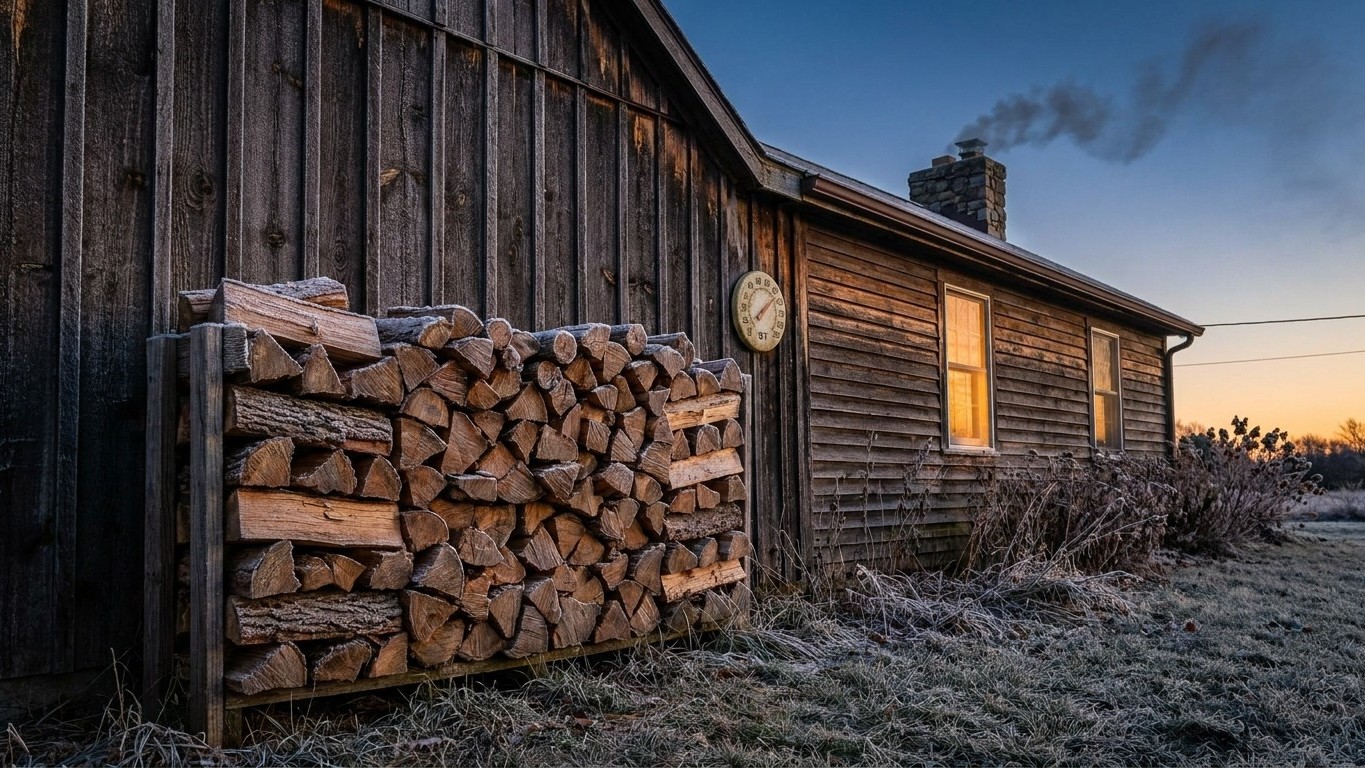

Chicago’s coldest month averages a nightly low of 18.8°F, according to NOAA’s 1991-2020 Climate Normals. That single number shapes every firewood decision in Illinois: how many cords you’ll burn, how dense your wood needs to be, and whether a stockpile in the garage is a nice-to-have or the thing keeping your pipes from freezing. Here’s how that cold translates into wood on the ground.
How cold it actually gets here

The reference figure for Illinois winter hardiness, the average low of the coldest month at Chicago, sits at 18.8°F. That’s not a record low or a scary one-week cold snap. It’s the typical overnight temperature across the whole coldest month, which in most of Illinois is January. When the baseline itself sits nearly 14 degrees below freezing night after night, you’re not dealing with an occasional chill. You’re dealing with a season that demands sustained, reliable heat.
This is well below the threshold where wood heat becomes optional. In parts of the country where the coldest-month low stays above 40°F, a wood stove is mostly ambiance, something for the occasional cold snap or a cozy evening. Illinois isn’t that state. At 18.8°F, a fire that goes out overnight means a cold house by morning, and in older farmhouses or drafty rural properties, it can mean frozen pipes by breakfast. Wood heat here is functional, not decorative.
Illinois is a long state, and the Chicago reference figure doesn’t describe every county the same way. Southern Illinois, down near the Ohio River, runs milder than the Chicago metro and the northern prairie counties, where lake-effect snow and open flat land let cold air move in fast. If you’re heating a cabin near Rockford or a farmhouse outside Peoria, treat the 18.8°F figure as roughly representative, maybe a touch mild for your specific spot. If you’re in the far south near Carbondale or Cairo, your actual winters likely run a bit warmer than the statewide reference, and your wood needs will scale down accordingly.
What this number really tells you is how much margin for error you have, and in Illinois, that margin is thin. A stove loaded with wet, half-seasoned wood might limp through a mild November evening. It won’t get you through a January night that bottoms out anywhere near 18.8°F. The cold here forces decisions: not just how much wood to have on hand, but what kind, and how dry it needs to be before it goes in the firebox.
Which woods are worth the effort here
Once you accept that Illinois winters are genuinely cold, the density of your firewood stops being a preference and starts being math. A cord is a fixed volume by definition: a stack 4 feet by 4 feet by 8 feet, or 128 cubic feet, no matter what species fills it. But wood species differ enormously in how much mass fits into that same volume. A cord of a dense hardwood, split and seasoned, holds far more usable fuel, and burns far longer, than a cord of a lighter, softer species stacked into the same box shape.
That’s why, in a climate like Chicago’s, where average lows sit near 19°F for weeks at a stretch, the densest hardwoods you can source locally matter more than they would in a milder state. Dense wood is what gets you through the coldest overnight stretches: it burns slower, holds coals longer, and needs less frequent reloading during the hours you’re asleep. Lighter, less dense species still have a real job. They’re easier to split, they catch faster, and they’re genuinely useful for starting a fire or carrying you through the shoulder months of October and April, when you want heat but not an all-night burn.
Matching wood to the job
A cord of well-seasoned hardwood, whatever the species, carries roughly 20 million BTU of heat energy on average, according to Michigan State University Extension. For comparison, that’s close to the heat you’d get from 145 gallons of #2 fuel oil, or 215 gallons of LP gas. But that 20-million figure is an average across seasoned hardwood generally, not a fixed number for any one species, and moisture content moves it substantially before you even get to which tree it came from. This site’s species-by-BTU comparison breaks down exactly which hardwoods rank densest and which run lighter, so you can pick species deliberately rather than by guesswork.
What matters just as much in Illinois, though, is availability. A theoretically superior dense species does you no good if nobody near you sells it seasoned, and you end up burning it green out of impatience. A modest hardwood you can actually buy split and dry, cured a full season, will outperform a premium species you’re forced to burn wet. Ask any firewood dealer in the state and they’ll tell you the same thing: the wood people regret buying isn’t the “wrong” species, it’s the unseasoned load that hisses and smokes instead of burning.
How much wood a winter takes
There’s no honest single number for how many cords an Illinois winter takes, and any published figure that hands you one without context is guessing on your behalf. The real answer depends on three things working together: how cold your specific location runs (that 18.8°F Chicago baseline, adjusted for where you actually live), how well your house holds onto heat once it’s made, and whether wood is your main heat source or just backup for a furnace that does the heavy lifting most nights.
Those three variables don’t add up, they multiply. A well-insulated, newer-construction home in the Chicago suburbs, burning wood as a supplement to a gas furnace, might get through winter on two or three cords, using the stove mainly on the coldest nights and for ambiance the rest of the time. A drafty, older farmhouse in the same county, relying on a wood stove as the primary heat source with no backup, can burn through five, six, even eight cords in the same weather, because every gap around a window or door frame is heat the fire has to replace continuously.
This is the mechanism that makes wood estimates swing so wildly between neighbors in the same town: insulation quality can roughly double consumption between two houses sitting in identical cold, with identical wood, and identical stoves. A leaky envelope forces the fire to work overtime just to replace heat that’s escaping as fast as it’s produced. Before you order firewood by the cord, it’s worth doing a cheap draft-check, weatherstripping, door sweeps, sealing obvious gaps, because every dollar spent there is wood you don’t have to split, haul, or pay for later.
The practical approach is to start conservative in your first wood-heating winter, track how fast you actually burn through a known stack, and adjust the following year based on real usage rather than a number pulled from an article that’s never seen your house.
Drying wood in this climate
Seasoning matters more than species almost everywhere, and Illinois is no exception. The target is the same regardless of what’s growing in your woodlot: firewood needs to burn at 20 percent moisture or less. Green, freshly cut wood can run over 60 percent moisture, and every bit of that water has to boil off inside the firebox before the wood contributes any usable heat, which is exactly why green wood hisses, smokes, and produces a fraction of the warmth it should.
What actually dries wood isn’t sunshine, it’s air movement and time. Wood needs to be split first, since bark and round, unsplit logs trap moisture and dry painfully slowly, then stacked loosely enough that air can pass through the pile. Illinois summers bring real humidity, particularly in the southern two-thirds of the state, which slows evaporation compared to a drier climate out west. A single Midwestern summer of stacking, roughly May through September, is generally enough to bring split hardwood down to burnable moisture, provided the stack is getting sun and wind, not shoved against a damp fence line in full shade.
Red oak is the one named exception worth remembering here, since MSU Extension flags it specifically as a slow dryer, thanks to its cell structure resisting moisture release even when properly split and stacked. If red oak makes up part of your woodpile, plan on it needing more time than the rest of the stack, not the same fixed number of months.
The most common mistake tied directly back to that 18.8°F winter baseline is timing. Wood cut and split this spring, for burning this coming winter, usually hasn’t had enough months stacked to reach 20 percent moisture, especially anything oak-heavy. That wood needs another full season before it’s ready. The firewood that will actually get an Illinois household through January is wood that was split and stacked last spring or earlier, sitting through a full summer’s worth of air and heat, not wood scrambled together in September for a fire that starts in November.