
Portland’s coldest month bottoms out at a mean low of 36.2°F, just above freezing. That single number reshapes how you should think about firewood in Oregon: not as pure survival fuel, but as a serious comfort heat source that still needs to be chosen and stacked correctly, especially once you leave the mild Willamette Valley for the colder high desert or the Cascades.
How cold it actually gets here

The reference figure for this region, from NOAA’s 1991-2020 Climate Normals at the Portland station, puts the average daily low for the coldest month at 36.2°F. That’s not a record low and not a monthly average temperature. It’s the mean minimum, the number that tells you what a typical night looks like at the coldest point of the year, and it’s the figure that should drive every decision about how much wood you buy and how dense that wood needs to be.
At 36.2°F, Portland and the broader Willamette Valley sit in a zone where wood heat is rarely a matter of life and death. Pipes don’t routinely freeze solid overnight. Furnaces, heat pumps, and electric baseboards handle the bulk of the load in most homes without strain. A woodstove or insert here is doing real work, but it’s working alongside a functioning grid, not against a brutal deep freeze.
That changes the whole calculation. If you live in Bend, La Grande, or up in the Cascade foothills, your local nights run considerably colder than this valley reference, and a dense, long-burning wood stops being a nice-to-have. But for the Portland-area reader, and for much of western Oregon, wood heat is closer to a lifestyle choice: lower utility bills, a warm room to sit in, backup during an ice storm that knocks out power for a day or two.
What this means for your wood pile
Write your firewood plan for the winter you actually have, not the one you imagine. A homeowner heating a drafty farmhouse near Portland through a mild winter needs a very different pile than someone running a woodstove as the sole heat source at 3,000 feet of elevation. If your winters mostly hover in the high 30s and low 40s, you can lean on easier-to-find, lighter woods for a good share of your burning and save the dense hardwood for the handful of nights that actually get cold. If you’re higher up or further east, treat every log as if it has to carry real weight, because it does.
Either way, the 36.2°F figure is your baseline. Everything else on this page, how much wood you need, which species to chase down, how long to season it, gets adjusted up or down from that starting point depending on where in Oregon you actually live.
Which woods are worth the effort here
A cord is a fixed volume: 4 feet by 4 feet by 8 feet, or 128 cubic feet of stacked wood. That’s the whole trick of firewood shopping, and it’s where a lot of buyers get shortchanged. Because the volume never changes, the only thing that changes how much heat you get out of a cord is the density of the wood packed into it. A cord of dense hardwood holds far more actual wood fiber, and far more potential heat, than a cord of the same size stacked with a light, airy softwood.
According to Michigan State University Extension, a cord of well-seasoned hardwood produces about 20 million BTU on average, roughly the heat equivalent of 145 gallons of #2 fuel oil or 215 gallons of LP gas. That 20 million figure is an average across hardwood species and assumes proper seasoning. A softwood cord of the same dimensions delivers meaningfully less, because the wood itself is lighter and less dense per cubic foot, not because the stack is smaller.
Matching wood to the job
In Oregon, that density gap plays out with a fairly predictable lineup. Denser hardwoods like oak and madrone are the ones worth chasing down for the coldest nights and for an overnight burn you want still smoldering at 6 a.m. Big leaf maple and alder sit in the middle, burning cleaner and easier to season, useful as a steady daily fuel rather than a specialist. Douglas fir and other softwoods, which make up a huge share of what’s actually available and cheap in this state, burn hot and fast, making them excellent for building a fire quickly or for the shoulder-season evenings when you just need to take the chill off, but poor for holding heat through a long night.
| Wood type | Best use | Smoke | Sparks |
|---|---|---|---|
| Oak, madrone (dense hardwood) | Coldest nights, overnight burns | Low once seasoned | Low |
| Big leaf maple, alder (medium hardwood) | Everyday steady heat | Moderate | Low to moderate |
| Douglas fir and other softwoods | Quick starts, shoulder season | Higher, more creosote risk if unseasoned | Higher, more popping |
What actually sits in Oregon woodlots and firewood ads matters more than any chart. A theoretically superior species you can’t find seasoned and dry does you no good. If the reliable local supply near you is fir and alder, plan your winter around burning those well rather than hunting for oak that never shows up seasoned in time.
How much wood a winter takes
There’s no honest single number for “cords per winter” in Oregon, and any source that gives you one flat figure is skipping the variables that actually decide it. The real answer depends on three things working together: how cold your specific location actually gets, how well your house holds the heat you generate, and whether the woodstove is your main heat source or just a supplement to a furnace or heat pump.
The cold figure comes first. A homeowner near the 36.2°F Portland baseline burns less overall than someone at higher elevation or further east where nights regularly drop well below that. But cold air outside means nothing if it isn’t reaching your living room. Insulation, window quality, and how tightly the house is sealed can swing your wood use dramatically even at an identical outdoor temperature.
That’s the piece most people underestimate. A poorly insulated older home in a hard winter can burn through double the wood that a tightly sealed, well-insulated house uses in that same climate, simply because so much of the heat is leaking straight through the walls, attic, and drafty windows before it ever does its job. Two neighbors with identical woodstoves and the same outdoor temperature can end up with completely different pile sizes by spring.
Run the estimate for your own house
- Local cold: how far your actual nightly lows run below or above the 36.2°F regional reference
- Insulation and sealing: attic insulation depth, window age, and how drafty the house feels on a windy day
- Role of the stove: whether wood heat is your primary source or backup to a furnace, heat pump, or electric heat
- Stove and chimney setup: an efficient modern insert extracts more heat from the same wood than an old open fireplace
Run those four factors against your own situation before you order or cut wood. Someone using a modern EPA-certified insert as backup heat in a well-sealed Willamette Valley home might get through a winter on two to three cords. Someone heating a drafty older place at elevation with wood as the primary source could need four times that. There’s no shortcut around measuring your own house.
Drying wood in this climate
Species matters less than most people think. Seasoning matters more, and it matters in every Oregon climate zone from the coast to the high desert. Michigan State University Extension puts the target at 20 percent moisture or less before burning, compared to green wood that can run over 60 percent. That extra water has to boil off inside your stove before the wood gives up any real heat, and that boiling eats the same energy you were hoping to put into your living room.
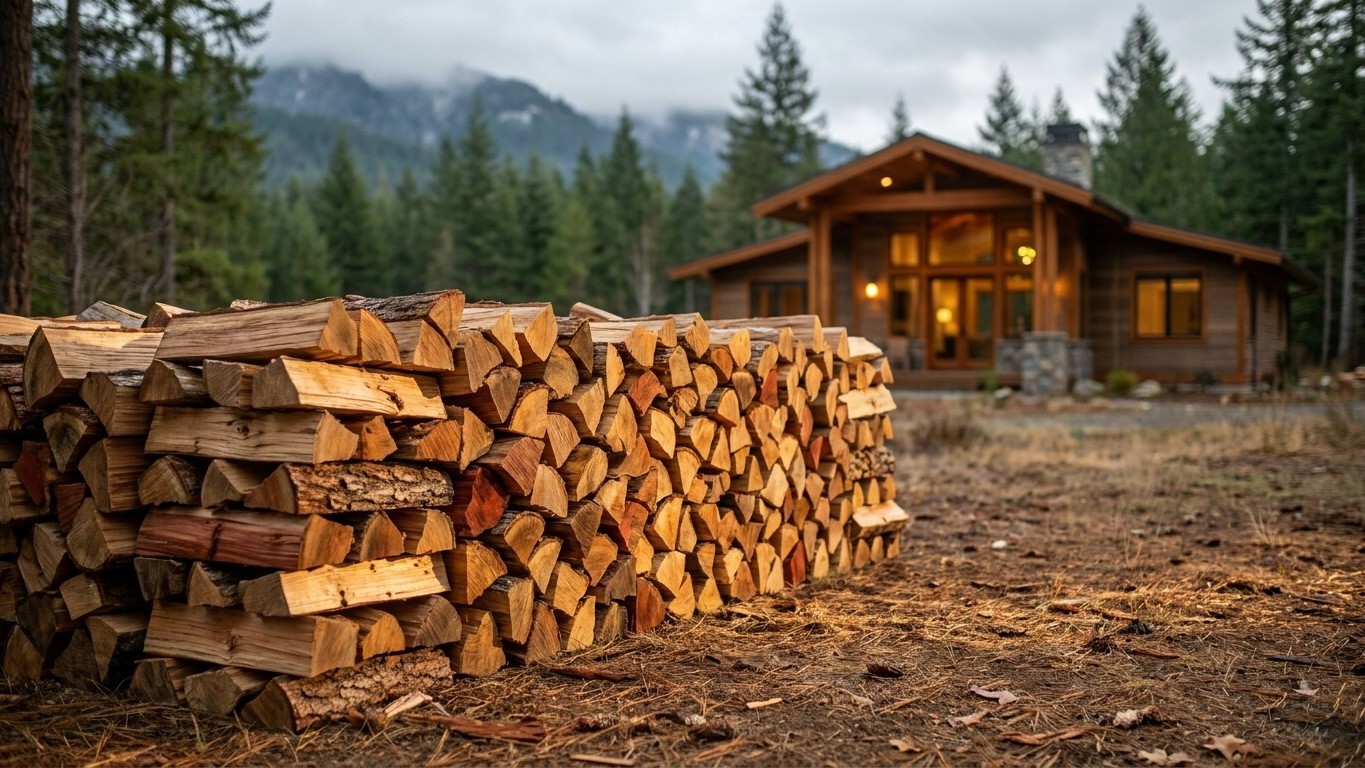
What actually dries wood is airflow and time, not sunshine. Split rounds into manageable pieces, then stack them loosely enough that air moves through the pile, ideally off the ground and under some kind of cover that blocks rain while leaving the sides open. Western Oregon’s wet, mild winters and relatively short dry summer window slow this process compared to drier eastern parts of the state, so plan on a full summer of stacked drying time as the baseline, not the exception.
The most common local mistake
Wood cut and split in spring for use that same winter usually isn’t ready. Given the moisture starting point MSU describes, one full summer of proper split-and-stacked drying is generally what it takes to reach that 20 percent target, and Oregon’s damp shoulder seasons don’t speed that up. Red oak is a named exception even under ideal conditions: MSU notes its cell structure makes it dry more slowly than most other hardwoods, so if oak is part of your stack, give it extra time rather than assuming it’s caught up with everything else.
The practical fix is buying or cutting a year ahead. Wood seasoning now should be earmarked for next winter, not this one, and the pile you’re burning through the current cold season should already have gone through a full summer stacked in the open air. Skipping that step is the single most common reason Oregon woodstove owners end up with a smoky chimney, poor heat output, and a lot of frustration despite having decent wood to start with.