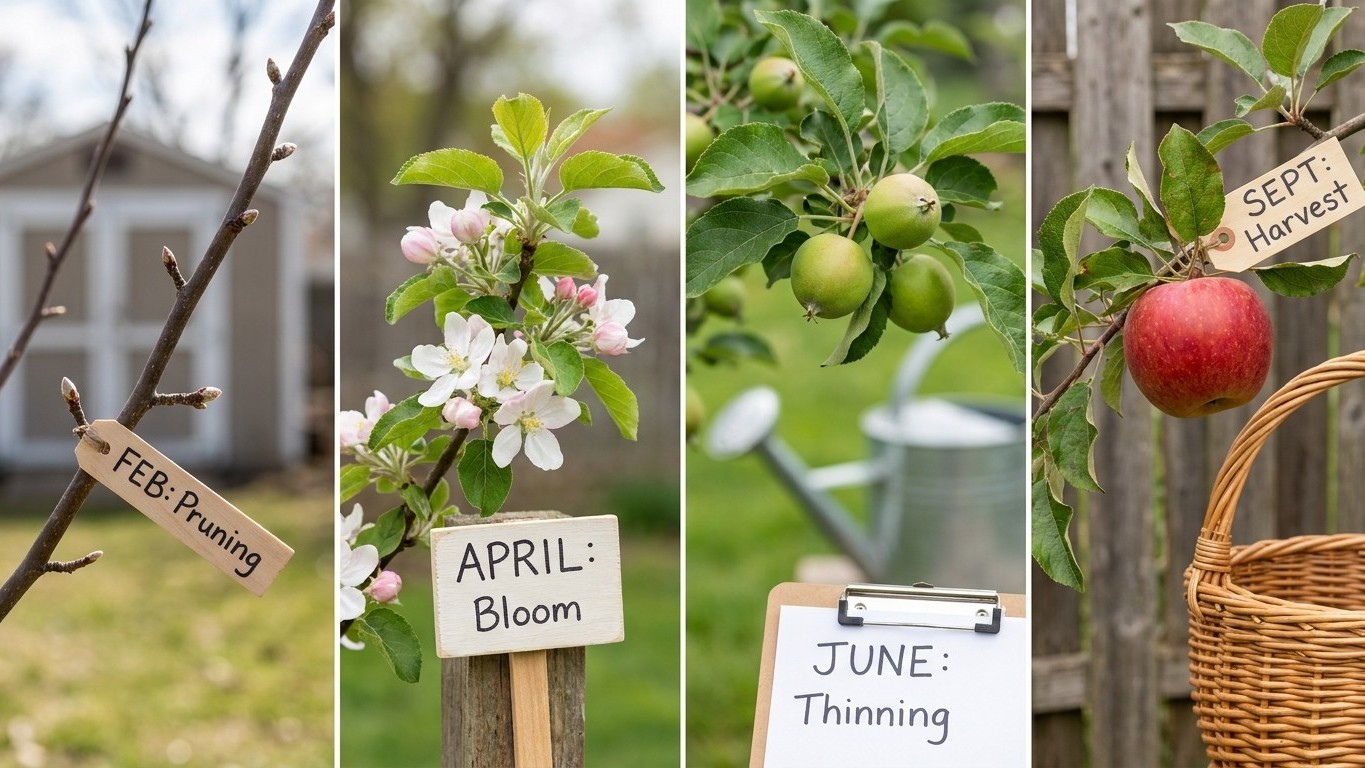

Illinois apple trees run on bloom, not on the wall calendar, and bloom tracks the region’s last spring frost. At the Chicago station, NOAA’s 1991-2020 climate normals put that last spring frost between April 11 and April 22, with the first fall frost landing between October 24 and November 3. Check your own tree’s bud stage against that window before you decide the frost risk has passed, not the date on the fridge.
The short answer for Illinois
Green tip, not the date on the wall, is what starts the clock on an Illinois apple tree. A warm March can pull that stage weeks ahead of average; a slow, cold spring holds it back near the tail end of frost season. The state’s frost numbers come from the airport station near Chicago, and rural, suburban yards typically run a week or two later on the back end. So it’s the stage the tree is actually showing, more than the week on the calendar, that decides which job is due.
What the answer depends on is which stage the tree is actually in, not what week it is. A warm March pushes green tip and pink earlier regardless of the date, and a cold, slow spring holds bloom back closer to or past the tail end of the frost window. It also depends on where in the state you are. NOAA’s figures above come from the airport station near Chicago, and the same source notes that suburban and rural gardens typically see a later last frost and an earlier first frost than the airport does, sometimes by a week or two.
Once a tree is planted and established (site prep and rootstock choice are covered separately in Growing Apples in Illinois), the calendar below is what tells you when to act on it: when to finish pruning, when to worry about a forecast freeze, when to thin, and when to pick.
Working through it

Each stage carries its own job and its own frost tolerance. Anchoring on the tree’s own appearance, rather than the date, is what keeps you from either panicking over a green-tip freeze that won’t hurt anything or ignoring a pink-stage freeze that will.
Dormancy

This runs through winter, while the coldest month’s mean minimum at the Chicago station sits at 16.5F under NOAA’s 1991-2020 normals. Dormant buds tolerate that kind of cold without injury, which is exactly why dormancy is the safe window for structural pruning and for any dormant oil application against overwintering pests. Finish pruning before the buds start to swell. Once green tip shows, cuts heal more slowly and you start losing potential fruiting wood.
Green tip

A sliver of green leaf tissue appears at the tip of the swelling bud. This stage usually arrives some weeks before bloom, and how many weeks depends on variety and on how warm the spring has run, not on a fixed date. Trees at green tip tolerate a freeze far better than trees at pink or bloom, but a hard, prolonged freeze at this stage can still injure the most exposed buds on young or dwarf trees.
Pink

The blossom buds swell further and show color through the scales, still closed. This is where frost risk starts climbing fast. If pink lands inside the April 11 to April 22 window at Chicago, or later in a cooler outlying county, a hard freeze at this stage is one of the more common ways an Illinois grower loses a season’s crop before a single flower has even opened. Early-blooming cultivars reach pink earlier than late-blooming ones, and that timing difference is exactly what’s compared, variety by variety, in The Best Apple Varieties for Illinois.
Bloom

Open white flowers with pink-tinged edges are the most frost-sensitive stage on the whole tree. Bloom typically arrives at or after the tail end of the Chicago last-frost window, but a late freeze after April 22 still shows up in cooler springs, and it shows up more often in the outlying counties NOAA flags as running behind the airport station. An open flower hit by a hard freeze is usually killed outright, which is why growers watch the overnight forecast hardest during this stage, not the calendar.
Petal fall

Petals brown and drop, and small green fruitlets appear where each blossom was. Frost sensitivity drops sharply here. A freeze that would have wiped out an open bloom does far less damage to a set fruitlet, which is one reason growers breathe easier once petal fall is well underway.
Fruit set

Fruitlets reach pea size and the main risk shifts away from frost and toward pests like plum curculio, which target the tree right around this stage. Thinning, where you remove excess fruitlets to improve size and reduce limb stress, is usually done once fruit set is confirmed and before the fruit gets much bigger than a marble.
Harvest
Harvest timing is a catalog fact crossed against the local fall frost window, not a fixed date. Catalog days-to-maturity are counted from bloom or transplant and shift a week or two with the season, but they still tell you roughly where a variety lands relative to Chicago’s first fall frost window of October 24 to November 3.
| Variety | Catalog ripening | Where that falls against the Chicago frost window |
|---|---|---|
| ‘Zestar!’ | Early season, ripens in late summer | Well ahead of the window, no frost pressure |
| ‘Honeycrisp’ | Midseason, ripens in early to mid fall | Several weeks ahead of the window in most years |
| ‘GoldRush’ | Late season, ripens in mid to late fall | Arrives close to the start of the window, pick promptly |
A late-season variety like ‘GoldRush’ leaves the least margin. In a year where cool weather has already pushed bloom and fruit set later than usual, that margin can disappear entirely before the fruit finishes ripening.
What changes across Illinois
The figures above come from the Chicago-area airport station, and Illinois runs roughly 380 miles from that latitude down to the southern tip near Cairo, so treating any single set of frost dates as statewide is a mistake. NOAA’s own caution on these normals notes that suburban and rural sites typically see a later last spring frost and an earlier first fall frost than the airport station, sometimes by one to two weeks, which shortens the safe growing window on both ends compared to what the Chicago figures alone suggest.
Lake Michigan itself moderates the immediate lakeshore counties around Chicago: the lake keeps nearby air cooler in spring, which tends to delay bud break and bloom, and keeps it warmer in fall, which tends to push the first frost later than it falls further inland at the same latitude. Move even a short distance away from the lake’s direct influence and that buffering effect weakens.
Southern Illinois, down toward Cairo, sits at a noticeably lower latitude than Chicago and generally experiences a milder, shorter winter with an earlier spring warm-up, which shifts the whole bloom-to-harvest sequence earlier in the season relative to the Chicago dates used above. No source in this piece gives a specific frost date for Cairo or for central Illinois, so treat the Chicago figures as a reference point to adjust from, not a number to copy.
Low-lying river valleys, including stretches along the Illinois and Mississippi rivers, are prone to cold air drainage: cold air is denser and settles into the bottom of a valley overnight, which can produce a harder, more frequent frost at the valley floor than on the surrounding higher ground even a short distance away. An orchard sited on a valley floor should expect a frost risk closer to, or worse than, the early end of the ranges above, while a similar orchard on nearby higher ground often escapes the same overnight freeze.
The mistakes this climate punishes
Three timing mistakes account for most of the crop losses this climate produces, and each one shows up at a specific stage rather than at a specific date.
- Choosing an early-blooming cultivar on a frost-prone site. Its flowers open before frost risk has actually cleared, especially in the outlying counties NOAA’s own caution flags as running behind the Chicago station, and a bloom-stage freeze there kills the open flowers outright.
- Fertilizing or pruning late in summer. Either one pushes soft new growth that has not hardened off by the time the first fall freeze arrives in the October 24 to November 3 window at Chicago, and that soft growth is what dies back and shows up the following spring as blackened, dead twig tips.
- Ignoring rootstock hardiness on a dwarfing tree. Dwarfing rootstocks are generally less cold-hardy at the trunk and root than a standard rootstock, and where the coldest month’s mean minimum runs around 16.5F, as NOAA’s 1991-2020 normals record for Chicago, an unmulched dwarf tree without snow cover for insulation is the one most likely to show trunk or root injury by spring.
The first mistake shows up in April, as blackened, collapsed blossoms after a night the tree could not shrug off. The second shows up the following spring, as dead wood that has to be pruned out before growth resumes. The third can take a full winter to show, appearing as bark splitting or a tree that leafs out weakly the next year despite looking fine the fall before.
Checking this against your county
Every figure above comes from the Chicago-area NOAA station, and your own county can run a week or two ahead of or behind it in either direction. Illinois Extension, extension.illinois.edu, is the place to check county-specific frost data, planting guidance, and pest alerts before you lock in a spray or pruning schedule based on the numbers here. The office nearest your orchard is the one to call if a forecast freeze during bloom has you deciding whether to cover young trees or risk the loss.
Common questions
Why did my apple tree bloom two weeks early this year?
A warm stretch in late winter or early spring pushes a tree through green tip and pink faster than the calendar suggests, and bloom follows whenever the tree reaches it, not on a fixed date. Track bud stage directly rather than counting days from a prior year’s bloom date.
Will one late frost during bloom wipe out the whole crop?
Not necessarily. A freeze during bloom usually kills the flowers that are fully open at the time, but flowers that haven’t opened yet, or that opened after the freeze passed, can still set fruit. A partial crop after a bloom-stage freeze is common, a total loss is less so unless the freeze is hard and prolonged.
Do I need two apple trees to get any fruit?
Most apple varieties are not reliably self-fertile and need a second, overlapping-bloom variety or a crabapple nearby for pollination. Check the specific cultivar’s pollination requirement before assuming one tree alone will set a full crop.
When should I spray for pests if I’m following this calendar?
Spray timing for pests like plum curculio and apple scab is tied to bud stage, particularly pink through petal fall, rather than to a set date, since that’s when the pest or fungus is active on the tree. Illinois Extension publishes current spray-timing guidance tied to these stages, and it’s worth checking against your county’s own pest pressure rather than relying on a generic schedule.