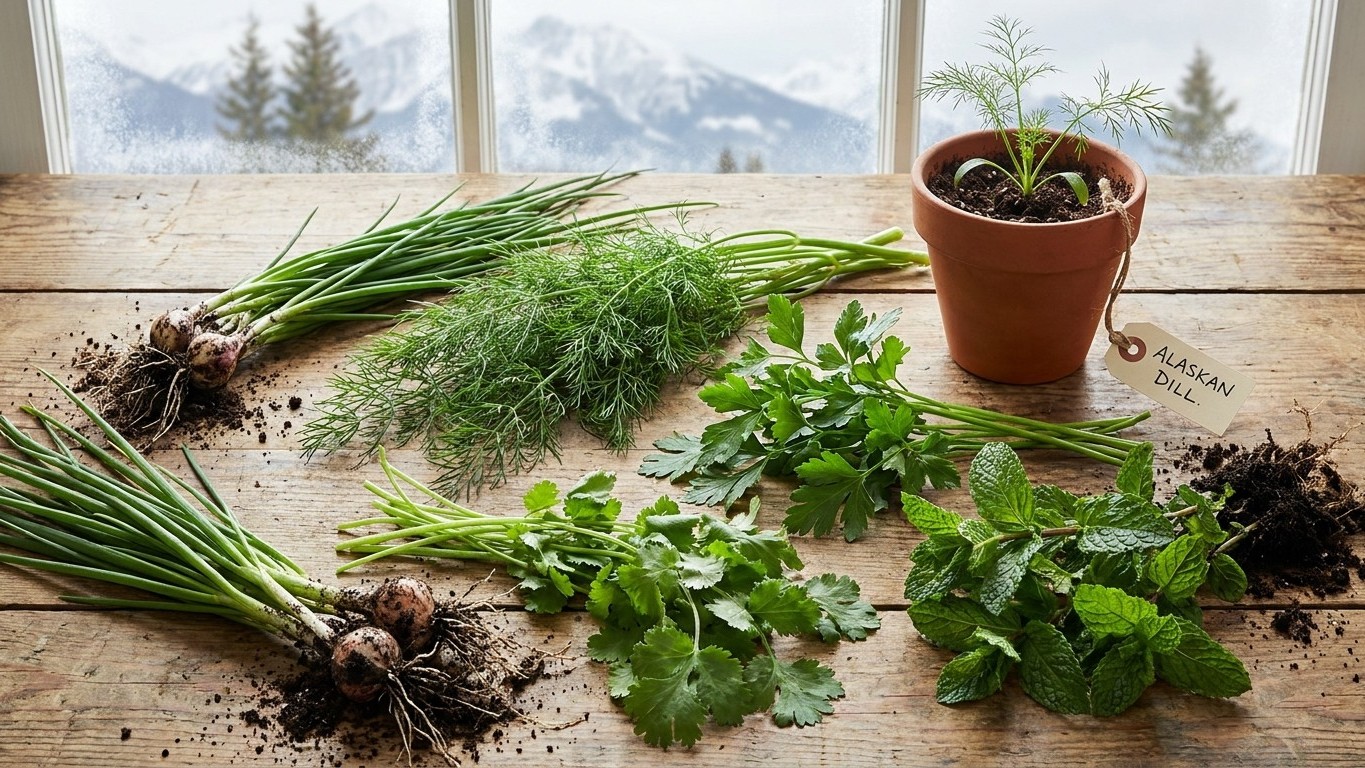

Illinois gardeners get the best results with a mix of fast annual herbs (basil, dill, cilantro) sown after the last frost, and hardy perennials (chives, thyme, oregano, sage) that survive winter once established. The split depends on how long your growing season runs and how cold your soil gets in January, and those numbers differ more than most people assume.
The short answer for Illinois
Start with the frost window. At the Chicago reference station, the last spring frost falls somewhere between April 11 and April 22, and the first fall frost lands between October 24 and November 3. That gives a growing season of roughly six and a half months, enough time for almost any herb sold in a garden center to go from seed or transplant to a full harvest, and often a second one.
That length matters more than most gardeners realize. Herbs split into two camps that behave differently once the season is set. Annuals like basil, dill, cilantro, and parsley race through their whole life cycle in one summer. They need warm soil to germinate and warm nights to keep growing, but they don’t need to survive a winter, so the frost dates above are really their entire lifespan. Sown a week or two after the last spring frost date for your specific spot, they’ll finish well before the first fall frost arrives, with room to spare for a second cilantro or dill sowing in late summer.
Perennials play a longer game. Chives, thyme, oregano, sage, and winter savory don’t just need a season to grow, they need to survive the coldest month intact. That’s where the 18.8°F average daily minimum for the coldest month becomes the deciding number. It’s not the record low, it’s the typical overnight low during the worst stretch of winter, and it’s cold enough to kill an unprotected Mediterranean herb root system in a bad year, but not cold enough to rule out the tough ones. Thyme, oregano, chives, and sage are bred for exactly this kind of winter and come back reliably with a couple inches of mulch over the crown.
Matching the herb to the type
The decision, in practice, comes down to what you’re planting for:
- Fast annual harvest, no winter risk: basil, dill, cilantro, parsley, summer savory
- Perennial anchor plants, worth the mulch: chives, thyme, oregano, sage, winter savory
- Borderline cases that need a sheltered spot: rosemary, French tarragon, some lavender varieties
Rosemary is the one plenty of Illinois gardeners try and lose. It’s not built for an 18.8°F winter without serious protection, and in most yards it behaves better as a container plant brought indoors than as a permanent bed resident.
What will not work here

Lemongrass, and other tropical or subtropical herbs sold as perennials in warmer states, simply won’t survive outdoors through an Illinois winter. A coldest-month average minimum of 18.8°F is well below what these plants tolerate even briefly, and no amount of mulch changes that math. If you want them, treat them as annuals, or as houseplants that spend summer outside and come back in before the first fall frost.
Rosemary deserves its own warning here. It’s marketed everywhere as a hardy perennial herb, and in zones warmer than what Illinois sees, it is. But left in open ground through a typical Illinois winter, most rosemary plants die back to the roots or die outright, especially in years when the cold arrives before snow cover builds up to insulate the soil. Gardeners who want rosemary long-term usually grow it in a pot they can move.
The growing season length also rules out herbs that need a genuinely long, hot stretch to mature fully, the kind of season found in states with earlier springs and later, hotter falls than what the frost dates here allow. Some seed catalogs list maturity times that assume 90-100 hot days in a row; with roughly six and a half months of frost-free window here, most herbs fit, but the slowest-maturing tropical basil varieties or certain long-season pepper-adjacent herbs can run out of runway if sown late.
Where humidity causes trouble
Illinois summers bring enough humidity that herbs planted too close together, especially basil and other leafy annuals, are prone to fungal issues like downy mildew. This isn’t a frost-date problem, it’s a spacing and airflow problem, and it shows up regardless of which part of the state you garden in. Herbs that thrive in a dry Mediterranean climate with wide spacing (many people replicate cramped spacing from those growing guides) tend to sulk or rot in a humid Illinois July if they’re planted shoulder to shoulder.
Watering habits matter too. A once-a-week soak works fine in a cooler, drier climate, but during an Illinois heat spell, containers and shallow-rooted annual herbs like basil and cilantro can dry out and bolt within days on that schedule. Herbs that need consistent moisture to avoid bolting are the ones most likely to fail under a “water it Sunday and forget it” routine.
What changes across Illinois
Illinois is not one climate. The USDA hardiness zone map places the state anywhere from 5a to 7b, and that spread is the widest single fact about Illinois. A herb that limps through winter in the coldest pocket of zone 5a might barely notice winter at all in a 7b pocket further south. There is no single answer for “will this herb survive winter in Illinois,” only an answer for a specific spot on that map.
The frost dates given here (April 11 to April 22 for spring, October 24 to November 3 for fall) come from one reference station. In practice, suburban and rural gardens tend to see their last spring frost later and their first fall frost earlier than a city airport station records, sometimes by one to two weeks, and more if the garden sits at higher elevation or in a low spot where cold air pools. That means a gardener acting on these dates alone risks planting tender annuals about two weeks too early, right into a frost the station never recorded.
The practical shift for a reader in the northern part of the state, or at any elevation above the flat river-valley baseline, is to push spring planting later and mulch perennial herb crowns more heavily going into fall. A reader in the southern tier of the state, closer to that 7b end of the range, can generally start earlier in spring and worry less about winterkill on borderline herbs like rosemary, though even there, an unusually harsh winter can still catch a plant unprotected.
None of this tells you which zone your own yard sits in. That’s a question for the map, not for a state-level article, because the boundary lines run through counties and sometimes through towns.
Where to check this for your own county
The state-level dates and zone range are a starting point, not a final answer. Illinois Extension, the University of Illinois’s cooperative extension service, publishes county-specific guidance that accounts for local microclimates, and that’s where a real planting decision should get made. Find it at extension.illinois.edu.
Two things are worth hunting for on the local extension pages. The first is a local planting calendar, if your county office publishes one, since it will reflect frost dates observed closer to your actual garden rather than the airport station cited above. The second is any list of herb or vegetable varieties that have been trialled by extension staff or master gardener volunteers in your specific county. A variety that performs well in trial plots near you tells you more than a general statewide recommendation ever could, because it’s already been tested against your soil, your humidity, and your local pest pressure.
A county recommendation beats a state one every time. This page gives you the state-level picture, the frost windows, the hardiness zone range, the coldest-month minimum that governs perennial survival, because that’s useful for understanding the mechanics of why certain herbs work here and others don’t. But it can’t tell you what happens in your specific yard the way a county extension office can, especially one that runs its own demonstration gardens or fields calls from gardeners in your exact area.
If your county doesn’t have a dedicated extension office nearby, Illinois Extension operates on a regional unit system, and the main site will route you to the unit covering your county along with contact information for a horticulture educator who can answer specific questions about local timing and variety performance.
Checking this against your own garden
Every date here is a probability built from decades of averages at one weather station. Your own garden will tell you more than any calendar once you know what to watch for.
Soil warmth by feel is the first and most reliable signal. Push a finger a couple inches into the soil where you plan to sow basil or cilantro. If it feels cool and slightly damp like a refrigerated vegetable drawer, it’s still too cold for germination even if the calendar says the frost date has passed. Warm, dry-on-top soil that feels closer to room temperature is the real green light, and it often arrives days or weeks after the official last frost date depending on how much sun that spot gets and how well it drains.
The first true leaves on any seedling matter more than the calendar date it was sown. The first pair of leaves on a basil or dill seedling are seed leaves, not the plant’s actual foliage, and they tell you almost nothing about vigor. Once the second set of leaves appears, looking like the mature herb’s actual shape, that’s confirmation the plant has moved past the fragile seedling stage and can handle a bit more stress, including a light transplant or thinning.
For perennial herbs coming out of winter, watch for new growth at the base of the plant rather than assuming it’s dead just because last year’s stems look brown and brittle. Chives, thyme, and oregano often send up fresh green shoots from the crown weeks after the surrounding ground still looks like winter, and that new growth is a better signal that the plant survived than any date on a frost chart.