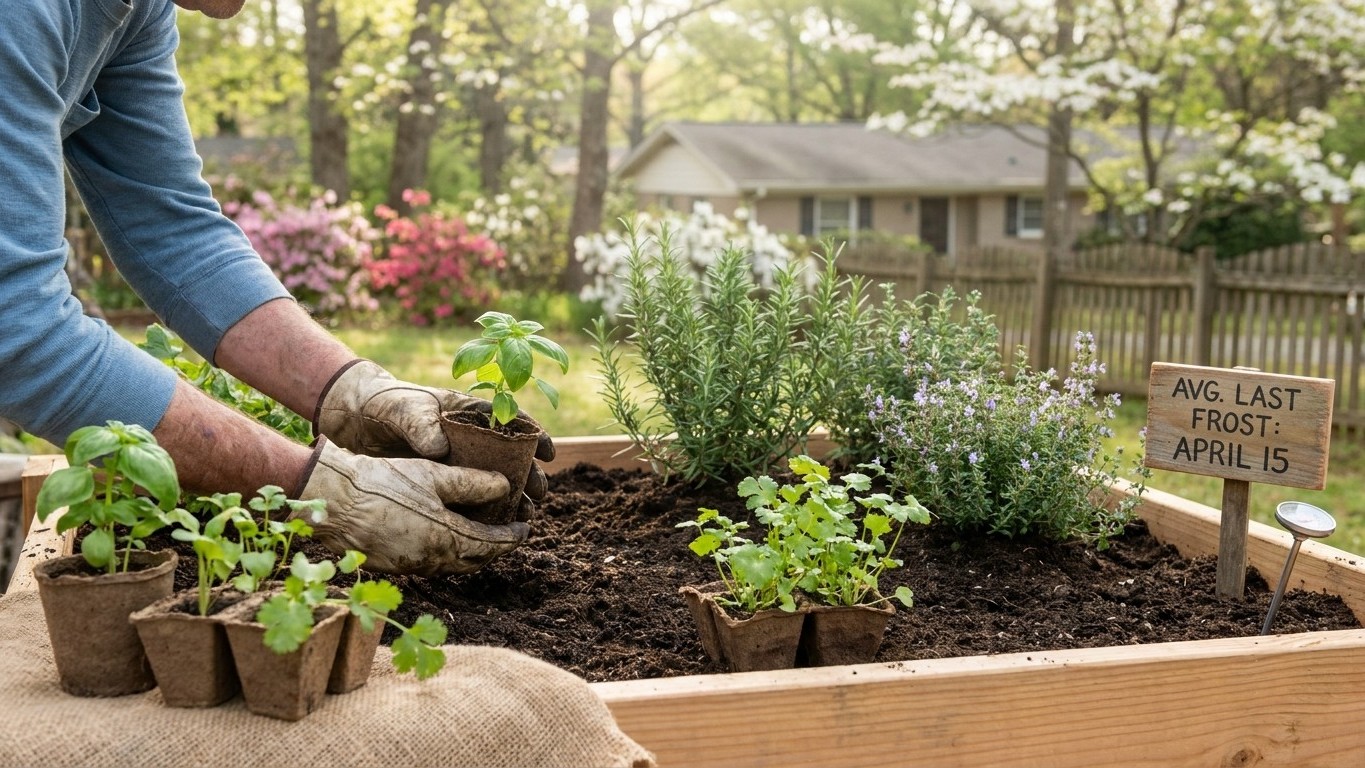

Illinois gardeners get one dependable marker for herbs: the last spring frost, typically April 11 to April 22 at the Chicago-area reference station. Hardy herbs like parsley, chives, and cilantro can go into the ground two to three weeks before that window closes. Tender herbs, basil above all, wait until it’s fully behind you and soil has had time to warm.
The short answer for Illinois
That frost date isn’t a promise, it’s a probability. NOAA’s 30-70% band for April 11 to April 22 means a 32°F freeze has roughly a 30% chance on the early end of that window and a 70% chance by the late end, at the specific airport station used to calculate it. Some years the last frost lands weeks earlier. Some years it doesn’t. That spread is exactly why the planting calendar for herbs works better as a set of rules by herb type than a single circled date.
Hardy herbs shrug off a light frost, so they can go in the ground while risk is still elevated, sometimes as early as late March in a mild year. Tender herbs and warm-season transplants need both the frost risk gone and the soil warm enough to keep roots from stalling, which usually pushes basil, tender perennials grown as annuals, and anything moved from a warm windowsill into the first half of May rather than the exact frost date.
| Herb type | Example | When to plant outdoors | Frost tolerance |
|---|---|---|---|
| Cold-hardy annual | Parsley, cilantro, dill | 2-3 weeks before last frost | Handles light frost |
| Semi-hardy perennial | Chives, sorrel | Around last frost date | Tolerates a brief freeze |
| Tender annual | Basil, tender bay transplants | 1-2 weeks after last frost | Damaged by any frost |
| Woody Mediterranean perennial | Rosemary, thyme, sage, oregano | After frost risk drops, soil workable | Frost-sensitive as young transplants |
The fall end of the calendar matters just as much and gets ignored more. First fall frost lands October 24 to November 3 at the same reference station. Tender herbs planted or seeded too late in summer never get a full harvest window before that date closes the season. Working backward from early-to-mid-fall frost, and forward from mid-April frost, gives Illinois roughly a 190-day frost-free stretch at this station, the number that should drive when slower herbs get started, not just when they get planted out.
What will not work here
Rosemary is the herb most gardeners get wrong in Illinois, and the coldest-month figure explains why. The average daily minimum in the coldest month runs 18.8°F. Rosemary’s hardiness threshold sits well above that in most winters, which is why treating it as a perennial left outdoors in open ground fails across most of the state almost every year. It survives as a container plant brought indoors, or as an annual, not as a permanent bed resident the way it is in milder climates.
Bay laurel runs into the same wall, and so does any Mediterranean herb marketed as “hardy to zone 8” without a caveat. That 18.8°F average minimum isn’t even the record low, it’s a typical night in the coldest month. A single winter with a deeper cold snap, which happens regularly, finishes off anything marginal that survived on luck the year before.
Basil sown too early is the opposite failure. Nighttime soil temperatures below the mid-50s stall germination and stunt young transplants even without a frost touching them, so a gardener who plants basil right at the last frost date instead of a week or two after it often ends up with yellowing, sulking plants that never really take off. The frost date protects against freezing, not against cold soil, and those are two different problems.
Humid Illinois summers create a third failure mode that has nothing to do with frost. Basil and other close-planted herbs grown in tight rows with poor airflow are prone to downy mildew and other fungal issues once July humidity sets in, a problem that shows up regardless of when the herb was planted. Wider spacing than the seed packet suggests, and watering the soil rather than the foliage, matters more here than in a drier climate where the same spacing works fine.
Slow-establishing perennial herbs like French tarragon and lavender also struggle when planted late in a short window. Given the frost-to-frost season length at this reference station, an herb that needs a full season to establish woody growth before winter should go in as early as hardiness allows, not squeezed in during June after other plants have taken priority.
What changes across Illinois
Illinois spans USDA hardiness zones 5a to 7b, a range built on one variable: average annual extreme minimum temperature. That’s a wide spread for a single state, and it means there is no single hardiness answer here, only a gradient. A herb that overwinters reliably as a perennial in the state’s warmer pocket may need to be treated as an annual, or moved indoors, in the coldest zone. The frost dates in this article come from one reference station and describe that station, not the whole range.
Northern Illinois sits at the colder end of that zone spread, which typically means a later last spring frost and an earlier first fall frost than the dates given here, shortening the practical growing season for tender herbs. Southern Illinois sits at the warmer end, often with more room on both sides of the season and a better shot at overwintering marginal perennial herbs in a sheltered spot.
Elevation and local terrain shift things further within short distances. A garden in a low spot that collects cold air overnight, sometimes called a frost pocket, can see frost weeks after a garden a few miles away on higher ground has cleared. Urban and close-in suburban gardens often run warmer than open rural ones nearby, thanks to pavement and buildings holding heat.
None of this is something to guess at from a general description of “northern” or “southern” Illinois. The USDA Plant Hardiness Zone Map lets a gardener check the specific zone for their address, and that’s the right tool for figuring out which end of the 5a-7b range applies to a given yard, rather than assuming based on the nearest big city.
Where to check this for your own county
Every figure in this article comes from one reference weather station, useful for a statewide picture but not a substitute for local data. The University of Illinois Extension, at extension.illinois.edu, publishes planting guidance built around Illinois conditions specifically, and that’s the resource to check before finalizing a planting date.
Two things are worth looking for once there. First, a county-level or regional planting calendar, since Illinois Extension offices often tailor recommended dates to local frost patterns that can run a week or two ahead of or behind the statewide averages used here. Second, any list of herb varieties trialled or recommended for Illinois conditions specifically, since variety performance for disease resistance and heat tolerance varies enough between regions that a variety that thrives in one county can struggle in another with different summer humidity or soil.
A county recommendation beats a state one every time, and a state recommendation beats a national one. Extension offices also field direct questions from gardeners, often by phone or email, and that local point of contact usually knows about frost pockets, soil quirks, and pest pressure that never make it into a general planting calendar.
Treat this article as the reasoning behind the recommendation, and the county Extension office as the source for the specific date to actually use.
The Moon calendar is a separate, older custom: see when to plant herbs by the moon, written as tradition rather than fact.
Checking this against your own garden
No calendar date beats what’s actually happening in a specific yard, and three simple checks tell a gardener more than any printed frost date. Soil warmth by feel is the first: reaching a hand into the top few inches of bed a few days after a warm stretch and finding it cool rather than cold suggests it’s close to ready for tender herb transplants, regardless of what the calendar says.
The second check applies mostly to herbs grown for flowers or seed, like dill and cilantro left to bolt: the first flush of flowers signals the plant has shifted from leaf production to seed production, a sign that succession sowing should start now if a continuous harvest matters, rather than waiting for a fixed date.
The third is the appearance of the first true leaves on any seedling started outdoors, the leaves that look like the mature plant rather than the rounded first leaves from germination. Their arrival, and how sturdy they look, says more about whether conditions have actually been favorable that season than counting days since the average last frost. A slow, pale set of true leaves after a supposedly warm week points to a colder microclimate than the regional average suggests, worth remembering for next year’s timing in that same spot.