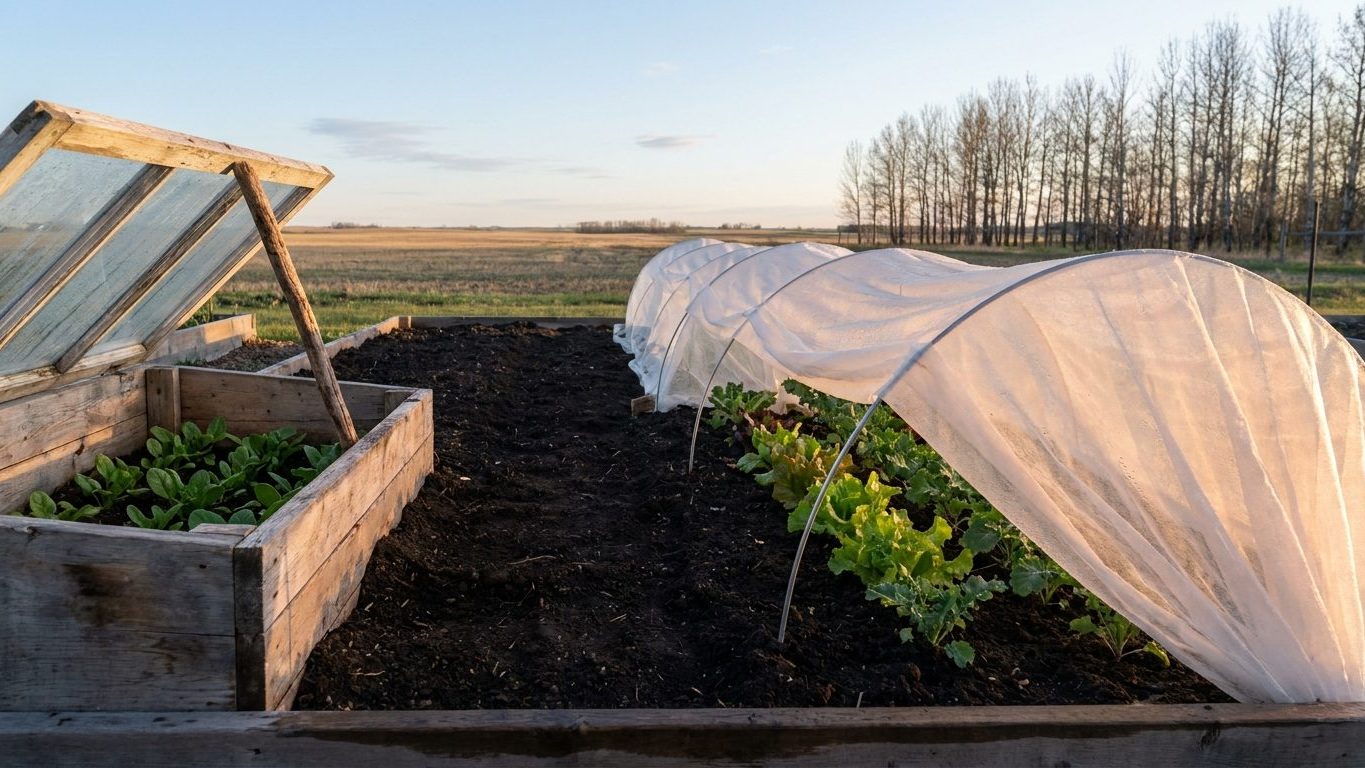

Floating row cover, low tunnels and cold frames do most of the useful work in Illinois gardens. They buy time at both ends of the season, and the climate asks for exactly that: a last spring freeze in mid-April and a first fall freeze between late October and early November at the Chicago reference station. Heavy equipment is rarely needed. Timing and venting matter more.
The short answer for Illinois
Start with lightweight floating row cover, ideally held over hoops as a low tunnel, for spring and fall. Add a cold frame for hardening off seedlings and for hardy greens. An unheated high tunnel is worth the money only if you want to keep harvesting well into winter. Those three tools match the numbers.
The numbers come from the NOAA 1991-2020 Climate Normals for the Chicago airport station. Its last spring frost falls between April 11 and April 22. Its first fall frost falls between October 24 and November 3. Each range is a probability band, not a promise: it spans the dates on which the odds of a 32°F freeze sit between 30 and 70 percent. Some years the freeze comes before the early date, and some years after the late one. Chicago’s Lake Michigan-influenced airport is also not your garden. Suburban and rural plots usually see the last spring frost later and the first fall frost earlier, often by one to two weeks.
That squeeze is the whole case for covers. If your spring freeze runs into early May and your fall freeze arrives in mid-October, a cover that shields plants through a few cold nights at each end gives you back real planting time. It does not add warmth to a full season. It handles the edges. For guidance on timing the cover itself, see When to Cover Your Garden in Illinois.
The coldest month at the reference station has a mean daily minimum of 18.8°F. That is well below freezing, so no simple cover turns January into a growing month for tender crops. It does mean hardy crops can sit in a protected bed through cold stretches.
| Extender | Best Illinois use | Watch for |
|---|---|---|
| Floating row cover | Spring frost nights, fall frost nights, insect screening | Wind lifting the edges, so pin it down |
| Low tunnel (hoops plus cover) | Early greens, brassicas, late fall salad crops | Heat buildup on sunny days |
| Cold frame | Hardening off, hardy greens into winter | Needs venting on mild days |
| Unheated high tunnel | Longest extension at both ends, some winter harvest | Cost, and the need to ventilate daily in spring |
For the bigger picture on the season, the pillar page on Extending the Growing Season in Illinois covers the full framework.
What will not work here
A sheet thrown over tomatoes in March will not work. Even at the early edge of the Chicago band, the odds of a 32°F freeze are still around 70 percent on April 11. A single layer of fabric protects against a light frost, not against a run of cold nights, and warm-season transplants need warm soil that no cover creates quickly.
Sealed plastic in April is the second failure, and probably the most common. Illinois spring days can swing from cold mornings to warm, sunny afternoons. Clear plastic with no vents turns a low tunnel into an oven by midday. Seedlings that survived the cold get cooked. If you use plastic, open it daily, and lean on breathable fabric when you cannot be home to vent.
Trusting the airport dates is a third. A gardener in an exposed rural spot who plants on April 22 because the reference station says so is working with a number measured somewhere else. The caution in the data is plain: your last frost may fall one to two weeks later, and your first fall frost one to two weeks earlier.
Fall rescues have limits too. Cover can carry a bed of peppers or tomatoes through a night or two near the first-frost band, which runs October 24 to November 3 at the reference station and earlier in many suburban and rural gardens. It cannot rescue a crop that still needs weeks to ripen. At 41.99 degrees north (the latitude of that station, not of the whole state), days shorten quickly in autumn. Plants slow down on light alone, and fabric does nothing about that.
Winter growing of warm-season crops is out. With a coldest-month mean minimum of 18.8°F, a cold frame without added heat will freeze solid around anything tender. What survives is spinach, kale and similar hardy greens, and even they mostly hold rather than grow in midwinter.
Onions show the same limit. They form bulbs in response to day length, not warmth, so a cover cannot push them to bulb earlier. Extenders work on temperature. Light and day length stay beyond their reach.
What changes across Illinois
The USDA Plant Hardiness Zone Map (2023, built on 1991-2020 data) puts Illinois in zones 5a through 7b. That is a wide spread. The zone system rests on one variable, the average annual extreme minimum temperature, so it tells you what winter will do to perennials, not when your last frost falls. There is no single answer for the state. The page can only describe the spread.
A gardener in the far north of the state should assume a later spring and an earlier fall than the Chicago figures, and should lean harder on tunnels and cold frames at both ends. Row cover matters more there because the margin for error is thinner. Someone far to the south starts earlier and gets frost-free weather longer, but warm weather also arrives sooner, which makes venting a spring chore rather than an occasional one. Heat becomes the problem a cover creates.
The 41.99 degrees north figure belongs to the Chicago reference station. A large state spans several degrees of latitude, so anyone near the northern or southern edge should check their own. Day length shapes onion bulbing and shapes how fast fall plants slow down, and it changes with latitude even when the thermometer reads the same.
The USDA Plant Hardiness Zone Map lets you enter a ZIP code. Use it to find your zone rather than assuming one from a neighbor or a seed packet. Then treat that zone as a winter-survival guide for perennials and borderline hardy crops, and rely on your own frost observations for everything seasonal.
Where to check this for your own county
Your state extension service is the next stop. University of Illinois Extension runs local offices across the state, and county staff know what actually happens in their soil and weather.
Look for two things. The first is a local planting calendar, ideally one built for your county or region, with frost dates and planting windows for the crops you grow. The second is the list of varieties trialled nearby. A variety that performs in a trial plot in your county has already faced your conditions, which beats a catalog description written for the whole country.
Ask staff or master gardeners at the local office about the specific extender you are considering. They can tell you how local wind, soil type and typical late-spring cold snaps affect a low tunnel or a cold frame, and whether other gardeners nearby have had success with high tunnels.
A county recommendation beats a state one, and this page is the state one. Everything here is built on a single reference station and a hardiness zone range that covers most of the state. Read it as a starting point, then let the county numbers overrule it.
Checking this against your own garden
Observation outranks every date on this page. Three things are worth watching, and none needs equipment.
- Soil warmth by feel. Push your hand into the bed in the morning. If it feels cold and damp, wait on warm-season seedlings even after the frost date. Compare a sunny south-facing spot with a shaded one. The difference is your microclimate.
- The first flush of male flowers. On squash and cucumbers, male flowers open before female ones. When they appear earlier in a covered bed than in an open one, the cover is working. When both arrive together, you may be venting too much or covering too little.
- The first true leaves. Seedlings first show seed leaves, then true leaves. If true leaves appear sooner under cover, the extender is giving you a head start. If they are slow or pale, the bed may be too cold or too wet.
Write down the dates you see these signs for a season or two. Those notes become your own calendar, and they will show how far your yard drifts from the airport figures.
Common questions
Will row cover protect plants from a hard freeze?
It protects against light frost. In a hard freeze, add a second layer or a tunnel, and watch the forecast. Hardy greens tolerate more, while tender crops need extra protection or should stay indoors.
Do I need a high tunnel in Illinois?
Not for most home gardens. Row cover, low tunnels and cold frames handle the frost edges well. A high tunnel makes sense if you want substantial winter harvests or a much earlier spring.
When should I remove covers in spring?
Vent them on mild days and remove them when frost risk has passed for your garden, not just the reference station. Plants under cover still need a gradual adjustment to open air.
Can I grow vegetables through winter under cover?
Hardy greens can survive and hold, but growth slows sharply in midwinter because days are short and the coldest month has a mean minimum of 18.8°F. Plan for harvesting what you planted in fall, not for steady new growth.