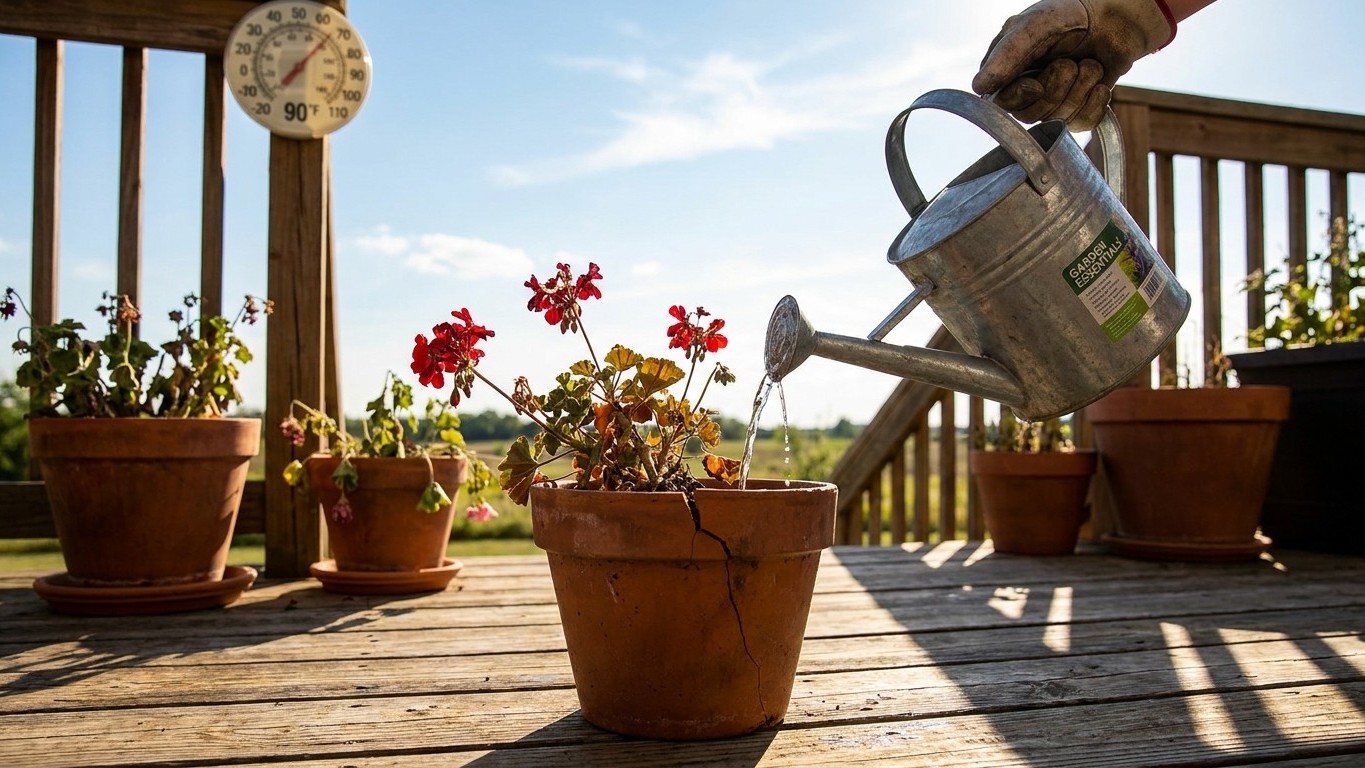

Wisconsin containers dry out faster than garden beds because potting mix drains quickly and holds a fraction of the water a real bed does. The state’s summer rain (3.4 inches in July, the driest month) rarely covers what a pot needs, and even a handful of 90-degree days can empty a container in hours. Watering pots here means checking soil daily and rarely trusting the sky.
What changes here

Two numbers set the baseline for every container in the state: July rainfall averages 3.4 inches, the lowest of the summer months, and the region sees 7.0 days a year at or above 90 degrees. Together they mean the driest stretch of summer also tends to land during the hottest week, so containers face their biggest water deficit exactly when evaporation is working against them the hardest.
A garden bed wants roughly an inch of water a week. Spread July’s 3.4 inches over that month’s four and a half weeks, and the sky delivers about 0.78 inch a week on average, close to the target but not quite there, and that figure assumes every drop soaks in rather than running off pavement or a porch roof. A container almost never gets that benefit. Rain has to fall straight into the pot to count, and a plant’s own foliage often deflects a good share of it before it reaches the soil.
Potting mix behaves like the sandy end of the spectrum described for garden soil: water moves through it within a day rather than sitting for a week the way it would in heavy clay. That drainage is why containers need shorter, more frequent watering instead of the deep weekly soak that works for a clay-based bed. The same inch of water that would keep a clay bed damp for days is gone from a hanging basket by nightfall.
None of this is a forecast. These are 1991-2020 normals from the reference station cited by NOAA, and a particular patio, balcony or driveway can run hotter or drier than the regional average depending on sun exposure and surrounding pavement. A finger in the pot, checked daily during summer, tells the truth a rain gauge alone can’t.
How to water when it matters
Containers need water at the root zone, not just at the surface, and the method has to fit fast-draining mix and Wisconsin’s stretch of hot, sometimes rain-starved weeks. Watering deeply and less often trains roots to grow down into the pot instead of clustering at the surface, where they’re the first to bake once a hot afternoon hits. Morning watering gives the plant a full day to take up moisture before evaporation peaks, and it means any water that splashes onto leaves has hours to dry rather than sitting overnight, which is when fungal problems get their start.
Checking moisture at depth rather than by looks matters more in a container than almost anywhere else, because the surface inch of potting mix can look bone dry while the middle of the root ball is still damp, or the reverse.
- Push a finger about two inches into the soil, or use a trowel on larger containers, before deciding to water at all.
- Water slowly at the base until it runs from the drainage holes, which confirms the whole root ball got soaked rather than just the top layer.
- During the driest week of July, when rainfall averages only 3.4 inches for the month, expect to check most containers daily and water every day or two depending on pot size and sun exposure.
- On the 7 days a year that reach 90 degrees or higher, check twice, once in the morning and again by late afternoon, since a small pot can dry out well before evening.
- Ease back the frequency during cooler, wetter stretches, letting the finger test rather than the calendar decide.
A daily check in midsummer is a starting point, not a fixed rule. Pot material, size, and how much sun a spot gets will push that rhythm faster or slower, so the finger test stays the final word over any schedule written down in advance.
What goes wrong
A light sprinkle every day
Giving a container a quick splash daily feels responsible, but it only wets the top half inch of mix. Roots follow the water, so they stay shallow and exposed right where the sun does the most damage, and the plant ends up thirstier than one watered less often but more thoroughly.
Watering leaves in the evening
Wet foliage that sits overnight, especially in the cooler, damp air common on Wisconsin summer nights, gives fungal spores hours to take hold before morning sun dries things out. Watering the base in the morning avoids that window entirely.
Trusting a passing shower
A ten-minute thunderstorm can look like it solved the watering problem, but dense foliage often shields the pot’s surface, and a light shower may wet only the top half inch of mix before running off the sides. The finger test settles it faster than guessing from the porch.
Skipping mulch on the pot’s surface
A bare soil surface in a container loses moisture to the sun almost as fast as it’s watered in, particularly during the handful of 90-degree days each summer. A thin layer of mulch or bark on top slows that loss and stretches the time between waterings.
Given the region’s modest number of extreme-heat days but real dry stretches in July, the costlier habit locally tends to be trusting rain that never fully reached the pot, rather than overwatering. Containers with poor drainage can still drown after a heavy storm, so checking that water actually exits the drainage holes matters just as much as checking for dryness.
Local help
For soil testing, plant selection and season-specific advice, the University of Wisconsin-Madison Division of Extension is the state’s land-grant resource. Watering restrictions for containers and gardens vary by city and water utility and change from year to year, so check with the local water provider for current rules before setting an outdoor watering routine.
Common questions
How often should I water containers in Wisconsin during July?
July is the driest month on average, at 3.4 inches of rain, so most containers need checking daily and watering every day or two depending on pot size and sun exposure.
Do containers need more water than garden beds?
Yes. Potting mix drains faster than most garden soil, closer to how sandy ground behaves, so containers hold less reserve water and dry out sooner between rains.
Is morning or evening better for watering pots?
Morning. It gives the plant the day to use the water before evaporation peaks and lets any wet foliage dry out, lowering the risk of fungal disease overnight.
How many extremely hot days does Wisconsin typically see?
About 7.0 days a year reach 90 degrees or higher on average, based on 1991-2020 climate normals, and those days sharply raise how fast containers lose moisture.