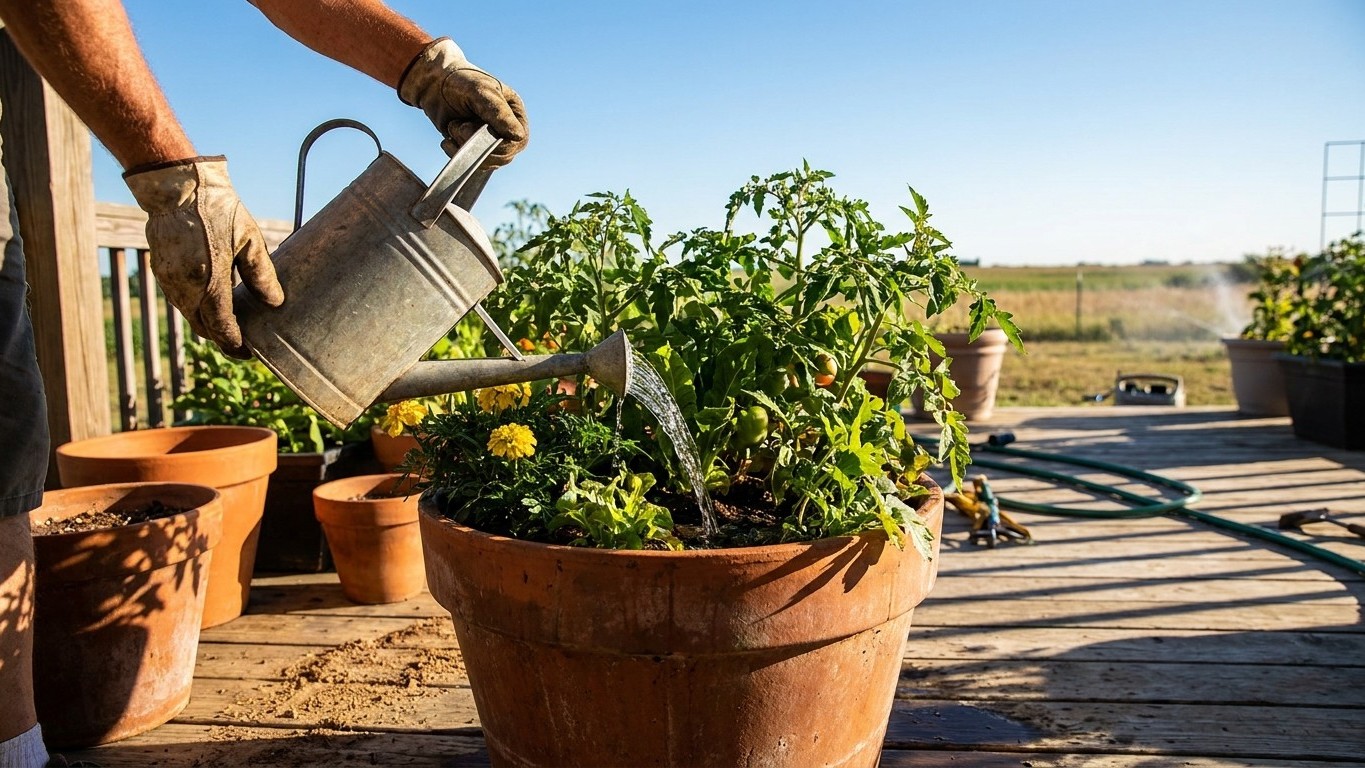

Iowa gardeners get a decent amount of summer rain on paper, about 13.2 inches from June through August, but July drops to just 3.82 inches while the region still logs 18.4 days a year at 90F or hotter. That gap between rainfall and heat is what decides whether a bed thrives or struggles by late July.
What changes here

Two numbers do the heavy lifting for Iowa gardens: 3.82 inches of rain in July, the driest summer month, and 18.4 days a year that reach 90F or above. Read together, they mean the sky delivers less water exactly when the air is pulling the most moisture out of the soil and out of plant leaves. That combination, not either figure alone, is why a garden that looked fine in June can wilt by the third week of July.
Run the arithmetic and the picture gets sharper. A vegetable bed or a young perennial border generally wants about an inch of water a week to keep growing without stress. July has roughly 4.4 weeks in it, and 3.82 inches spread evenly across that month works out to about 0.87 inches a week, if the rain fell evenly, which it rarely does in the Midwest. Summer rain here tends to arrive as thunderstorms rather than steady drizzle, so a single storm can dump half an inch in twenty minutes and then nothing for ten days. The monthly average hides that unevenness.
So the honest math is this: on paper, July comes up about 0.13 inches a week short of the one-inch target, but in practice the shortfall is usually worse, because storm runoff and quick evaporation on hot days mean less of that 3.82 inches actually soaks in around the root zone. June, at 5.26 inches, and August, at 4.17 inches, both clear the weekly target more comfortably. July is the month that separates a garden on autopilot from one that needs a gardener carrying a hose or dragging out a soaker hose.
The 18.4 days above 90F matter because heat drives evaporation from both soil and leaf surfaces, and it does so faster than most people expect. A day at 95F pulls noticeably more water out of a bed than a day at 80F, even with the same rainfall. Iowa’s heat days cluster in July and August, right when rainfall is already thinnest, which is exactly the kind of overlap that turns a manageable dry spell into a stressed garden.
How to water when it matters
The goal in Iowa’s climate is to get water down to where roots actually live, not just to wet the surface and call it done. Deep, infrequent watering trains roots to grow downward, following the moisture, which makes the whole plant more resilient during the hot stretches in July and August. Shallow, frequent sprinkling does the opposite: roots stay near the surface, where the first hot afternoon bakes them.
Morning watering beats evening watering for a simple reason. Water applied in the morning has hours of daylight and airflow to dry off leaves before nightfall, which matters because wet foliage sitting overnight is an open invitation for fungal disease. Evening watering feels convenient, but it sets up exactly the damp conditions that fungal spores need to take hold.
Before assuming a bed needs water, check it. Push a finger about two inches into the soil near the base of the plant, or use a trowel for a quick core sample. If it’s dry at that depth, water. If it’s still damp, wait, even if the surface looks dusty. Surface dryness is a poor guide on its own, since the top half-inch of Iowa soil can dry out within a day of a hot afternoon while the root zone below stays moist.
A reasonable starting point for most Iowa vegetable and flower beds during July’s driest stretch is about 1 to 1.5 inches of supplemental water a week, delivered in one or two deep sessions rather than daily light passes. That number is a starting point, not a rule. Sandy patches drain fast and dry out sooner; heavier, clay-rich ground holds water longer and can go longer between waterings, but also punishes overwatering with root rot if it’s soaked again before it has had a chance to dry. Watch your own bed for a season and adjust from there.
- Check soil moisture two inches down with a finger or trowel before watering, rather than judging by the surface.
- Water at the base of the plant, aiming the hose or can at the soil rather than the foliage.
- Water in the morning, ideally before 10 a.m., so leaves dry fully before evening.
- Apply about 1 to 1.5 inches per week during July’s driest stretch, split into one or two deep sessions rather than daily sprinkles.
- Adjust the interval up or down based on how fast your specific soil dries between waterings.
What goes wrong
A daily sprinkle that never reaches the roots
Watering a little bit every day feels responsible, but it keeps moisture in the top inch of soil and nowhere deeper. Roots follow the water, so they stay shallow, and shallow roots are the first to suffer once a 90F afternoon hits and that top inch flashes dry within hours. This is probably the most common mistake in Iowa yards during the July dry stretch, because it looks like care while actually starving the plant of a stable water supply.
Watering leaves in the evening
Soaking foliage after dinner because it’s convenient sets up a warm, damp environment overnight that fungal diseases like powdery mildew and blight thrive in. Iowa’s humid summer air already gives fungal spores a boost; wet leaves sitting in the dark for eight hours makes it worse.
Trusting a rain shower that barely wet the surface
A quick thunderstorm can look like it solved the watering problem, but a short, hard rain often runs off compacted soil or a mulched bed faster than it soaks in, leaving only the top half-inch damp. Check with a finger before skipping a scheduled watering. This matters more in a July with only 3.82 inches spread across scattered storms than in a wetter month like June.
Skipping mulch and losing what rain does fall
Bare soil under an 18.4-days-a-year heat load loses moisture to evaporation fast. A two to three inch layer of mulch around plants, not touching the stems, slows that loss and keeps the soil’s temperature more even, which means less of July’s already-thin rainfall gets wasted.
Local help
Iowa State University Extension and Outreach tracks local growing conditions, soil questions, and seasonal watering guidance county by county. Find your local office and current advisories through Iowa State University Extension. Watering restrictions vary by municipal water provider and can change during dry stretches, so check with your local utility for current rules before setting a summer watering schedule.
Common questions
How often should I water my Iowa garden in July?
Aim for about 1 to 1.5 inches a week, delivered in one or two deep sessions, and adjust based on how quickly your specific soil dries between waterings.
Is Iowa’s summer rainfall enough on its own?
June and August generally clear the one-inch-a-week target on average, but July, at 3.82 inches for the month, typically falls short and needs supplemental watering, especially during the region’s 18.4 annual days above 90F.
What’s the biggest watering mistake in Iowa yards?
Shallow daily watering is the most common issue, since it keeps roots near the surface where summer heat dries them out fastest.
Does a summer thunderstorm mean I can skip watering?
Not necessarily. Check the soil two inches down with a finger first; a hard, short storm often runs off before it soaks in deeply.