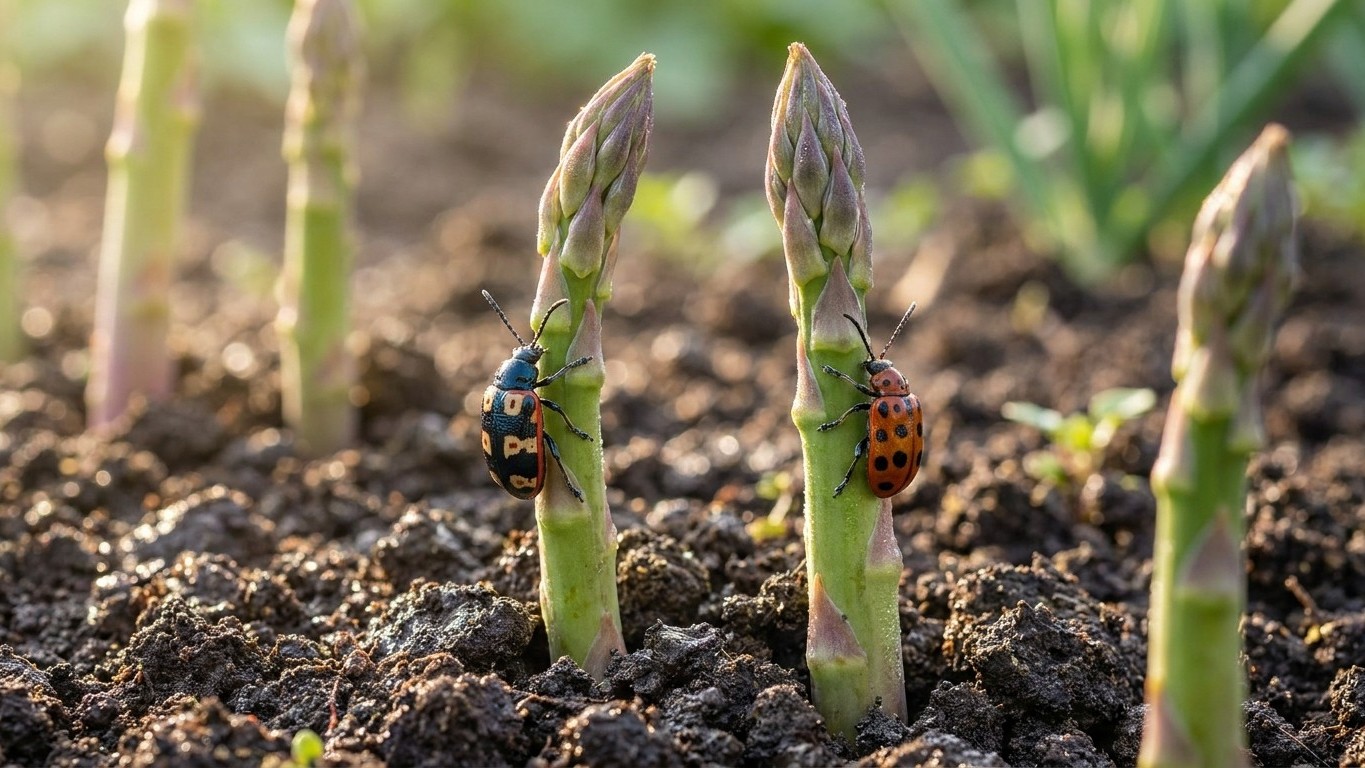

Stop cutting when most of the spears coming up are thinner than a pencil. That is a thing you can hold in your hand, not a date on the calendar. Cut spears keep best at 32 to 35°F in near-saturated air, with the butts standing in water. Above 50°F they toughen within hours, and at 30.9°F or lower they freeze and collapse. Getting to that first cutting takes a well-drained spot and patience, so the soil comes first. More on the crop is in Growing Asparagus in Iowa.
The short answer
Iowa’s state soil is the Tama series, a Mollisol: the deep, dark prairie ground that built the Corn Belt. A bed planted in it is a long commitment. Utah State University Extension says crowns go into the ground, nothing is harvested until year 3, and the bed then produces for 10 to 15 years. The only soil requirement that source sets is that the ground drains. Most soils will do, provided they do.
Does the dominant Iowa soil drain well enough? Yes. USDA records Tama as well drained. Its representative surface values are 4 percent sand, 26 percent clay and 70 percent silt, with organic matter around 3.5 percent and a surface pH of about 6.5, slightly acid. Silt-heavy ground like that holds moisture without drowning what grows in it. These are USDA’s representative values for the surface layer of mapped Tama soils (246 components), not a measurement of anyone’s worked bed. The Extension source says nothing about the pH asparagus prefers, so the 6.5 describes the series and nothing more. It is not your pH.
Here is where a state soil stops being useful. Iowa spans hundreds of soil series, and the Tama figures describe what the region’s ground tends to do, not what your back garden does. River bottoms can stay wet. Hill country can run thin or steep. Any lot a builder has scraped, filled or compacted can behave like a different state entirely.
That matters more for asparagus than for any other crop. A tomato bed in heavy ground is an annual nuisance you amend each season. An asparagus bed in heavy ground is a decision you live with for fifteen years, and the crowns sit in a furrow 8 inches deep, which is exactly the shape of something that collects water. For the deeper dig, see Will Iowa Soil Hold an Asparagus Bed for Fifteen Years?
If a spot is doubtful, test it before planting. Dig a hole where the bed would go, fill it after a wet spell, and watch how long the water stands. Water still sitting there the next day is a warning. A soil test through your county Extension office gives you the real numbers for your plot. If the ground fails, the cheaper fix is a different spot, or a bed built up above the surrounding grade, because you cannot easily improve drainage under crowns once they are in.
Will the summer here water it for you?
Mostly, in a normal year. NOAA’s climate normals for the Iowa reference airport station show about 13.2 inches of rain across June, July and August, out of 36.5 inches for the full year. The bed wants 1 to 2 inches every other week for the first two years, then every three weeks after that. Here is how to work out what you add.
- Do the arithmetic. June brings 5.26 inches, July 3.82 and August 4.17. Thirteen inches over roughly thirteen weeks is about an inch a week. A typical two-week stretch lands near the 2-inch top of the target. Even July, the driest month, works out to about 1.7 inches per two weeks.
- Distrust the average. These are normals over a 30-year span for one station. They are not a forecast, and a slope, a city or a patch of shade changes them. A single summer thunderstorm can drop an inch that mostly runs off, and days at or above 90°F pull water back out of the ground fast.
- Put a rain gauge on the plot. It settles the question better than any table. Read it every two weeks and compare the total with the 1-to-2-inch target.
- Add only the gap. If the gauge shows less than an inch over two weeks, water to make up the difference. If it shows an inch or more, leave the hose alone. Tama-type ground, mostly silt with some clay, holds water far longer than sand does, which is why the rainfall figure goes further here than it would on a sandy lot.
- Stretch the schedule after two years. Once the bed is established, move to the every-three-weeks rhythm, again counting rain first.
The practical upshot is that an Iowa gardener on well-drained ground adds water in dry spells rather than on a fixed schedule. Midsummer is when the gap most often opens, and the gauge is how you catch it.
When to put the crowns in
Early spring. Utah State University Extension has crowns going into furrows 8 inches deep at that time, and Iowa’s frost dates tell you roughly when that is. NOAA NCEI’s 30-year normals put the last spring freeze (32°F) at around April 12 to April 24 at the reference airport station. Treat that as the optimistic end. Iowa State Extension county figures run about 4 days later in spring, so a plot away from the airport may not clear its last freeze until around the end of that window or just past it. A mean date is an average, and some years will break it on either side.
Planting is not a one-day job, either. The furrow is backfilled gradually through the year, two inches every other month, not all at once. Filling it in a single pass buries the crowns before they have grown up through it. A furrow worked this way is also another reason drainage matters, since the crowns spend months sitting low in the ground.
Then comes the wait. Nothing is harvested until year 3. After that the first cutting runs 4 weeks, the next season 6 weeks, and the season after that 8 weeks. The pencil rule ends each season: when most spears come up thinner than a pencil, stop cutting and let the ferns grow. Do not soften that into “a few spears won’t hurt” in year 2, because the bed is still building the root reserves it will live on for a decade or more.
The alternative to crowns is growing from seed. This page holds no published sowing dates or timing for the seed route, so follow your seed packet and expect to wait longer than crowns would take. Whichever route you choose, put the bed where water drains away, since the seed bed is just as long a commitment.
Common questions
How do I know it is time to stop cutting each season?
Look at the spears, not the calendar. When most of the new ones are thinner than a pencil, stop and let them fern out. Before that, the harvest window grows with the bed’s age: 4 weeks the first harvest year, then 6, then 8.
How do I keep cut spears fresh?
UC Davis Postharvest puts the optimum at 32 to 35.6°F with 95 to 100 percent relative humidity, and says high humidity is needed to prevent desiccation. In a home kitchen, that means standing the butts in water or wrapping them damp, since the cut end loses moisture faster than anything else. Keep them cold but not freezing. Toughening begins quickly above 50°F, and at 30.9°F or lower freezing injury turns them soft and water-soaked.
Does Tama soil mean I can skip the soil test?
No. Tama is the soil USDA lists as representative of Iowa, and it drains well, but your plot may be river bottom, hill ground or builder fill. A soil test gives your own numbers, including pH, which the Extension source on asparagus does not address.
What else wants the spears besides me?
Insects, mostly, and the timing depends on the season. What Eats Asparagus in Iowa, and When walks through who shows up and when to look for them.