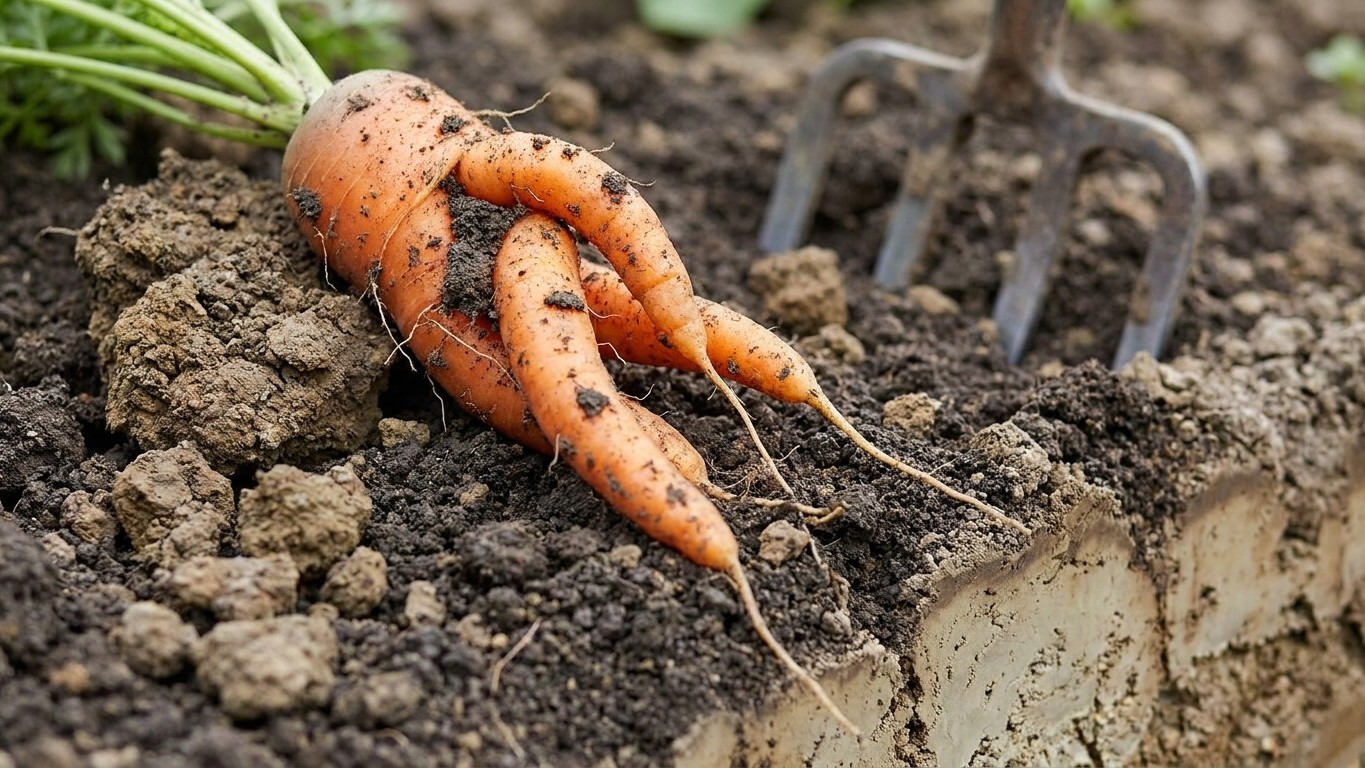

Not much shows up here as insect damage once you look closely. Iowa’s own representative soil, the Tama series, runs heavy and fine-textured, and that mismatch with what a carrot root wants to grow through causes far more forked, stunted, and oddly shaped roots than any chewing insect does. The real answer starts with the ground, then moves to timing, then to storage.
Which pests attack carrot in Iowa
The sourced record behind this page doesn’t carry a state-issued inventory of insects that feed on carrot in Iowa. No entomology service is named in the data used to build this article, and inventing species or a diagnostic lab to match the search would do more harm than leaving that gap open and honest. What the record does carry is the soil this state is built on, and that soil accounts for a large share of what gardeners actually find on a carrot root that no insect ever touched.
Iowa’s representative soil, the Tama series, is a Mollisol, the deep, dark prairie soil that made the Corn Belt what it is. Its surface horizon runs about 4 percent sand, 26 percent clay, and 70 percent silt, with organic matter around 3.5 percent and a surface pH near 6.5. It’s well drained, but it’s also clayey and fine, and carrots do not want that. Utah State University Extension is direct on this point: carrots want deep, sandy, well-drained soil rich in organic matter, and heavy or rocky soil makes the root fork. A silt-and-clay-dominant soil like Tama is closer to the soil that forks a carrot than the soil that grows one straight.
A forked, stubby, or split root pulled from heavy Iowa clay looks, to an untrained eye, exactly like something chewed it off course underground. It didn’t. The root simply hit resistance early and split around it, or grew wide and short because it had nowhere loose to push into.
None of this means Iowa gardens are free of insects that feed on carrot foliage or roots. It means this page’s sourced facts don’t include which ones, at what pressure, or in what county. Treating that unknown as a known list, borrowed from another state’s data or from memory, would tell a reader something that hasn’t actually been checked for Iowa. The honest move is to separate what the soil and the crop’s own biology explain (covered here) from what only a confirmed local insect identification can explain (covered in the last section, where the right office to ask is named).
When each one shows up, and what it does first
Without a sourced pest calendar for Iowa, the more useful timeline is the one the crop itself runs on, because most of what a gardener notices lines up with a growth stage, not with an insect’s arrival. Carrots are sown directly in the ground; there’s no transplant date to count from. Clemson Cooperative Extension’s guidance puts harvest at about 65 to 75 days after planting, and that window is the one fixed point this page can offer with a source behind it.
In the earliest weeks after seeding, the root is establishing itself in whatever soil it landed in. This is the stage where a fork gets decided, long before anything is visible above ground. If the bed is heavy, undug clay in the Tama range described above, the taproot meets resistance in the first few inches and starts to split or curl. Nothing above the soil line signals this is happening; the first sign a gardener sees is at harvest, when the root comes up bent, forked, or short instead of long and straight.
Through the middle of the growing period, the visible plant is mostly feathery top growth, and this is the stage where wilting, yellowing, or stunted tops get noticed and, often, misread as an insect problem. Without sourced pest data for Iowa, this page can’t say whether a chewed leaf at this stage is insect feeding or something else. What it can say is that the timing itself is not diagnostic on its own. A wilted top at that stage points as often to moisture stress in a fast-draining or a heavy, poorly worked bed as it does to feeding damage.
The next fixed point is harvest, at that 65-to-75-day mark, when the root itself becomes visible and forking, splitting, and rough patches finally show. After that comes storage, and this is where a mistake made at harvest, not in the field, does the most visible damage over the following one to two weeks. That mechanism gets its own section next.
Telling the damage apart from everything else
Most of what looks like a pest problem on an Iowa carrot traces back to one of three other causes: soil texture, moisture, or a storage mistake made right at harvest. Separating them starts with where on the plant the damage shows up and how it behaves once conditions change.
| What you see | Likely cause | What settles it |
|---|---|---|
| Root is forked, split, or short and stubby | Heavy or rocky soil resisting the taproot | Pull a few roots from a loosened, compost-worked bed and compare |
| Tops wilt or yellow while still in the ground | Moisture stress, not feeding | Check soil moisture at root depth, not just the surface |
| Bunched carrots (tops still attached) go limp within a week or two | Tops still drawing moisture from the root, not decay from feeding | Trim the tops off and compare storage life |
| Roots soften or sprout in storage within days | Storage temperature too warm | Check the storage temperature against 33°F |
| Clear holes, tunnels, or chewed foliage with an insect visible | Actual feeding damage | Confirmed identification through the county extension office |
The storage line deserves attention because it’s the one gardeners most often blame on something that happened in the garden, when the actual cause happened in the kitchen. Clemson Cooperative Extension is specific: carrots should be stored at 33°F and high humidity, and bunched carrots, meaning the tops are still attached, keep for only about 10 to 14 days before they wilt. That’s not a pest timeline; it’s the tops still pulling moisture out of the root after harvest. Cut the tops off at harvest and the root holds up far longer in the same cold, humid storage. A carrot that goes soft in the crisper a week after harvest usually didn’t get eaten by anything. It got stored with its leaves still on, or it got stored too warm.
None of this rules out real insect feeding. It just means that a fork, a wilted top, or a soft root doesn’t confirm one, and treating any of those as pest damage without checking soil, moisture, or storage temperature first is how a gardener ends up solving the wrong problem.
What actually works here, and what is a waste of time
On soil like Iowa’s, most of the useful work happens before the seed goes in, not after damage shows up. Utah State University Extension’s fix for a heavy, forking soil is not a spray or a trap. It’s compost worked in generously and, on genuinely heavy ground, double digging the bed so the root has loose, deep soil to grow through instead of clay it has to split around. That single step, done at planting, prevents more visible “damage” on an Iowa carrot than anything applied later in the season.
The other move that pays off is timing the harvest and the first few minutes after it. Pulling roots inside that 65-to-75-day window, then cutting the tops off immediately and getting the roots into cold, humid storage at 33°F, prevents the wilting and softening that gets misread as pest or disease damage every year. This costs nothing and takes a few minutes at harvest.
What’s a waste of time is treating a forked root as if it were an insect problem. No spray, trap, or barrier fixes a root that already forked around compacted clay weeks earlier. That damage was decided underground before the top growth even filled in, and the only fix is next season’s bed prep. It’s also a waste, and sometimes a real cost, to apply any product against a guessed pest without a confirmed identification first. This page names no product and no active ingredient, because the reader’s county extension office is the only party positioned to say what’s registered and appropriate for a specific insect in Iowa, and guessing wrong wastes money and can hurt insects that were never the problem. Storing bunched carrots and expecting them to last as long as trimmed ones is the third common waste; the tops keep drawing moisture regardless of temperature, so the fix is cutting them off at harvest, not colder storage.
Where to check this for your own county
Nothing in Iowa’s representative soil data or in the crop’s general storage and soil requirements tells a reader what’s actually feeding on the carrots in one specific garden. The Tama series describes the soil USDA lists as representative of the state, drawn from an average of 246 mapped components across Iowa. It is not a description of any one garden. River bottoms, hill country, and any ground a builder has scraped or filled will differ from it, sometimes completely.
The same logic applies to insects. A species present in one county’s fields or gardens may be absent from another, and a state-level record, even where one exists, doesn’t confirm presence in a specific yard. That confirmation only comes from a local source with eyes on the actual plant or a sample of it.
The next concrete step is a call or visit to the local county extension office, which can run a soil test to check whether a garden’s texture matches the state’s clay-heavy tendency or differs from it, and can confirm the identity of any insect actually found on a carrot plant before anything gets treated. Bringing in a damaged root or a sample of the pest itself, rather than a description, is what turns a guess into a confirmed answer.
Common questions
Do Iowa gardens need raised beds for carrots?
Not automatically, but Iowa’s representative soil runs clay-heavy and fine-textured, which is the condition Utah State University Extension identifies as causing forked roots. A raised bed filled with looser, compost-rich soil sidesteps that problem where working the native ground deeply isn’t practical.
How long do harvested carrots actually keep?
At 33°F and high humidity, bunched carrots with tops still attached keep about 10 to 14 days before wilting, according to Clemson Cooperative Extension. Trimming the tops off at harvest removes the moisture drain that causes that wilting and extends storage life well beyond that window.
Why do my carrots keep coming up forked?
Heavy or rocky soil is the documented cause, per Utah State University Extension. The root meets resistance early and splits around it. Working compost into the bed and loosening it deeply before seeding, rather than treating anything after the fact, is the fix.
I see chewed leaves. Should I treat for insects right away?
Confirm the cause first. Wilting and chewed-looking foliage can come from moisture stress or soil conditions as easily as from feeding. The county extension office can identify an actual insect from a sample; this page doesn’t name products or active ingredients because registration and recommendations vary by state and are the office’s call to make.