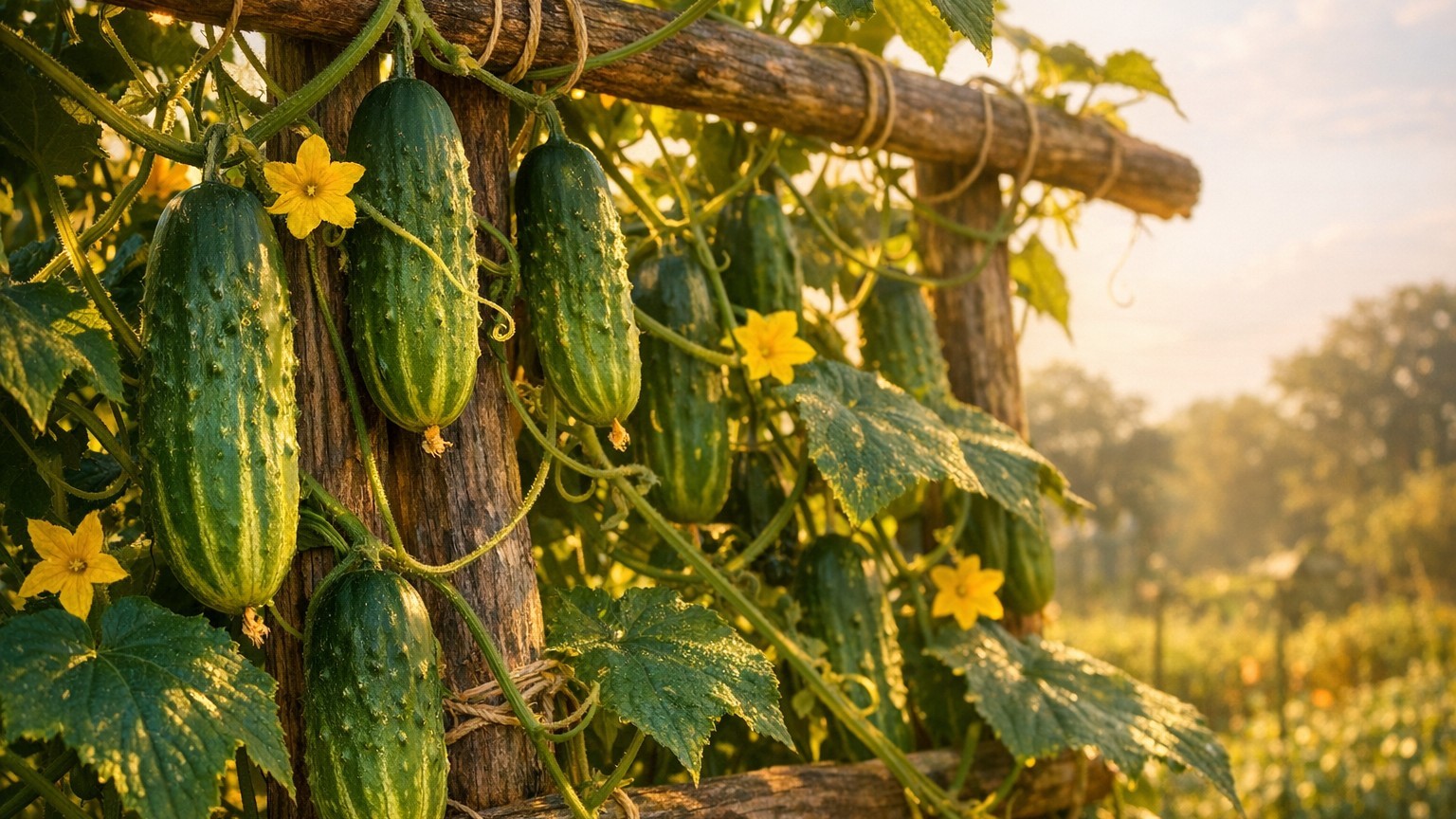

Iowa’s growing season runs long enough for nearly every cucumber type, from bush plants tucked into a raised bed to vining slicers trained up a trellis. The choice that matters most is not the variety name but the type: how it handles the state’s humid, occasionally scorching summers and its clay-heavy soils. Iowa State University Extension has the county-level list.
The short answer for Iowa
Start with the window you actually have. At the reference station used for these normals, the last spring frost falls between April 12 and April 24, and the first fall frost arrives between October 14 and October 25. That gives a frost-free stretch of roughly five to six months at the optimistic end. But Iowa State Extension’s own county-level data, drawn from 1950 to 2021, tends to run about four days later in spring and ten days earlier in fall than that airport figure. So the safer planning number is a season that closes sooner than the raw dates suggest, not later.
Inside that window, heat is moderate rather than extreme: the Des Moines reference station averages 18.4 days a year at or above 90°F. That is enough heat stress to matter, but not the kind of relentless summer that rules out slower-maturing types outright.
Given those two facts together, a mid-length season with a moderate but real heat load, the type question breaks down cleanly. Bush cucumbers suit gardeners working in containers or small raised beds, since they finish their fruiting cycle without needing the full length of the frost-free window and take up little space while doing it. Vining slicing types make good use of the extra weeks Iowa’s season offers, especially when trained vertically on a trellis or cage, which also keeps the fruit off damp soil during humid stretches. Pickling types, generally quicker to bear and picked young and often, forgive a compressed season better than a long-vining slicer does, which matters if your actual planting date slips past the optimistic frost figure.
Parthenocarpic and burpless types, which set fruit without needing pollinators, are worth considering less for the season length than for the humidity. Since they are almost always grown trained upward, they get better airflow around the leaves than a sprawling ground vine, which helps in a state where summer rain arrives in bursts rather than a steady drizzle. None of this tells you which named cultivar to buy. That answer lives at the county level, at the link in the next section, where Iowa State Extension publishes the varieties actually trialled in local conditions rather than a general type recommendation like this one.
What will not work here

The biggest risk in an Iowa cucumber patch is not cold, it is wet foliage. Summer rainfall across June, July, and August averages about 13.2 inches, but it does not fall evenly: June brings 5.26 inches, August 4.17, and July, the hottest stretch, only 3.82. That means the driest month lines up almost exactly with the highest heat load of the year, the very stretch when 90°F-plus days are most likely to cluster. A garden watered on a fixed weekly schedule through July will often be underwatering during the worst heat and overwatering during the wetter bookend months, which is a common cause of bitter fruit and blossom drop in this state.
Ground-sprawled vining types planted at tight spacing are the classic failure here. Iowa’s clay and silt-loam soils hold surface moisture longer than sand does, so a heavy June rain can keep leaves and soil damp for days rather than hours. Combine that with humid air in July and August and you get the conditions that favor downy and powdery mildew on cucumber foliage. A vine trained up a trellis dries faster after rain than one lying flat on wet clay, which is one reason vertical training matters more in Iowa than in a drier state.
Planting before the soil has actually warmed is another specific trap. The April 12 to April 24 frost window looks generous on paper, but cucumber seed germinates poorly in cold, wet clay soil, and an early planting that beats the air-frost date can still sit and rot before the ground itself is warm enough to wake it up. Waiting for the extension-adjusted, later end of that frost window is usually the safer bet in a clay-soil garden, even if the airport station’s calendar seems to allow an earlier start.
Finally, a long-maturing vining type pushed in after a late spring, or one still setting fruit as the extension-adjusted fall frost date approaches in early-to-mid October, risks running out of season before it finishes. That is a real constraint here, even with a frost-free window that looks comfortable at first glance.
What changes across Iowa
Iowa is not a single garden, and the state’s USDA hardiness zone range, 4b to 6a under the USDA Plant Hardiness Zone Map, makes that plain. That range is built on one measure only, the average annual extreme minimum winter temperature, but it tracks reasonably well with how much earlier or later a given county’s frost-free season starts and ends compared to the reference figures cited above.
A garden at the colder end of that range, generally toward the northern part of the state, should expect a shorter effective growing season than the airport-based dates suggest, with both a later usable planting date in spring and an earlier realistic finish in fall. A garden at the warmer end, more typical of the state’s southern counties, has more room on both sides of that window and can lean more comfortably on longer-season vining types without the same risk of an unfinished harvest.
Because the range spans four separate USDA zones, there is no single planting date or single “safe” cucumber type that applies evenly from one end of Iowa to the other. A recommendation tuned to the reference station used in these normals is, at best, a starting point for the middle of that range, not a fixed answer for every county.
Where to check this for your own county
Everything above is a state-level average, built from a single reference weather station and a statewide hardiness zone range. A county recommendation beats a state one every time, because it accounts for local soil, local microclimate, and years of trial plots that a statewide normal simply cannot capture.
Iowa State University Extension and Outreach, the state’s land-grant extension service, is the place to get that county-level detail. Two things are worth looking for specifically once there. First, the local planting calendar for your own county or region, which will reflect the extension’s own 1950-2021 frost data rather than the single-station airport figures, and which typically runs a few days tighter on both ends of the season than the numbers cited above. Second, the list of cucumber varieties actually trialled in Iowa conditions, organized by type, pickling, slicing, bush, vining, or burpless, which is the resource that can put an actual name to the type recommendations made here.
Types and statewide normals are what a single article covering the whole state can responsibly claim. A county extension office works from years of local trial data and knows what has actually performed in soil and weather like the reader’s own.
Checking this against your own garden
Every date in this article is a normal, an average built from decades of past weather at one station. The reader’s own garden, on the actual week planting happens, outranks all of it. Three things to watch settle the question better than any calendar.
Soil warmth by feel is the first. Push a finger a couple of inches into the planting bed. If it still feels cold and heavy rather than lightly warm, cucumber seed is likely to sit and struggle regardless of what the calendar says about frost risk having passed. This matters more in Iowa’s clay soils than in sandy ones, since clay holds cold longer into spring.
The first flush of male flowers is the second signal. Cucumber plants typically produce a run of male blossoms before the female flowers, the ones with the small swelling at the base that will become fruit, appear. Seeing male flowers first is normal and tells you the plant is healthy and on schedule; a long delay before any flowers show at all often points to stress from cold nights, drought, or too little sun rather than a problem with the variety itself.
The first true leaves, the second set to appear after the rounder seed leaves, tell you whether the plant has settled in. Slow, pale true leaves after a normal germination usually mean the soil is still too cool or too wet for that particular spot, a useful check against the state-level dates above, since a backyard microclimate, a slope, a windbreak, a paved area nearby, can run warmer or colder than the nearest weather station by more than the few days separating the airport and extension frost figures.