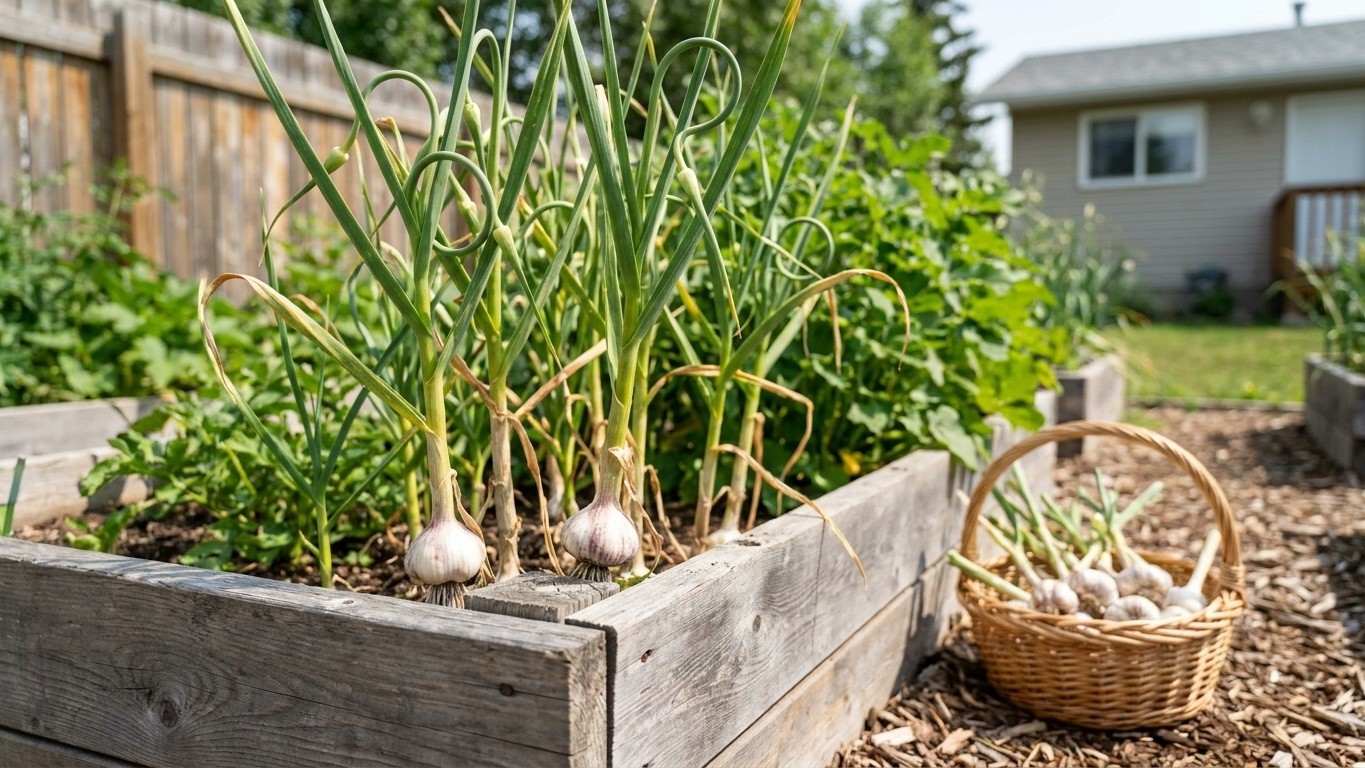

Garlic planted last fall in Iowa comes out of the ground the following summer, usually when the lower third to half of the leaves have turned brown while the top five or six stay green. There’s no fixed calendar date for this. It depends on the fall planting date, the variety, and how the growing season played out, so the leaves themselves are the signal to watch, not a page on a calendar.
When garlic is ready to lift in Iowa
The leaf count matters more than most gardeners expect. Each leaf on a garlic plant corresponds to a wrapper layer around the bulb. Pull too early, while eight or nine leaves are still green, and the bulb hasn’t finished sizing up or forming distinct cloves. Wait too long, past the point where most of the foliage has collapsed, and the wrapper layers start to split or rot in the ground, leaving cloves exposed and vulnerable to soil moisture and disease.
Reading the leaves instead of the calendar
The reliable method is a visual count: when roughly 40 to 50 percent of the leaves (starting from the bottom) have browned and the rest are still green and upright, it’s time to check a bulb. Pull one test plant, brush off the soil without washing it, and slice the bulb crosswise. If the cloves fill out the skin and are clearly separated, the rest of the bed is likely close behind. If the cloves look thin or undifferentiated, give it another week and check again.
Soil conditions play a role too. A stretch of heavy rain right before the expected harvest window can push the timeline back a few days, since wet ground makes bulbs harder to lift cleanly and raises the risk of the wrapper leaves staining or splitting. Conversely, a dry spell in early summer can accelerate leaf die-back, sometimes prematurely, so the test-dig step matters more in an uneven season than in a predictable one.
This whole cycle traces back to how the cloves were planted the previous autumn. Iowa gardeners typically get cloves in the ground before the ground freezes hard, giving roots time to establish before winter dormancy. For general planting-window guidance and other garlic-growing basics specific to the state, Iowa State University Extension is the relevant resource to consult, since county-level advice can vary across the state’s climate divisions.
Curing it, and where to hang it here
Curing is the step that determines whether a garlic harvest lasts three months in storage or eight. Freshly pulled bulbs are still around 70 to 80 percent water by weight in the outer layers, and that moisture has to leave slowly, through the neck and wrapper, before the bulb is stable enough to store. Rushing this step, or curing in the wrong spot, is one of the most common reasons a harvest that looked fine in July is soft and moldy by October.
Picking a spot that actually works
The goal is shade, airflow, and protection from rain, not direct sun and not a sealed space. Iowa summers bring both high heat and high humidity in July and August, which is exactly the combination that slows curing and invites mold on the outer skins. A garage with the door cracked, a covered porch with a fan running, or an open-sided shed all work better than a closed shed or a plastic-covered hoop structure, where trapped humidity can undo weeks of drying in a single muggy stretch.
| Location | Airflow | Temperature control | Humidity risk |
|---|---|---|---|
| Attached garage, door cracked | Good with a fan | Follows outdoor swings | Low if ventilated |
| Screened porch | Good | Follows outdoor swings | Moderate on humid days |
| Open-sided shed or barn | Very good | Follows outdoor swings | Low |
| Closed shed, no fan | Poor | Can overheat | High |
Bulbs should hang or lie in a single layer, never piled, with stems and roots left intact until the curing period ends. Two to three weeks is the usual range before the necks feel fully dry and papery, though a stretch of unusually humid weather can stretch that out. Only after the necks are dry should the roots be trimmed, the tops cut back to about an inch above the bulb, and the outer layer of dirty wrapper peeled away.
Storing it through a Iowa winter
Cured garlic wants the opposite conditions from curing garlic: cool, dry, dark, and steady, rather than warm airflow. A consistent range in the mid-50s to low-60s Fahrenheit with moderate humidity, somewhere well ventilated but out of direct light, keeps bulbs firm the longest. Iowa homes offer a few options that come close, though none is perfect year-round, which is part of why bulbs still slowly decline through the winter no matter how they’re kept.
Matching the storage spot to the season
A basement corner away from the furnace, an unheated back closet, or a mudroom that stays cool but doesn’t freeze are the most practical spots in a typical Iowa house. A working refrigerator is too cold and too humid for long-term whole-bulb storage and tends to trigger early sprouting; it’s better reserved for cloves that have already been peeled and are headed for the kitchen within a week or two. Attics and uninsulated garages swing too widely between summer heat and winter cold to hold garlic well through an entire storage season.
| Location | Typical temp range | Humidity | Best suited for |
|---|---|---|---|
| Cool basement corner | Steady, cool | Moderate | Long-term whole bulbs |
| Unheated closet or pantry | Cool, fairly steady | Low to moderate | Long-term whole bulbs |
| Mudroom or breezeway | Cool, some swing | Variable | Medium-term storage |
| Refrigerator crisper | Cold | High | Peeled cloves, short-term only |
Softneck types generally outlast hardneck types in storage, often keeping firm for six to eight months under decent conditions, while hardnecks, more common in colder growing regions for their winter hardiness, tend to soften or sprout after four to six months even when stored well. Checking the stored batch every few weeks and pulling any bulb that’s gone soft, sprouted, or moldy keeps that one bulb from spreading trouble to its neighbors in a shared basket or mesh bag.
What goes wrong here
Most garlic failures in Iowa trace back to one of three points: pulling at the wrong stage, curing in a humid or sealed space, or storing bulbs somewhere that’s either too warm or too damp. But pests documented for this territory can also affect a garlic bed before harvest ever happens, which is worth flagging separately from the storage issues above.
Pests documented for Iowa gardens
Iowa State University Extension documents several pests relevant to home garden beds in the state, though not all are specific to garlic itself, since alliums share growing space with a wide range of other vegetables and ornamentals:
- Common stalk borer
- Grasshoppers
- Iris borer (Macronoctua onusta)
- Japanese beetle (Popillia japonica)
- Lily leaf beetle
- Spotted cucumber beetle
- Squash bug
- Squash vine borer
- Striped cucumber beetle
That’s the documented list for this territory; it’s not padded out with pests that show up in other regions’ extension guides. Anyone seeing garlic damage that doesn’t match one of these should treat it as an open question rather than assume the cause, and reach out to Iowa State University Extension directly for a local diagnosis.
On timing, it’s worth remembering that the first fall frost across central Iowa typically lands between October 14 and October 25, based on NOAA’s 30-year climate normals for the Des Moines airport station covering 1991 to 2020. That date is a midpoint, not a guarantee, meaning in roughly half of all years the actual freeze comes later than that window suggests. County-level records kept by Iowa State University Extension over a longer stretch, 1950 through 2021, tend to run about ten days earlier for fall freezes than the airport figures, so anyone timing a fall garlic planting around the first freeze should treat the NOAA window as the optimistic end of the range, not the latest possible date.
Common questions
Can garlic be left in the ground past the point when the leaves die back completely?
No. Once nearly all the foliage has collapsed, the wrapper layers around the bulb start to loosen and split underground, which lets soil moisture and organisms in and shortens storage life dramatically, even if the bulb still looks fine at harvest.
Does washing the bulbs before curing speed anything up?
Washing does the opposite. It reintroduces moisture right when the goal is to let the bulb dry down slowly, and it can also nick the outer skin, opening a path for mold during the curing weeks. Brushing off loose soil by hand is the safer approach.
Is it fine to braid softneck garlic for storage instead of hanging it loose?
Braiding works well for softneck varieties once the necks have fully dried and gone limp enough to bend without cracking. Hardneck varieties, with their stiff central stalk, don’t braid the same way and are usually better trimmed and stored loose or in mesh.
Why do some bulbs sprout green shoots in storage well before spring?
That usually points to storage that’s too warm, too humid, or both, which signals to the bulb that conditions favor growth. It can also happen with hardneck varieties simply reaching the end of their shorter natural storage window sooner than softnecks.