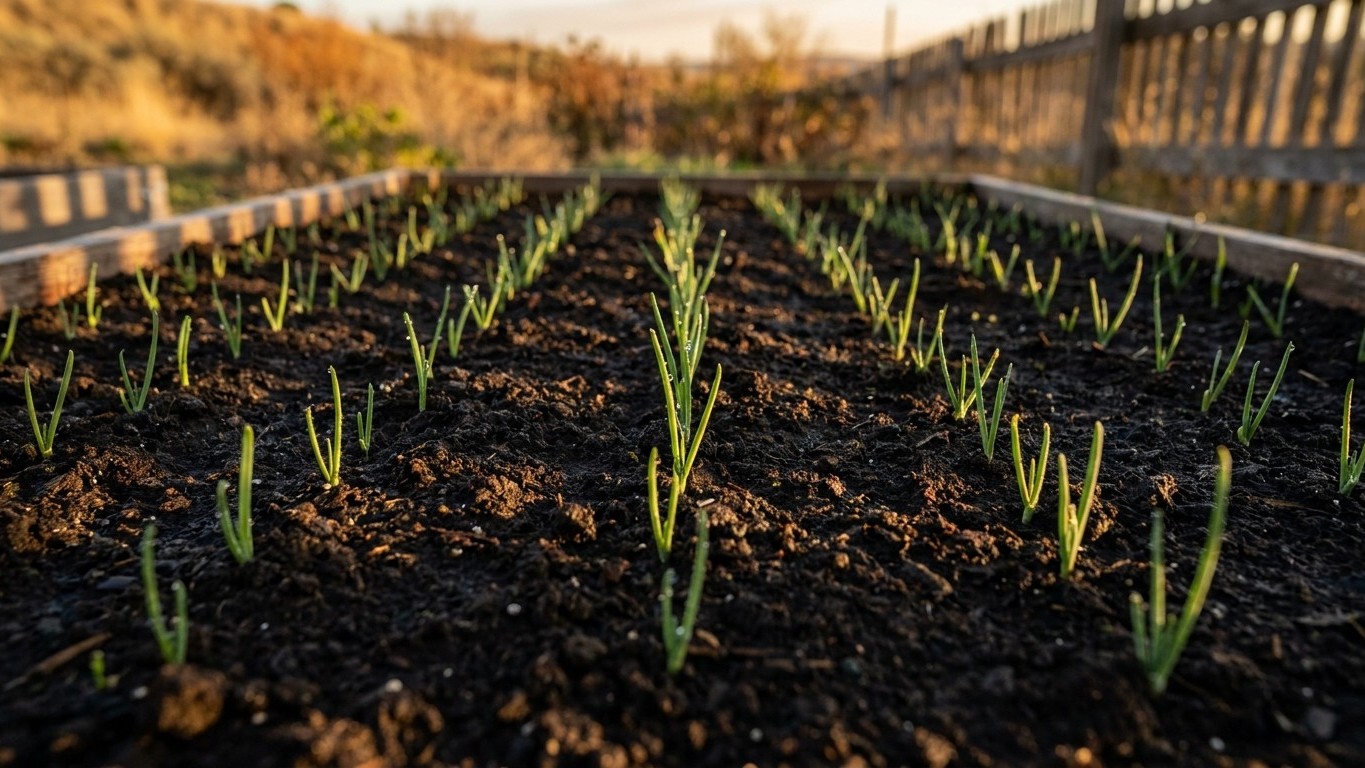

Garlic in Iowa gets hit in waves, not all at once. Rodents and soil insects go after cloves in the months after planting. Maggots and thrips feed on the green plant in spring and early summer. Two microscopic pests, a nematode and a mite, ride in on the seed itself. Which wave hurts you depends on where the bed sits, what grew there before, and how the planting date lines up with the first fall frost.
The short answer for Iowa
The calendar that organizes everything else is the first fall frost, which the NOAA NCEI 1991-2020 Climate Normals place at October 14 to October 25 (the 30-70% band of 32°F freeze probabilities). Cloves go into the ground around that window, and the pest season follows from it: voles, mice, squirrels and wireworms in the first months, maggots in spring, thrips as the bulbs swell, and the seed-borne nematode and mite whenever you bring in new garlic.
That range is a midpoint, never a safe date. In roughly one year out of two the frost arrives later than the figure, and in the other it arrives earlier. A warm October can push the real first freeze well past October 25, which leaves cloves sitting in soil that is still warm and attractive to insects. A cold one can lock the ground before roots form.
There is a second reason the date moves. The airport numbers come from a single station, and Iowa State Extension county figures (1950-2021) run about 4 days later in spring and 10 days earlier in fall than that station. For fall planting, the airport range is the optimistic end. Your own frost may arrive sooner.
Garlic follows a simple rhythm here: planted in autumn, lifted the following summer. That means the crop spends roughly nine months in the ground, with pests getting a turn in nearly every one of them. The practical question is not whether something will try to eat your garlic, but which pest is on duty during which stretch.
Working it out for your own garden
A state is not one climate, so the arithmetic is worth doing for your own plot. Start with the NOAA range, October 14 to October 25. If you live where Extension county figures apply, take the 10 days off the fall end: that moves the range to roughly October 4 to October 15. This is simple subtraction on two sources, not a published date, so treat it as a planning range.
Then adjust for the site. Elevation, a large body of water and a coastline can each move frost dates by about two weeks either way in other states. Iowa has no ocean coast and no Great Lake, so its swings come mostly from latitude, river valleys, hilltops and the heat held by town and city soil. A bed on a low spot where cold air pools can freeze days before a bed on a rise 200 yards away.
Once you have your frost range, lay the pest calendar over it. The table below follows a fall-planted crop from the weeks after planting to the summer lift.
| Stage | Pest on duty | What you see |
|---|---|---|
| Weeks after planting | Squirrels, chipmunks, wireworms | Dug-up beds, missing or hollowed cloves |
| Winter under mulch | Voles and mice | Tunnels in the mulch, gaps in spring emergence |
| Early spring | Rabbits, deer, onion maggot | Nibbled shoots, wilting plants, tunneled bases |
| Late spring to early summer | Onion thrips, garlic curl mite | Silvery streaks, twisted or yellow-streaked leaves |
| Any season | Bulb and stem nematode | Swollen, distorted leaves, soft bulbs |
The nematode sits on the last row because it does not keep a seasonal schedule. It lives in soil and inside cloves, and it shows itself whenever the plant is growing. Once a bed has it, there is no home remedy, which is why clean seed and rotation matter more than any spray.
For the planting side of the calculation, see When to Plant Garlic in Iowa: Counting Back From the First Frost. The broader overview lives in Growing Garlic in Iowa.
What changes across Iowa
North versus south
Northern Iowa, including the north-central counties and the Minnesota border tier, reaches its first hard freeze earlier than the southern counties along the Missouri line. That shortens the fall window for roots and pushes the spring thaw later. The pest consequence is a delayed spring: maggots and thrips show up later in the north than in the south, and rodents have more months under snow cover to work in the mulch.
Southern Iowa runs warmer and later in fall, so cloves planted on the same calendar date sit in warmer soil longer. Wireworms and squirrels stay active there for more of the autumn. Gardeners in the southern tier sometimes read Kansas guidance because the climate is closer. When to Plant Garlic in Kansas: Counting Back From the First Frost and Garlic Varieties That Suit Kansas Winters show how the calendar shifts further south, though Iowa winters remain colder than anything in Kansas.
River valleys, bluffs and hills
The Loess Hills along the Missouri River in western Iowa have steep, well-drained soil that dries out fast in summer. Dry, hot stretches favor thrips, which multiply when plants are stressed. The Driftless Area in the northeast is a different story: hilly, wooded and broken by cold valleys. Woodland edges mean deer, rabbits and voles close to the bed, and low pockets collect frost early.
Soil history matters as much as geography. A bed carved out of old sod, pasture or lawn tends to hold wireworms and grubs wherever it is in the state. A bed that grew onions, leeks or garlic in recent seasons can carry nematodes and maggot populations forward. Check what grew there before you plant, not only where the bed is.
The mistakes this climate punishes
Iowa winters are cold enough that most garlic mistakes come down to timing and cover. Plant too shallow and the freeze-thaw cycles of late winter heave cloves up toward the surface, where squirrels and birds find them and roots break. Plant too late, after the ground has begun to freeze, and cloves never root before winter. A clove that has not rooted is a snack, not a plant.
Planting too early is the opposite trap. A warm October lets green tops emerge before winter, and that growth is exposed to cold and to browsing. Rely on the airport frost range alone and you are likely to plant early, since Extension county figures run about 10 days earlier in fall than that station. Because the frost date is a midpoint, planting on it is a coin flip, not a guarantee.
Mulch timing is its own Iowa-specific error. A thick straw blanket laid down while the soil is still warm is an invitation to mice and voles, who nest in it and eat cloves all winter. Wait until the ground has cooled and begun to chill, then mulch. Pull it back a bit in spring so the bed warms and dries; soggy, shaded stems encourage maggots.
Three more mistakes cost crops across the state:
- Replanting your own seed from a stunted or twisted crop. Nematodes and mites travel inside cloves, so you are seeding next year’s infestation.
- Putting garlic back into a bed that held onions, leeks or garlic last season.
- Leaving finished bulbs in the soil past the summer lift, which gives maggots and rot more time to work.
Variety matters too. Hardneck types generally take Iowa winters better than softnecks, which is covered in Garlic Varieties That Suit Iowa Winters. A hardy plant that went in on time and rooted well tolerates a few thrips. A weak one does not.
Checking this against your county
Iowa is large enough that a statewide range only gets you started. Iowa State University Extension publishes county-level frost figures, and its county offices can identify a pest if you bring in a damaged plant or a sample of soil. Compare your county’s fall frost date with the NOAA range above, and expect it to come out earlier. Then count your planting window back from the Extension date rather than the airport one.
Common questions
When do pests attack garlic in Iowa?
Rodents and soil insects come first, in the weeks after planting and through winter. Maggots arrive in spring. Thrips and mites show up in late spring and early summer, as bulbs swell ahead of the summer lift. Nematodes can appear at any point in the growing season.
Is the October 14 to October 25 frost range safe for planting?
No. It is a midpoint from the NOAA NCEI 1991-2020 Climate Normals, so in about one year out of two the first frost comes later. Iowa State Extension county figures run about 10 days earlier in fall than this airport station, so your own date may fall before the range.
Can I stop nematodes once they are in the bed?
Not with anything a home gardener can reasonably apply. Prevention is the strategy: buy clean seed, rotate out of garlic and onions, and discard any seed from plants that came up twisted or swollen.
Do deer eat garlic in Iowa?
Deer and rabbits sometimes nibble the young shoots in early spring, especially near woodland edges such as those in the Driftless Area. The damage is usually to leaves rather than bulbs, so a plant that is well rooted tends to recover.