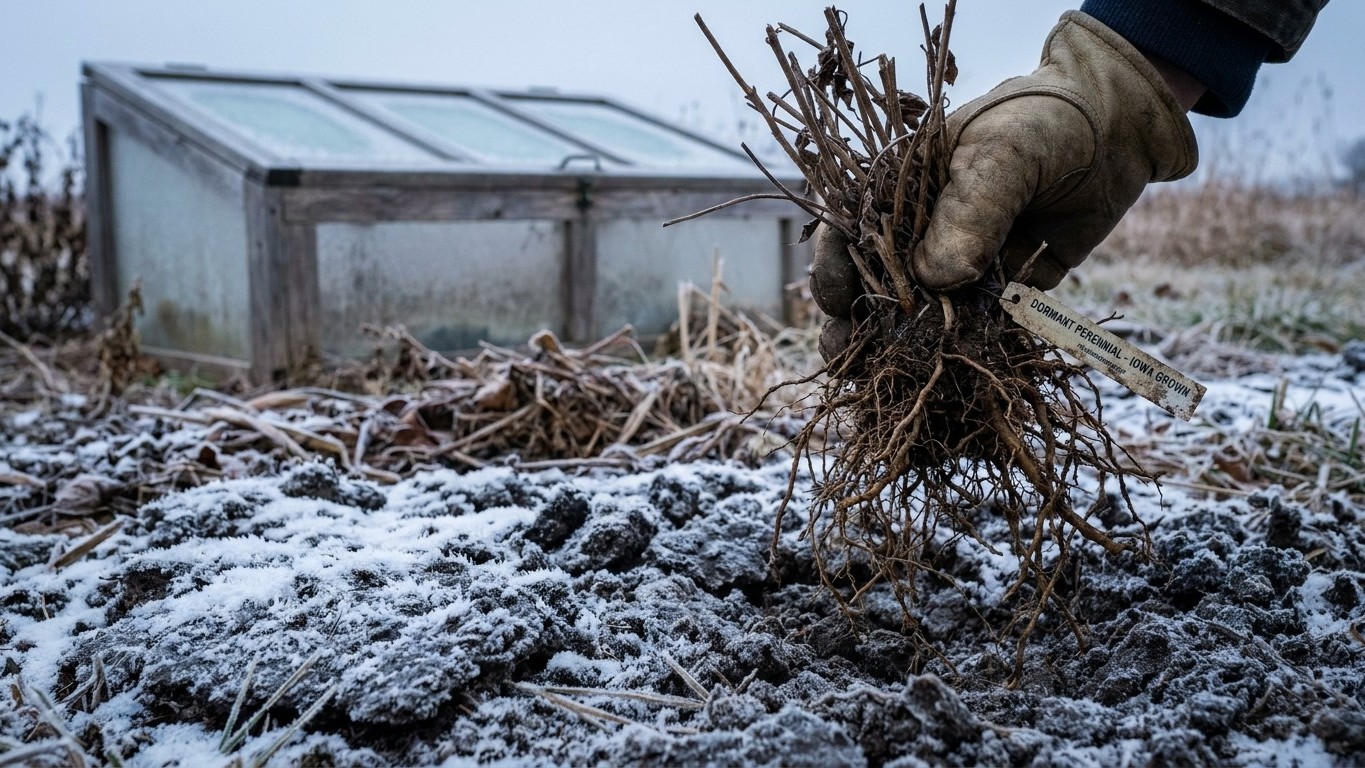

The direct answer: in December, Iowa’s ground is frozen solid across nearly the whole state, and nothing gets planted outdoors. The season closed somewhere between October 14 and October 25 depending on where you garden, and it won’t reopen until spring. What’s left this month is dormant-season work: bare-root planning, cold frame management, forcing roots indoors, and the seed-ordering and pruning jobs that keep next season on track.
What goes in the ground in December

Soil temperature decides this, not the page on the calendar. Iowa sits in USDA Hardiness Zone 4b-6a, and the first fall frost lands somewhere between October 14 and October 25 depending on the station. By December, that threshold is six to ten weeks in the past, and the ground itself has frozen to a depth that makes digging a planting hole close to impossible almost everywhere in the state.
So the honest answer is that nothing goes into open Iowa soil this month. Garlic and shallots, which do go in the ground here, need to be planted in October or early November, while the soil is still workable and before it locks up for winter. By December that window has closed. If you missed it, hold the bulbs in a cool, dry spot rather than trying to force them into frozen dirt, and plant in early spring instead, knowing the harvest will run smaller and later than a fall-planted crop.
What still counts as planting this month
Cold frames and low tunnels that already hold hardy greens, spinach, mache, claytonia, keep producing through December if they were set up before the ground froze. Starting new transplants under a frame this late rarely works, since the soil beneath the frame is usually as frozen as the open garden. Bare-root fruit trees and cane fruit belong in the ground before freeze-up too; nursery stock that arrives now should be kept dormant and cool, not planted, until the soil thaws.
Two things genuinely happen indoors this month that count as “planting.” Belgian endive and other chicory roots, dug in fall and stored cool, get forced in a dark, warm spot to produce pale, tender heads over several weeks. Rhubarb crowns, dug and chilled, do the same trick in a dark basement, pushing up sweet, blush-pink stalks weeks ahead of anything outdoors. Neither needs garden soil at all.
What to start under cover
The arithmetic runs backward from the last spring frost window, April 12 to April 24, not forward from December 1. Onions and leeks, the slowest common seed-started crops, need roughly 10 to 12 weeks indoors before transplanting. Counted back from April 12, the early edge of that window, 12 weeks lands in mid-January. Even the longest-season alliums don’t call for a seed tray in December.
Two crops are the exception. Celery and artichokes grown as annual crops need 12 to 16 weeks under lights before they go out, and 16 weeks before April 12 lands on December 21. That gives late December a legitimate, if narrow, starting date for those two specifically, particularly for gardeners in the cooler zone 4b stretches of the state who are working from the earlier end of the frost window.
Starting too early is the more common mistake at this end of the calendar. A seedling started in early December for a crop that doesn’t transplant until April spends four extra months in a pot, gets rootbound, stretches toward the light, and never fully recovers once it’s in the ground. Starting too late carries the opposite cost: a transplant that goes out small and behind schedule loses weeks it can’t get back in a growing season that, in the northern part of the state, is already short. Herbs and microgreens sidestep the whole calculation, since they’re grown and eaten indoors on their own timeline, frost windows aside.
What is ready to pick
Little to nothing comes out of an open Iowa garden this month, and that’s worth saying plainly rather than padding the list. What still feeds the table comes from three places: what’s buried under mulch, what’s under glass, and what’s on the shelf.
Kale and leeks left in the ground under a heavy blanket of straw or snow often stay harvestable well into winter, though pulling them means breaking through a crust of frozen soil at the surface. Cold frames that were planted before freeze-up keep handing over spinach, mache, and claytonia in small pickings, especially after a stretch of sun warms the frame during the day. Sprouts and microgreens grown indoors on a windowsill or under a light are the most reliable fresh green this month, ready in days rather than weeks.
Storage is the other harvest. Winter squash should get a squeeze near the stem end, and anything gone soft there gets eaten first, not left to rot the whole bin. Potatoes need a check for green patches, sprouting eyes, or shriveling, with any that show it pulled before they spread. Onions are the most unforgiving: a soft, moldy neck on one bulb is a sign to sort the whole batch, because storage rot moves fast from one onion to its neighbors.
The jobs that matter this month
December carries plenty of real work, even with the ground closed for planting. Dormant pruning of apple, pear, and cherry trees, along with raspberry and blackberry canes, is best done now while the plants are fully asleep and the branch structure is easy to see without leaves in the way. The catch: wood is brittle in deep cold, and cuts made on a bitterly cold day are more likely to crack or split than heal clean. Save pruning for a day when temperatures sit closer to freezing rather than well below it.
Seed catalogs go out this month, and ordering early matters more than it seems. Popular varieties, especially disease-resistant tomatoes and early-maturing sweet corn, routinely sell out by late winter, leaving procrastinators with whatever’s left on the list. This is also the natural point to sketch next season’s crop rotation on paper, while the beds are empty and there’s no pressure to decide on the spot.
Soil testing, compost turning, and tool care round out the list. A soil sample pulled before the ground fully froze, or one saved from fall, can still go to a lab for analysis while you wait out winter for the results. Compost piles slow down in the cold but benefit from an occasional turn to keep air moving and prevent the pile from going anaerobic. Tools cleaned of dirt, sharpened, and wiped with a light coat of oil are one less thing to deal with once spring work starts. And bed frames, trellises, and fencing are far easier to repair now, with nothing growing, than once the garden fills back in.
What not to do in December
The classic mistake this month is pruning fruit trees during an extreme cold snap. Wood that’s frozen solid is brittle, and a saw cut made at well below freezing is more likely to crack the surrounding bark than heal cleanly. Wait for a stretch closer to the freezing mark, and skip pruning entirely during a hard cold spell.
A close second is uncovering cold frames or pulling back mulch too early after a few unseasonably mild days. It feels like a break worth taking advantage of, but a warm spell in December is nearly always followed by another hard freeze, and plants or crowns exposed too soon lose the protection that got them through the cold in the first place.
Nitrogen fertilizer has no place in the garden this month. Dormant plants aren’t taking up nutrients, so applied nitrogen either leaches into groundwater with winter precipitation or, worse, triggers a flush of tender new growth that the next freeze kills outright. Skip feeding until active growth resumes in spring.
Walking on frozen or saturated garden beds compacts the soil structure in a way that takes seasons, not weeks, to undo. And letting stored crops sit unchecked in a bin is asking for one soft potato or moldy onion to spread rot to everything around it; a five-minute check every week or two catches problems before they spread.
Checking this against your own county
A statewide month is a starting point, not an instruction. Elevation, wind exposure, and the difference between Iowa’s northern and southern counties shift these windows by weeks, not days. The frost dates above come from a single weather station, and Iowa State University Extension county-level records, drawn from 1950-2021 data, run about four days later in spring and ten days earlier in fall than that station, meaning fall closes in sooner and spring opens later almost everywhere else in the state. Check the Iowa State University Extension site for county-specific guidance before planning around any date on this page.
Common questions
Can I still plant garlic in Iowa in December?
Not reliably. Garlic needs to go in before the ground freezes, typically October or early November in Iowa. By December, hold the bulbs cool and dry and plant in early spring instead, accepting a smaller, later harvest.
Is it too late to start seeds indoors in December?
For almost everything, yes. Most seed-started crops, including onions, need only 10 to 12 weeks before the last frost window of April 12 to April 24, which points to mid-January starts. Celery and artichokes, needing 16 weeks, are the rare exceptions that can start in late December.
Should I prune fruit trees in December?
Dormant pruning is appropriate this month, but avoid cutting during an extreme cold snap, when wood is brittle and cuts crack rather than heal. Pick a day closer to the freezing mark.
What can I actually harvest from an Iowa garden in December?
Outdoors, very little: kale or leeks under heavy mulch, and cold-frame greens like spinach or mache on milder days. Indoors, sprouts and microgreens are the most dependable fresh crop, alongside checking stored squash, potatoes, and onions for early signs of rot.