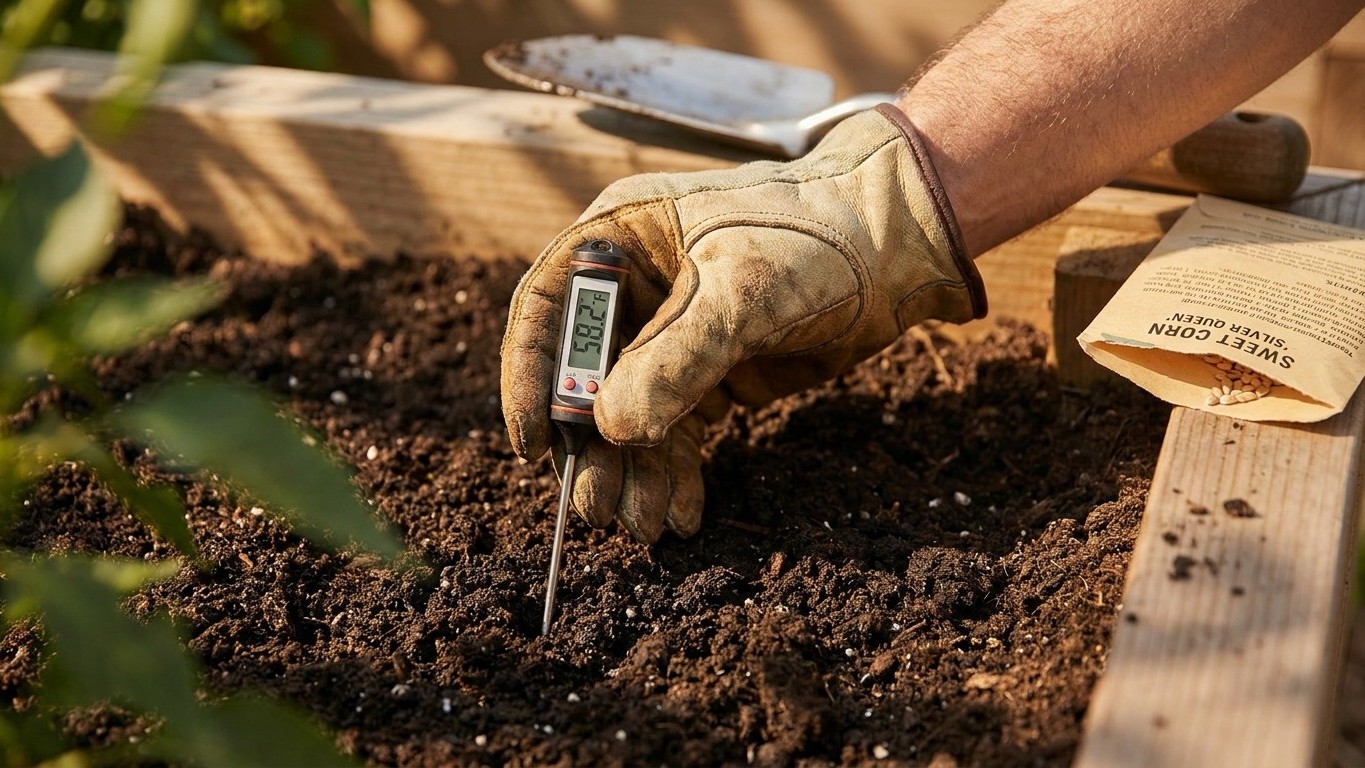

Sweet corn seed goes into Iowa ground once the soil holds steady above 60°F, and that day lands well after the last frost, typically sometime in May across most of the state. From that point, a 60- to 90-day variety has plenty of room to mature before the first fall frost arrives in mid to late October.
The short answer
Here’s the part gardeners get wrong most often: they watch the calendar for the last frost and assume that’s their green light. It isn’t. Iowa’s last spring frost falls somewhere between April 12 and April 24, depending on where you sit in the state, according to NOAA’s 1991-2020 climate normals for the Des Moines area. But sweet corn seed doesn’t care about frost. It cares about soil temperature, and soil takes its own sweet time warming up once the air stops freezing.
Soil needs to hold above 60°F before sweet corn seed will germinate reliably, and that threshold comes well after the last frost date, not on it. A patch of ground can be frost-free for two or three weeks and still sit too cold for corn, especially in a spring with lingering rain or clay-heavy soil that holds moisture and cold longer than sandy ground does. That gap is the single biggest reason early plantings fail or sit in the dirt rotting instead of sprouting.
Once that 60°F mark is reached, the countdown starts, and sweet corn needs 60 to 90 days from planting to reach harvest, per Utah State University Extension. Iowa’s first fall frost arrives between October 14 and October 25 at the reference station, though Iowa State Extension’s longer county-level record (1950-2021) runs about 4 days later in spring and 10 days earlier in fall, so the safer planning window is narrower than the airport numbers alone suggest.
Do the math and the season works. Soil warm enough by May, a crop needing at most 90 days, and a frost line that doesn’t show up until mid-October at the earliest, leaves a comfortable buffer for most of the growing window. The tighter question is what happens at the edges of that buffer, particularly for gardeners who plant later than they meant to, or who reach for a variety on the long end of the maturity scale. Summer heat matters too: Des Moines averages 18.4 days a year at 90°F or above, which drives up water demand during the weeks corn is tasseling and filling ears, a stretch when the plant is least tolerant of drying out.
Does a late variety fit here?
Not every variety on a seed rack behaves the same way once it’s in Iowa ground, and the maturity number printed on the packet is really a countdown clock, not a guarantee. Whether that clock fits inside the state’s frost-free stretch depends heavily on when the seed actually goes in, not just on what the calendar says is possible in theory.
A 60-day variety
A short-season type gives the widest safety margin available. Planted once soil holds above 60°F, likely sometime in May for most of the state, a 60-day variety reaches maturity by mid-to-late July at the earliest planting, or by August even with a planting delayed into June. Either way, it clears the finish line long before the first fall frost shows up in mid-October. This is the forgiving choice: a cool spell that slows germination by a week or two still leaves room to spare, and a late-June planting for a second succession crop still has time to mature before frost risk climbs.
A 90-day variety
The long-season type is a different calculation, and here the honest answer is that it does not fit comfortably for every Iowa gardener. Planted right at the earliest safe date in May, a 90-day variety matures around mid-August, which still clears the October frost window with room left over. The trouble starts when planting slips, and in Iowa it often does. Wet springs push planting into late May or even June for gardeners waiting on soil to dry and warm. A 90-day variety planted that late matures in late August or into September, right as the season’s margin starts shrinking against the earlier end of the fall frost range, and against the 10-days-earlier caution built into the longer county record. Add a cool, cloudy August that slows ear fill, and a late-planted 90-day crop can find itself racing frost instead of beating it comfortably. For gardeners who reliably get seed in the ground in early May, a 90-day variety works. For anyone planting after Memorial Day, it’s a genuine risk, and a shorter-season type is the safer bet.
What goes wrong here
- Soil sown too cold. Seed goes in right after the last frost, before soil has actually climbed past 60°F, and it either fails to sprout or rots in cool, wet ground. The fix is patience: check soil temperature directly rather than trusting the frost date, and wait for a stretch of consistently warmer days before planting, even if that means waiting into May.
- A variety too late for the season. A 90-day type gets planted in June, after a slow, wet spring, and it runs out of season before the ears fully mature, especially if the fall turns cool early. The remedy is matching maturity length to actual planting date: if seed goes in after mid-May, switch to a shorter-season variety rather than gambling on a long one catching up.
- Sweetness lost because two types tasseled together. This one has nothing to do with Iowa’s climate and everything to do with garden layout. Standard (su), sugary enhanced (se), and supersweet (sh2) types cross-pollinate if they tassel and shed pollen at the same time, and the result is starchy, disappointing corn on plants that looked fine all season. Utah State University Extension notes sweet corn needs to be grown in blocks of three or more rows for good pollination in the first place, which makes side-by-side plantings of different types even riskier if their timing overlaps. The fix isn’t a measured distance, since that figure isn’t published here, but staggered timing: choose varieties with maturity dates far enough apart that they tassel in different weeks, or stick to a single type per planting block if you’re growing more than one variety in the same season.
Common questions
Can I use Iowa’s last frost date to decide when to plant sweet corn?
Not directly. The last frost date, April 12 to April 24, marks when killing cold is unlikely, but soil needs to climb past 60°F before corn seed will germinate well, and that typically happens weeks after the frost date, not on it.
How do I know when my soil has actually reached 60°F?
A soil thermometer pushed a few inches into the planting area, checked over several consecutive mornings, is the only reliable way. Waiting for warm afternoon air temperatures alone can be misleading, since soil holds cold longer than air does, especially in shaded or clay-heavy ground.
Does Iowa’s summer heat affect sweet corn once it’s planted?
Yes. Des Moines averages 18.4 days a year at 90°F or higher, and that heat load increases water demand right when corn is tasseling and filling ears, a stage where drying out hurts yield and ear quality the most.
Can I plant an early and a late variety in the same garden?
Yes, as long as their tasseling windows don’t overlap. The concern isn’t how far apart they’re planted but whether su, se, or sh2 types shed pollen during the same stretch of days; stagger planting dates or choose maturity lengths far enough apart to keep their tasseling weeks separate.