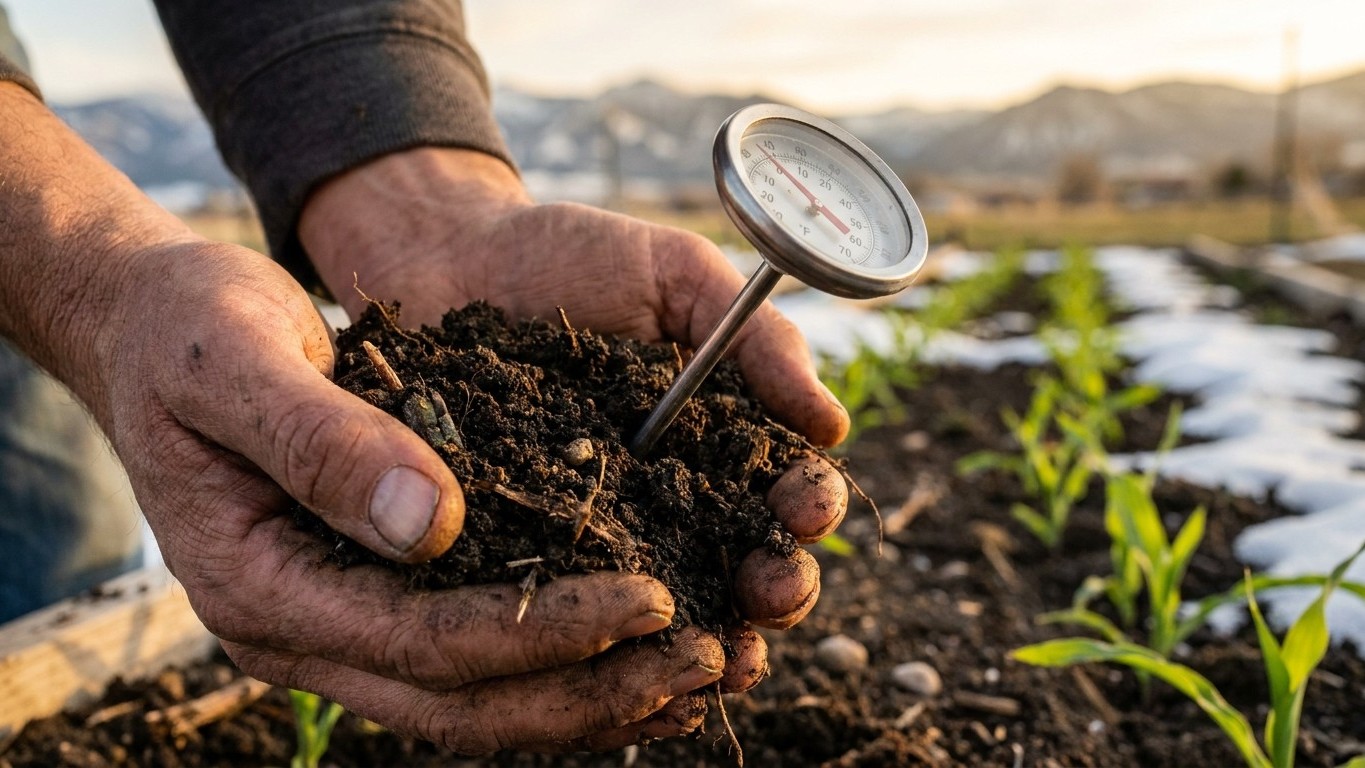

Iowa’s growing season is long enough for sweet corn to ripen almost anywhere in the state — see Will Sweet Corn Ripen in Iowa? for the full picture — but the calendar math only works if you plant by soil temperature, not by the last frost date. Soil needs to hit 60°F before seed goes in the ground, and that threshold arrives well after the frost risk has passed. Once it does, a 60- to 90-day variety has real room to mature before the first fall freeze.
The short answer
Start with the number that trips up most first-time growers: soil warms to 60°F after the last spring frost, not on the same day. NOAA’s 1991-2020 climate normals put Iowa’s last spring frost (the 30-70% probability band for a 32°F freeze) somewhere between April 12 and April 24. That’s an air temperature threshold. Soil is slower. It sits under a blanket of last year’s residue and standing moisture, and it takes real weeks of warm days to catch up to the air. So the earliest a grower should even think about dropping sweet corn seed is later than that frost window, once a soil thermometer (not a calendar) confirms 60°F — see When to Sow Sweet Corn in Iowa for the full breakdown of timing.
From there, the clock that matters is the one Utah State University Extension lays out for sweet corn everywhere: 60 to 90 days from planting to harvest, depending on variety. The question for Iowa is whether that window closes before the first fall frost arrives. NOAA’s data puts that fall freeze between October 14 and October 25 at the reference station. Subtract the spring end from the fall end and you get a frost-free season somewhere between roughly 173 and 196 days, depending on which end of each range actually shows up in a given year.
That’s a wide season by most standards, and it’s why Iowa is corn country in the first place. But two things narrow the margin. First, the soil-warming wait after frost eats into that number before a single seed goes in the ground. Second, Iowa State University Extension’s own county-level data (drawn from 1950-2021 records) runs about four days later in spring and ten days earlier in fall than the airport-station figures above. That means the NOAA numbers here are the optimistic end of the range, not the safe average. A grower planning tight should lean on the more conservative county figures, not the airport ones.
There’s also the heat load to account for. Des Moines averages 18.4 days a year at 90°F or hotter. That’s not a frost-date issue, but it does affect water demand and stress during pollination, which is the stage that decides whether ears fill out evenly. None of that changes whether the crop fits the season, but it does affect how well it performs once it’s in the ground.
Put together: yes, sweet corn ripens reliably in Iowa. The margin is comfortable for early and mid-season varieties, and workable but tighter for the latest ones, especially once you account for the slower soil warm-up and Iowa State’s more conservative county averages.
Does a late variety fit here?
A 60-day variety
This is the easy case. Once soil hits 60°F (call it several weeks past the last frost, whenever that actually falls in a given county), a 60-day variety needs to reach maturity well before the fall frost risk sets in. Even using Iowa State’s more conservative dates, that leaves a wide cushion, likely a month or more of slack between expected harvest and the first fall freeze. There’s room here for a replant if a cold snap or a soggy stretch delays the original planting date, which is exactly the kind of insurance a shorter-season variety buys a grower in a state where spring weather can swing hard from one week to the next.
A 90-day variety
This is the one worth working out on paper before committing a garden bed to it. Take the more conservative Iowa State figures: last frost running about four days later than the airport data, first fall frost about ten days earlier. In the tightest version of that scenario, the frost-free window shrinks to roughly 159 days. Subtract the wait for soil to reach 60°F, and a 90-day variety still generally has enough runway to mature before the first fall frost, particularly in central and southern Iowa where the season runs longest. It’s a narrower margin than the 60-day case, and in a cold, wet spring that delays soil warming, or in the far northern counties where fall frost tends to arrive earliest, that margin can close faster than a grower expects. The late variety fits Iowa’s season in most years and most counties. It’s not the safe bet the 60-day corn is, and it leaves little room for a delayed planting.
What goes wrong here
- Soil sown too cold. Seed goes in based on the calendar date of the last frost rather than an actual soil reading. Sweet corn seed sitting in soil below 60°F rots or germinates unevenly, which shows up later as gaps in the row and staggered maturity. The fix is simple: check soil temperature directly before planting, and treat the frost date as background information, not a planting trigger.
- A variety too late for the season. A 90-day type gets planted late (after a wet spring, or because the grower waited for a hard frost date that arrives later than expected) and runs out of season before the ears finish filling. This is the risk covered above: in a bad year, in a northern county, or after a slow soil warm-up, the math can fail to close. The remedy is choosing maturity length with the conservative Iowa State dates in mind, not the optimistic airport figures.
- Sweetness lost, and it has nothing to do with weather. Utah State University Extension is specific here: su, se, and sh2 sweet corn types lose their sweetness if they tassel at the same time nearby. This is a pollination problem, not a climate one. The source gives no isolation distance to plant by, so the only reliable fix is timing: stagger planting dates so different types don’t tassel together, or grow just one type in a given season. Planting in blocks of three or more rows (rather than one or two long rows) also helps ensure the pollination that does happen stays consistent within a single type.
Checking this against your own county
Everything above uses two reference points: an airport weather station’s climate normals and Iowa State University Extension’s own county-level averages, which run later in spring and earlier in fall than the airport data. That gap matters more in some counties than others, and it’s exactly the kind of local detail a state extension office tracks year to year.
Iowa State University Extension is the resource to check directly at extension.iastate.edu. Local extension offices track county-specific frost dates, soil temperature trends, and variety performance in a way that no single statewide average can capture. Before committing to a 90-day variety, or before setting a planting date based on the numbers here, a quick check against that county-level data is worth the five minutes it takes.
Common questions
Can sweet corn be planted before the last frost date in Iowa?
No. Even if the air temperature looks mild, soil needs to reach 60°F before seed goes in, and that threshold arrives after the last frost window, not before or during it.
How do I know when the corn is actually ripe?
Three signs together confirm it: dry, brown silks; husks that are still moist and green; and milky (not clear or doughy) juice from a punctured kernel. One sign alone isn’t a reliable test.
Is the 60-to-90-day number the same as the time from silk to harvest?
No, and mixing them up leads to picking too early or too late. The 60-to-90-day figure runs from planting and tells you whether the variety fits the season at all. A separate, shorter window (roughly 17 to 24 days from when silks first appear) tells you which week to actually pick.
Does planting in blocks instead of long rows change the maturity timeline?
No. Blocks of three or more rows are about pollination reliability within a single variety, not about speeding up or slowing down the days-to-maturity clock.