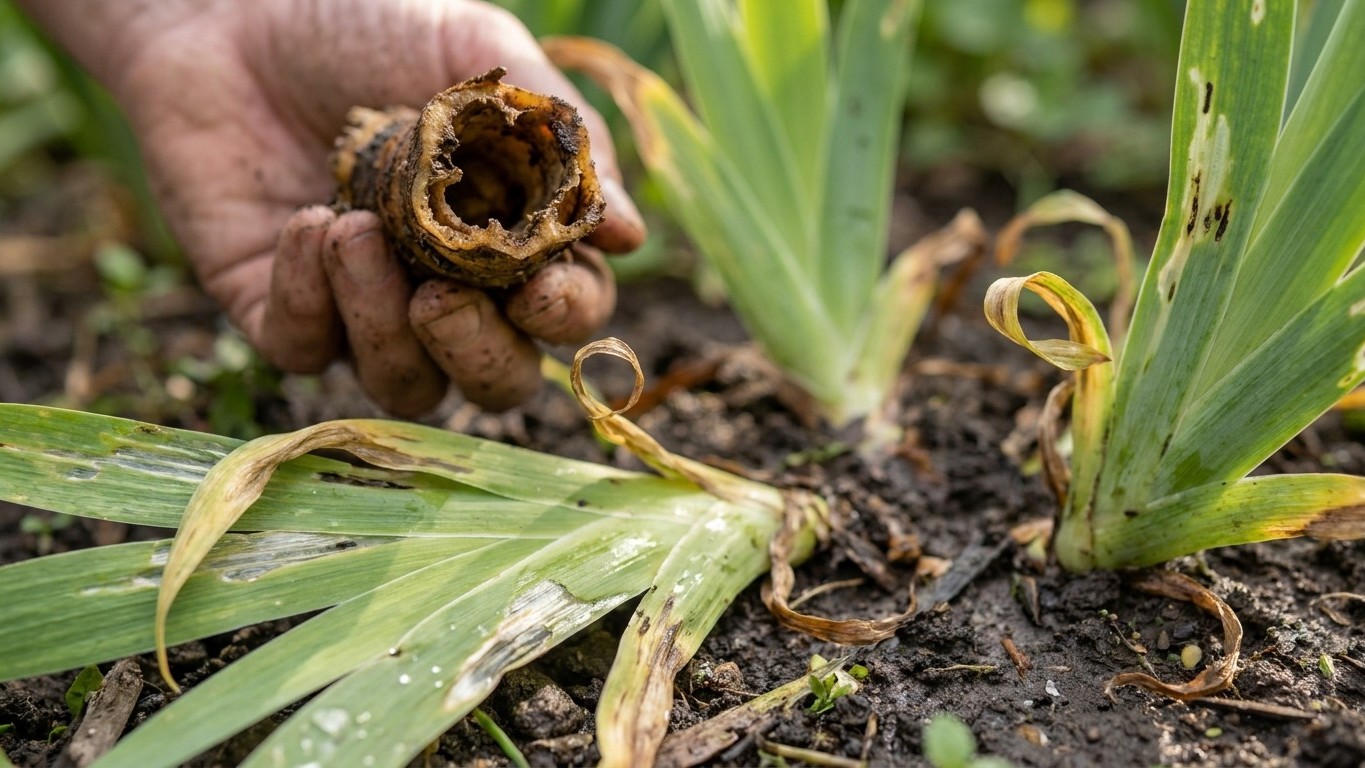

Iris borer causes visible damage in Iowa from May into June, when larvae mine iris leaves, and the real destruction hits the rhizome from July into early August, according to Iowa State University Extension. Sanitation, not sprays, stops it: removing old foliage in fall and discarding hollowed rhizomes in summer breaks the cycle before it starts over.
The weeks to watch

Iris borer damage in Iowa runs from May through June for the leaf-mining stage, with the worst of it, rhizome destruction, showing up from July into early August, per Iowa State University Extension. This insect produces one generation a year, so there’s no second wave to watch for later in the season the way there is with some garden pests. Everything happens in a single, extended push from spring through midsummer.
Spring: leaves first
The earliest sign is on the leaves, not the roots. Young larvae hatch from eggs that overwintered on old iris foliage and immediately start tunneling inside the leaf tissue, leaving narrow, water-soaked streaks that widen as the caterpillar grows and moves downward toward the base of the plant.
Midsummer: the rhizome takes the hit
By the time July arrives, the larva has usually reached the rhizome itself, where it feeds internally and hollows it out. This is the stage that actually kills or weakens the plant, and it runs into early August before the larva pupates and the cycle resets for the following year.
Reading the calendar from your last frost

Iowa’s last spring frost falls between April 12 and April 24, based on NOAA’s 1991-2020 climate normals for the state’s freeze probabilities. That’s a range, not a single date, and Iowa State University Extension’s own county-level figures tend to run about four days later than this airport-based estimate, so treat April 12-24 as the optimistic end of the window rather than a guarantee.
Iris borer doesn’t check a calendar. It responds to soil warming and new leaf growth, which means an early, warm spring pulls the whole sequence forward, while a cold, wet April pushes it back. Since the leaf-mining damage window opens in May, the arithmetic works like this:
- Start from your local last spring frost date. For most of Iowa, that’s somewhere in the April 12 to April 24 range, and can run a few days later depending on your specific county.
- Add roughly two to six weeks from that frost date before the first mined leaves typically show, since Iowa State University Extension’s documented damage window opens in May and full leaf growth needs to be underway before larvae have enough tissue to tunnel through.
That spread matters for anyone thinking about covering or inspecting iris beds. A cold spring buys a little extra time before the first leaf checks are worth doing; a warm one shortens it.
What it attacks, and what the damage looks like

The first thing most gardeners notice isn’t a bug at all. It’s a leaf that looks water-stained or streaked, almost bruised, running vertically along the blade, sometimes with a ragged, notched edge where the tissue has been chewed through. Later in the season, the base of the plant may go soft, the foliage yellows and flops, and digging around the rhizome reveals a hollow, mushy mess that often smells foul from secondary bacterial rot moving in behind the larva.
Only the larval stage does the feeding damage, which matters for timing any response. Once the caterpillar has tunneled past the leaf and into the rhizome, there’s no leaf-level fix left, since the insect is now protected inside plant tissue that a gardener can’t reach without digging up the root itself.
Iris borer is specific to iris plants. The crops and ornamentals affected are limited to:
- Bearded (German) iris
- Siberian iris
- Japanese iris
- Other rhizomatous iris species grown in home gardens
Nothing outside the iris family is a host, so a wilting tomato vine or holey squash leaf nearby is a different problem entirely.
How Iowa sits in this pest’s range

Iris borer is documented in one territory in this series so far, Iowa, so there’s no cross-state comparison to draw on yet within this collection. That doesn’t say anything about how common or severe the pest is beyond Iowa’s borders; it just means the published guidance and timing here rests entirely on Iowa State University Extension’s own observations, without a neighboring state’s data to check it against.
For a home gardener, the practical takeaway is narrower than it might sound: the season windows given here, the May-June leaf damage and the July-to-early-August rhizome destruction, are Iowa-specific figures from Iowa State University Extension, not a regional average pulled from several states. Anyone gardening near Iowa’s borders should treat these dates as the closest documented reference point available, while expecting some drift depending on local soil warming and microclimate.
What actually works against it

Iris borer control in Iowa gardens comes down to timing and sanitation more than any product. Here’s the order that gets the most value for the least effort:
- Cut back and destroy old iris foliage in fall, after it’s been killed by frost, before new growth starts in spring. Adult moths lay their eggs on dead leaf tissue in autumn, so removing that debris eliminates the eggs before they ever get a chance to hatch.
- Check new leaves closely in spring for the early watery streaks, and squeeze or hand-pick the larva inside the leaf tunnel while it’s still small. This only works while the caterpillar is in the leaf; once it tunnels down into the rhizome, hand-picking from the leaf surface no longer reaches it.
- Dig and inspect rhizomes in midsummer, ideally when dividing plants from July into early August. Discard any rhizome that’s soft, hollow, or discolored, since that removes the larva or pupa before it can complete its cycle and emerge as an egg-laying moth in fall.
- Replant only firm, healthy rhizomes with clean-cut edges. This doesn’t kill anything directly, but it keeps a damaged rhizome from reintroducing the pest into a bed that’s otherwise been cleaned out.
- Keep the bed free of dead leaf litter through the rest of the growing season, not just in fall. Fewer old leaves lying around in late summer means fewer places for the next generation of moths to lay eggs when they emerge.
None of these steps involve a spray or a treatment applied to the plant itself, and that’s not an oversight. Once the larva is inside the rhizome, there’s no topical fix; digging it out is the only option left.
Common questions
Does iris borer affect other garden plants besides iris?
No. Iris borer feeds exclusively on iris species, including bearded, Siberian, and Japanese iris. Damage on tomatoes, squash, or other vegetables comes from a different insect entirely.
Where do iris borer eggs spend the winter in Iowa?
They overwinter on old, dead iris leaves and plant debris left standing at the base of the clump, which is exactly why fall cleanup is the single most effective step a gardener can take.
Can anything be done once the larva has reached the rhizome?
Not through the leaves or soil surface. At that point the only real option is digging up the rhizome, checking it for soft or hollow sections, and discarding any that show damage before replanting the healthy pieces.