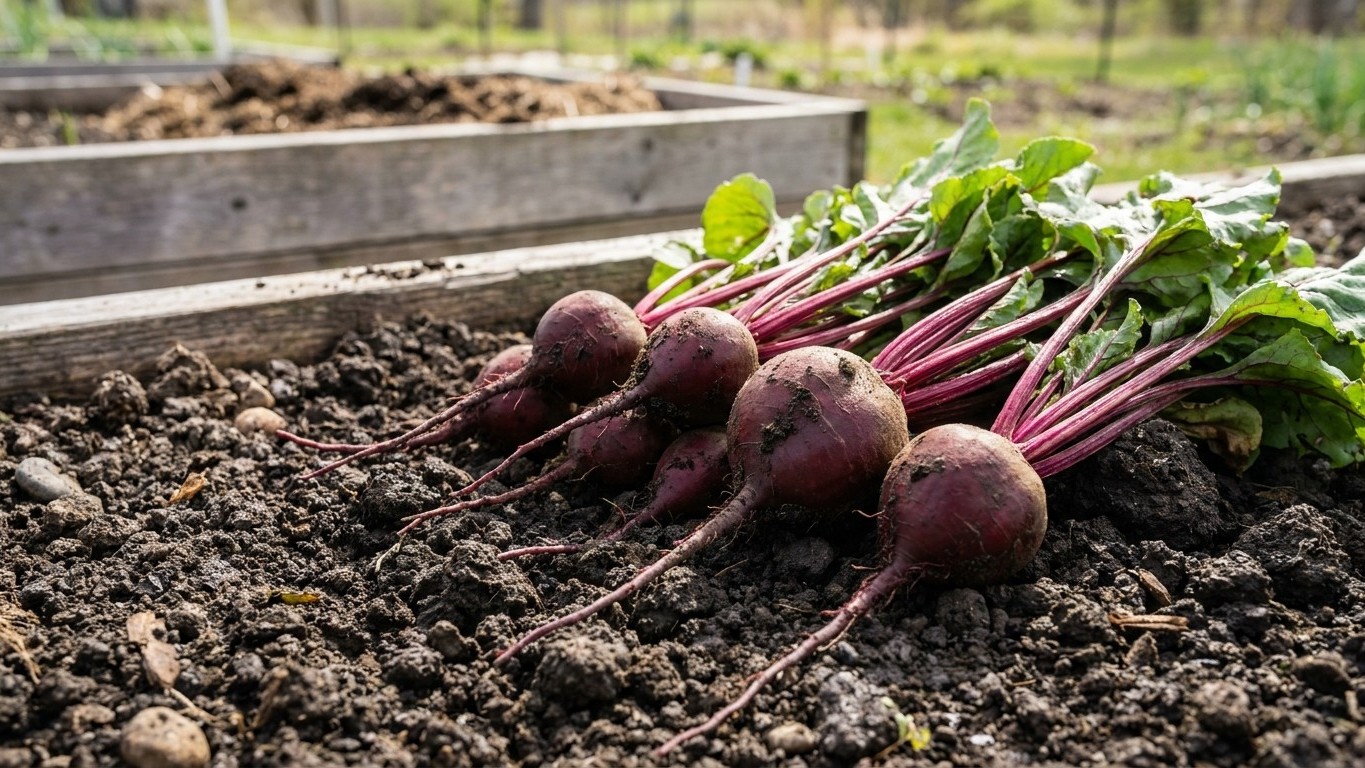

Pull beets once the roots have sized up and before the ground freezes hard. Then store the topped roots at 33 to 36 °F, not at the coldest setting you can find. The second half surprises people. USDA’s storage handbook says beets held at 32 to 34 °F develop more black spot and rot than beets held slightly warmer. A refrigerator runs colder than that range, and a heated room runs far warmer. Here is what the target looks like in a Massachusetts house.
Why colder is not better for beets
The source is USDA Agricultural Handbook 66, The Commercial Storage of Fruits, Vegetables, and Florist and Nursery Stocks, in the chapter on beets by F. Adamicki. It says that during storage at 0 to 1 °C (32 to 34 °F), more black spot and rot occur than at higher temperatures. For topped beets it recommends 1 to 2 °C, which is 33 to 36 °F, with relative humidity at 98%. The gap is one or two degrees, yet it separates a root that keeps from a root that spoils.
This contradicts the habit most gardeners build with carrots, where the rule of thumb is to get the roots as close to freezing as possible. Beets reward the opposite instinct. Pushing them to the bottom of the range is what invites the black spot and rot the handbook describes. Anyone who stores several root crops in one spot should expect to compromise, and the beets are the ones that need the slightly warmer end.
How long do bunched beets keep?
Bunched beets, the ones still wearing their leaves, can be kept for about 10 to 14 days at 0 °C (32 °F) and above 98% relative humidity, according to the same handbook. That is a ceiling under ideal conditions. A crisper drawer, a cool pantry or a shaded porch will not match those conditions, so plan for less. The leaves also keep drawing water out of the root, which is why anyone who wants beets to last past two weeks should take the tops off first.
What humidity do topped beets need?
A reading of 98% means air that is nearly saturated. Beet roots have no thick skin to hold their water, and in dry air they lose it and go rubbery. A cellar with a bare floor or a closed container with damp packing material comes closer to 98% than a heated room, where the air is dry in winter. The humidity target matters as much as the temperature target. A root at the right temperature in dry air will still shrivel.
Where in the house that actually is
A refrigerator is set colder than the 33 to 36 °F target, and a heated room is far warmer. The handbook adds that a cellar or pit should never drop below about 31 °F (-0.5 °C) or climb above 41 °F (5 °C). That gives a workable band, and a Massachusetts house has a few places that can fall inside it.
The best candidate is usually an unheated basement or cellar, especially in an older house with stone or poured-concrete walls. The coolest corner, often along a north-facing foundation wall or near a bulkhead landing, tends to hold steady temperatures. Early in fall the whole basement can still be warmer than 41 °F, so the roots may need to wait a few weeks, or sit in the coolest spot, until cold weather pulls the temperature down. An unheated attached garage swings the other way, because a hard cold snap can push it below 31 °F. An outdoor pit has the same risk, since a shallow one can freeze in a hard New England winter.
How do you check a space with a thermometer?
Buy a min-max thermometer, which records the lowest and highest readings since you last reset it. Set it at the shelf height where the crates will sit, and leave it for a week. The low should stay above 31 °F and the high below 41 °F, with the typical reading between 33 and 36 °F. The floor is usually cooler than a high shelf, so measure where the beets will actually be. Check again after the first hard cold snap, because a cellar that read fine in October can drift by January.
If you have a hygrometer, use it. Without one, the roots will tell you. Shriveling in the first couple of weeks means the air is too dry, and packing the roots in a box of damp sand or sawdust is the usual fix.
Not every root deserves a place on the shelf. The handbook is explicit that large roots keep much better than small ones because they lose water and shrivel more slowly. Keep the big roots for storage and eat the small ones first, because a small beet put away in November is the one that will be soft by midwinter. That runs against the instinct to save the tender little ones for later.
When should you pull beets in Massachusetts?
Beets are sown in place, since a beet does not get transplanted. NOAA’s NCEI climate normals put the last spring freeze at Boston’s Logan station between April 1 and April 8. Logan sits on the waterfront and is the mildest spot in the state, so inland suburbs and the Berkshires frost later in spring and earlier in fall. For a fall crop, count back from the date hard frost normally reaches your garden. Your county extension office can tell you that date.
For fresh eating, pull roots as they reach a usable size. The shoulders usually show at the soil line. For storage, let the roots size up, since large ones keep better, and pull them before the ground freezes hard. A simple test is whether a trowel still slides in easily. Pick a dry day, loosen the soil and lift each root without nicking it. Twist or cut off the leaves right away, leaving a short stub of stem, because topped roots keep longer than bunched ones.
Look each root over as you lift it. Chewed or damaged roots go to the kitchen first, since wounds are where rot starts. What Eats Beet in Massachusetts, and When covers what leaves those marks.
Two separate problems can ruin a crop before harvest, and they have different causes. Utah State University Extension says water stress in the first 6 weeks causes premature flowering, so a dry spell right after sowing can send the plant toward bolting. Later, heat above 85 °F combined with water stress makes the root woody. Early thirst and late heat are different failures, and fixing one does not fix the other. A bolted plant has already put its energy into a flower stalk, and a woody root will not soften by waiting. Timing a sowing so the roots swell during cooler weather helps with the second.
Soil sets the starting point. The state soil, the Paxton series, is well drained and sandy, with 61 percent sand, 7 percent clay and 32 percent silt. Organic matter is about 5.5 percent and the surface pH about 5.5, which is slightly acid. Those are the representative surface values USDA records for that series, and they line up with what beets want: deep, sandy, well-drained soil rich in organic matter. Utah State University Extension adds that compost should go on at no more than 1 inch per 100 sq ft. Still, your own garden may be nothing like Paxton. River bottoms, hill country and any ground a builder has scraped or filled differ a lot, so a soil test gives your real numbers. Beet Soil in Massachusetts: What the Root Will Meet goes into it, and Growing Beets in Massachusetts covers the season from sowing on.
Common questions
How many days until beets are ready to pull?
Count the days on the packet from seeding. Beets are sown directly in the ground, so there is no transplant date to count from. Cool weather tends to stretch the count, and the roots are ready when they reach the size you want.
Can beets stay in the ground over winter?
Frozen ground is far colder than the 31 °F floor the handbook gives for cellars and pits. Pull storage beets before the ground freezes hard, top them, and move them to a cool, humid spot. Roots left in frozen soil are at risk, and the leaves are no help once the weather turns.
Is the refrigerator a good place to store beets?
It works for a short stay. Take off the tops and keep the roots in a bag or container that holds humidity. For long storage a refrigerator runs colder than the 33 to 36 °F range, and the handbook links the 32 to 34 °F range to more black spot and rot. An unheated cellar that holds the right temperature does better.
Which beets should I store and which should I eat first?
Store the large, firm, undamaged roots, because they lose water and shrivel more slowly. Eat the small ones first, along with anything nicked, cracked or chewed. Bunched beets with their leaves on keep about 10 to 14 days at best, so topping them is the first step for anything you plan to keep.