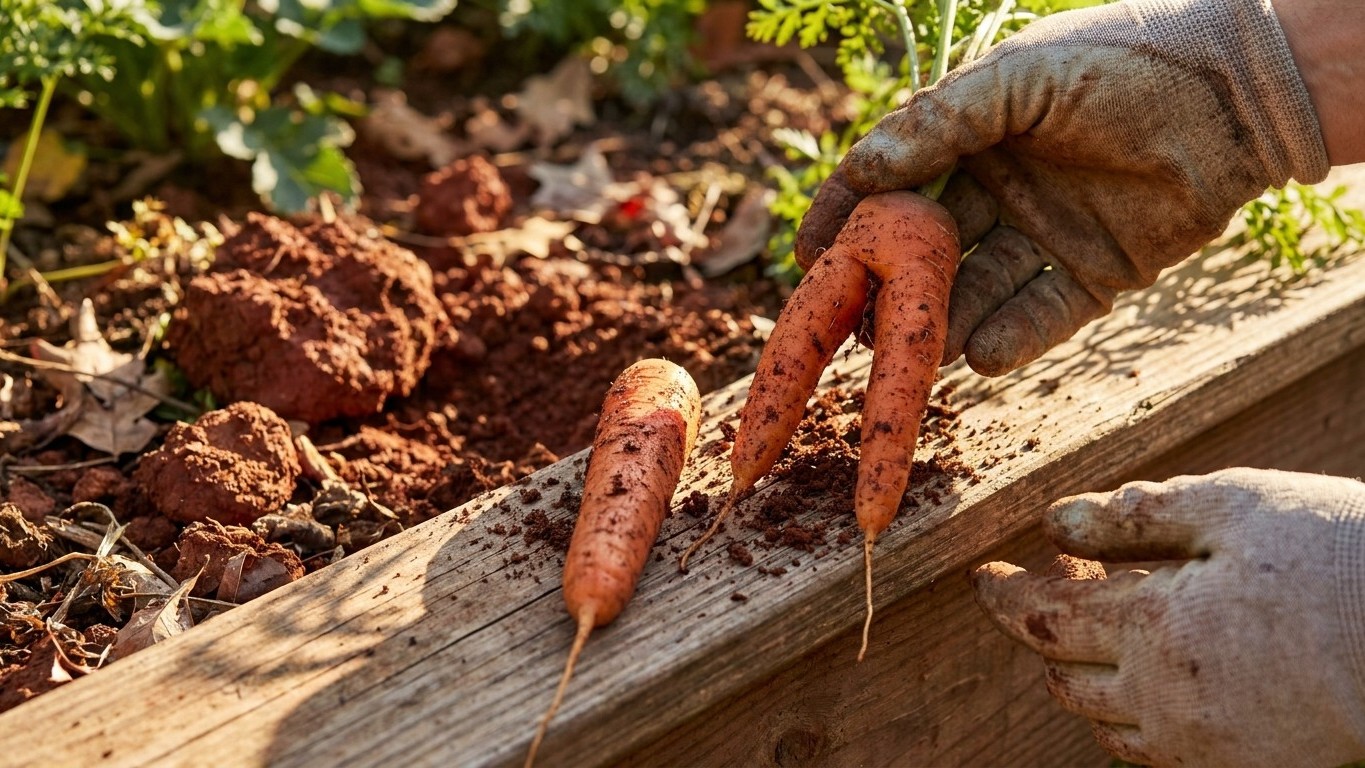

A carrot growing in Kansas’s own state soil, the Harney series, has decent odds of running straight rather than forking, since that soil carries no rock and drains well. The catch is its silt-heavy texture, which can crust and compact without help. Compost and a loosened bed handle most of the risk; a truly heavy or shallow spot may still call for a raised bed. Your own dirt, not the map, has the final say.
The short answer
Kansas’s official soil is the Harney series, named the state soil by Kansas law. It’s a Mollisol, the deep, dark prairie soil type that built the Corn Belt, and USDA’s Soil Survey Geographic Database lists its surface horizon as roughly 9 percent sand, 24 percent clay and 67 percent silt, a texture that falls in the loam-to-silt range. Surface pH runs near neutral, about 6.7, organic matter sits around 2.0 percent, and the series is classed well drained.
None of those figures describe a soil that will stop a carrot cold. Utah State University Extension is direct about what causes forking: heavy or rocky ground resists a taproot as it pushes down, bending it or splitting the tip, and the fix is compost worked in deep along with double digging. Harney carries no meaningful rock fraction and drains well, so a carrot growing in true Harney ground starts with a real advantage over one growing in stony or waterlogged dirt. The risk sits in that 67 percent silt number instead. Silt-dominant ground doesn’t feel gritty like sand or sticky like clay, but it packs down under foot traffic and can crust into a hard skin after a heavy rain, and a crust or compacted layer does to a young root exactly what a rock does: it forces the tip sideways or splits it in two.
The practical answer is that Harney ground doesn’t need a raised bed on drainage grounds alone, but it benefits from the same prep Utah State recommends for heavier soil anyway: compost dug in ahead of seeding, and the bed loosened at least a foot down before any seed goes in the ground. That combination breaks up whatever crust-prone layer sits near the surface and gives the root a clear column to grow through, which matters more in practice than the clay percentage by itself.
None of this describes any one garden, and it shouldn’t be read as one. A state spans hundreds of mapped soil series, and Harney is simply the one chosen to represent Kansas on paper, not a sample pulled from a particular backyard. River bottoms tend to run sandier, hill country tends to run shallower and stonier, and any lot a builder has graded, filled or stripped of topsoil can bear no resemblance to the Harney profile at all. Take these figures as the state’s general lean toward fine, silty ground that packs down rather than a diagnosis of what sits under your own carrots.
The test that settles it in your own garden
The Harney numbers describe the soil chosen to represent Kansas, not the dirt in your particular bed. The only way to know whether your ground will fork a carrot is to look at it directly, and that takes about twenty minutes with a shovel and no special equipment.
- Dig a hole at least a foot deep where the carrots will grow. A spade or post-hole digger works fine; the point is seeing the soil in profile rather than just the top few inches, since a carrot needs that full depth of loose dirt to run straight down.
- Check for depth and stones. Note where workable soil ends and where a hardpan, dense clay layer, or rock begins. Pull out anything larger than a marble along that first foot of depth, since each one is a potential point where a root will fork or bend.
- Feel the texture with a moist handful, squeezed in your palm. Sand falls apart when you open your hand, clay holds together in a slick ribbon, and loam or silt holds loosely and crumbles when poked. Soil that stays balled up and greasy is the heavy kind Utah State University Extension warns forks carrots, and it’s the kind that needs compost and double digging before it’s fit for a root crop.
- Watch how water drains. Fill the hole and time how long it takes to disappear. Water gone within a few hours points to decent drainage; water still sitting there the next day points to a compacted or clay-heavy layer that needs breaking up, or a bed built above it instead.
Run the test in more than one spot if the yard has any slope, a history of construction work, or a mix of shaded and sunny ground, because soil can shift completely across just a few feet. A bed near a foundation, for one common example, often sits on fill dirt trucked in during construction, which has nothing to do with the mapped soil series for the county it sits in. The shovel test costs nothing, takes less time than a trip to buy a soil kit, and answers the forking question far better than any state-level figure ever could.
What goes wrong here
- Forking in heavy or compacted ground. Wherever a bed runs closer to clay than the Harney average, or wherever foot traffic and old construction have packed the subsoil down, a taproot meets resistance and splits or bends around it. The remedy Utah State University Extension gives is direct: work in a generous layer of compost and double dig the bed, loosening soil well past the depth the root will reach, before any seed goes into the ground.
- Poor germination during a hot, dry stretch. Carrot seed is slow to sprout under good conditions, and a crusted or dried-out surface layer, the same crust a silt-heavy soil like Harney can form after a hard rain, keeps seedlings from pushing through at all. Keeping the top inch of soil steadily damp until seedlings appear, with light, frequent watering rather than one heavy soak, keeps that crust from forming in the first place.
- Splitting from uneven watering. A carrot that grows through a dry spell and then gets hit with a sudden heavy watering or rain can swell fast enough to crack open along its length. This isn’t a texture problem so much as a scheduling one, and it shows up on both loose and heavy ground alike. A steady, even watering routine rather than feast-or-famine soaking fixes it, and a layer of mulch helps hold that moisture level steady between waterings.
- Shallow beds that stop the root short. Where workable soil gives way to a hardpan or dense clay layer within the first foot, as the shovel test above can reveal, a carrot root simply runs out of room and forks or stalls rather than growing straight down. A raised bed filled with loosened, compost-amended soil sidesteps that layer entirely instead of fighting it season after season.
Common questions
Does Harney soil need amending before planting carrots?
Working compost into the bed ahead of seeding helps even where the underlying soil matches the Harney series closely. The series carries organic matter around 2.0 percent at the surface, which is workable but not rich, and added compost both loosens the silt-heavy texture and feeds the root as it develops. Skipping this step raises the odds of the crusting and compaction that cause forking.
Will a raised bed fix forking for good?
A raised bed filled with loose, compost-amended soil removes the hardpan or clay-layer problem entirely, since the root never has to push through the ground underneath. It won’t help with the other causes of a poor crop, though. Uneven watering still splits carrots in a raised bed just as it does in the ground, and hot, dry stretches still slow germination unless the surface is kept damp.
How long after seeding do carrots mature?
Carrots are sown directly where they’ll grow; there’s no transplanting step and no transplant date to count from. Maturity generally runs somewhere between 70 and 100 days counted from the day the seed goes into the ground, though the exact number depends on the variety planted and the conditions that season.
What does a soil test tell me that this page doesn’t?
This page describes the soil chosen to represent Kansas on paper, not a measurement of any particular yard. A soil test, or the shovel test described above, tells you the depth of workable ground, the presence of stones or a hardpan, and how quickly water drains on your own property, which is the information that actually predicts whether your carrots will fork.