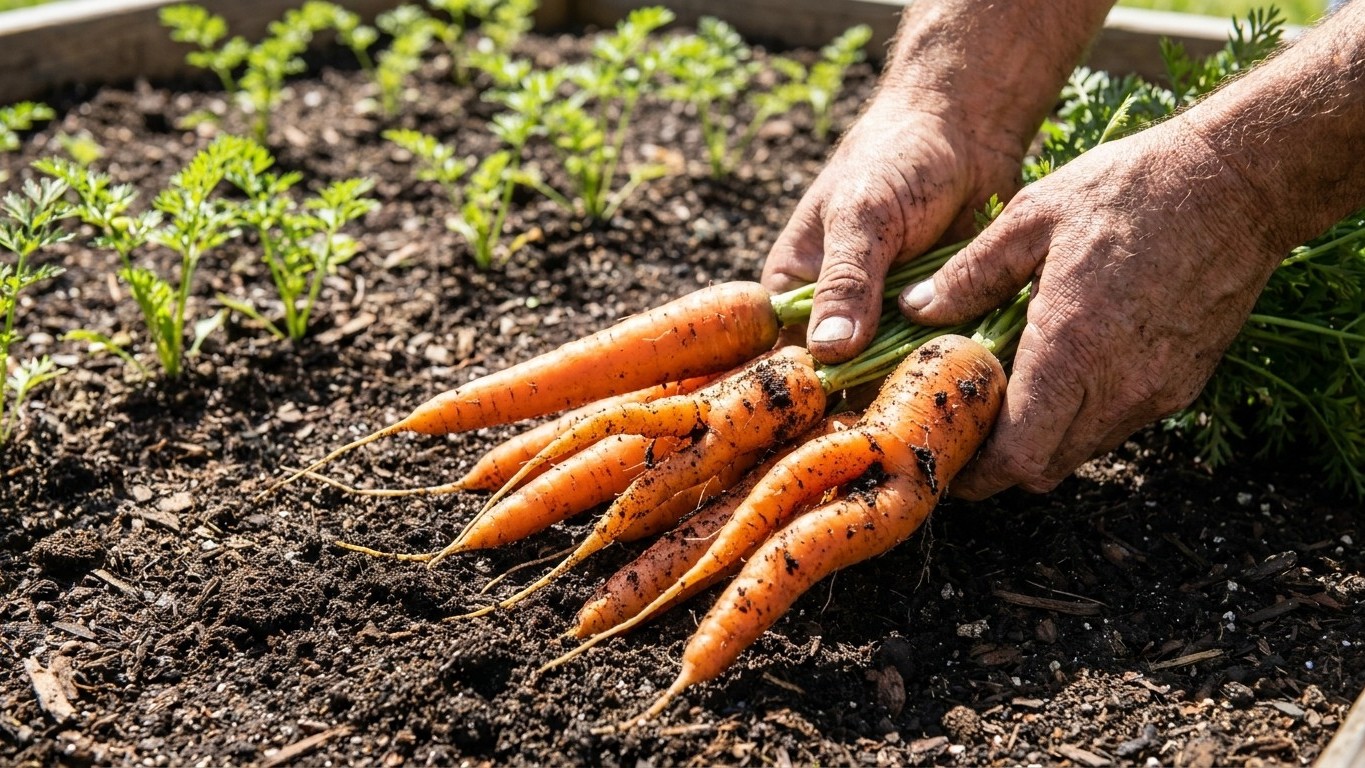

Kansas gardeners get one clear answer from Extension guidance: carrots go into the ground as seed, directly where they’ll grow, timed backward from the local last-frost date rather than forward from a calendar month. There’s no seedling to harden off and no transplant shock to dodge, because a carrot root never leaves the spot where it first cracks the soil. But timing the seed is only half the job here. The other half is a state soil that runs heavier and siltier than the sandy loam a carrot actually wants.
The short answer
Kansas has an official state soil, and it tells you a lot about what’s likely waiting under your boots. The Harney series, named by Kansas law as the state soil, is a Mollisol, the deep, dark, organically rich prairie soil that built the Corn Belt. Its surface layer runs close to neutral, with a pH around 6.7. Texture-wise it’s a silt loam: about 9 percent sand, 24 percent clay, and a full 67 percent silt, with organic matter around 2.0 percent. It’s classified as well drained.
That drainage rating is genuinely good news. Standing water rots a carrot faster than almost anything else. But drainage is only one piece of what a carrot root needs. Utah State University Extension is direct on the point: carrots want deep, sandy, well-drained soil rich in organic matter, and heavy or rocky ground makes the root fork instead of running straight. Harney soil, with two-thirds silt and roughly a quarter clay, is not sandy. It’s the kind of ground that can compact into a dense, tight-knit layer, especially once foot traffic or tillage packs it down, and that density is exactly what pushes a taproot sideways or splits it into forks. The organic matter figure, around 2.0 percent, also sits on the lean side of what a carrot bed benefits from.
None of that means carrots are off the table in Kansas ground. It means the fix Utah State University Extension recommends for heavy soil, generous compost worked in plus double digging to loosen the profile well below where the root will travel, is worth doing here rather than skipping. A raised bed filled with a loose, compost-rich mix sidesteps the problem entirely if double digging a full row isn’t practical.
Treat all of this as a starting point, not a verdict on your own dirt. Kansas spans hundreds of mapped soil series, and Harney represents the state in aggregate, not the particular quarter-acre behind your house. Land near a river bottom, ground in the hill country, or any lot a builder has scraped, filled, or graded can differ from this benchmark completely. The next section is how you find out what you’re actually working with.
The test that settles it in your own garden
A state soil profile can’t tell you what’s eighteen inches under your own tomato bed. The only way to know is to look, and the process takes less time than a trip to the garden center.
- Dig a test hole. Use a shovel or a soil probe and go straight down in the spot you’re planning to sow. You’re not looking for a number here, you’re looking for what the ground actually does as you go deeper.
- Check the depth and the stones. Note where the loose, workable soil ends and where you hit a denser layer, a clay pan, or rock and gravel. A carrot root needs a clear, unobstructed column to grow into; anything that stops your shovel will stop the root the same way.
- Feel the texture. Take a handful of moist soil from the hole and rub it between your fingers. Gritty means sand. A silky, almost floury feel means silt. Sticky and moldable, holding a ribbon shape when you squeeze it, means clay. Most Kansas gardens will land somewhere between silty and clay-heavy, matching the Harney pattern, but sandy river-bottom ground and heavier clay pockets both turn up across the state.
- Watch how water drains. Fill the hole with water and see how long it takes to disappear, or simply watch a low spot in your yard after a hard rain. Water that lingers for hours points to compaction or a clay layer holding it up. Water that vanishes almost immediately suggests a sandier, faster-draining profile that will dry out quicker between waterings.
Put those four observations together and you’ll know more about your carrot bed than any state average could tell you. Heavy, slow-draining ground with stones close to the surface calls for the raised bed or double-dig approach described above. Loose, well-drained ground with few obstructions means you can likely sow straight into a row with just a normal compost topdressing.
What goes wrong here
Most carrot failures in Kansas gardens trace back to the same handful of causes, and each one has a straightforward fix once you know what’s happening underground or in the air above it.
- Forking in heavy ground. A silty, clay-leaning soil like the Harney series can pack tight enough to split a taproot into two or three legs the moment it meets resistance. The remedy is the one Utah State University Extension gives for heavy soil generally: work in plenty of compost and double dig the row, breaking up the profile well past the depth the root will reach, or build a raised bed filled with loose, amended mix.
- Poor germination in a hot spell. Carrot seed is slow to sprout under the best conditions, and a dry, high-silt surface can crust over hard as it bakes in a Kansas summer heat wave, sealing in the tiny seedlings before they ever break through. Keep the seedbed consistently damp until germination, and a light mulch or thin covering over the row helps hold that moisture without smothering the sprouts.
- Splitting from uneven watering. A dry stretch followed by a heavy soaking, whether from rain or an inconsistent hose schedule, makes the root swell unevenly and crack along its length. A steady watering routine, backed by mulch to slow evaporation between waterings, keeps the moisture level from swinging so hard.
- Surface crusting that traps seedlings. That same high silt content that defines Harney soil can form a hard cap on the surface as it dries after watering or rain, which is tough for a fine carrot seedling to push through. Covering the seed row lightly, or keeping the top inch of soil consistently moist through germination, keeps the crust from forming in the first place.
Common questions
Can I sow carrots directly in Harney soil without amending it?
You can, but expect more forking than you’d get in a looser bed. With 24 percent clay and 67 percent silt, this soil packs tighter than the sandy loam carrots prefer, so working in compost before you sow, or building a raised bed, gives straighter roots.
What if my garden’s soil test comes back different from the state soil described here?
That’s expected, and it’s actually the more useful number. Harney represents Kansas broadly, but river bottoms, hillsides, and disturbed lots can all differ from it. Your own dig-and-feel test, or a lab soil test, tells you what’s actually under your row.
How long until carrots planted here are ready to harvest?
Carrots typically need 70 to 100 days counted from the day you sow the seed, not from a transplant date, since carrots are sown in place and never moved as seedlings.
Does the near-neutral pH of Kansas’s state soil mean my garden is the same?
No. The pH around 6.7 is the representative surface value USDA records for the Harney series specifically, not a measurement of any individual garden bed. A soil test is the only way to know your own bed’s pH.