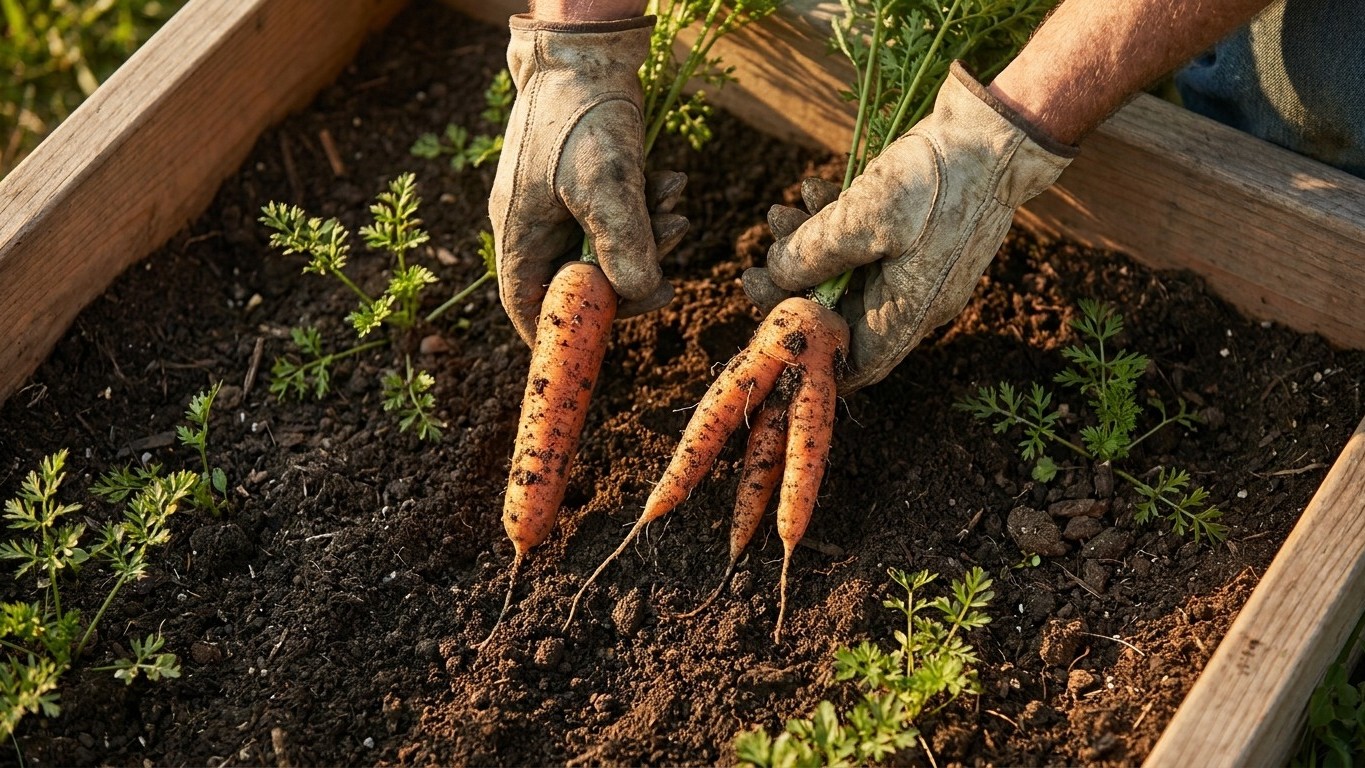

Kansas’s official soil, the Harney series, is a deep silty loam that drains well and sits near neutral pH. That’s a decent starting point for carrots, but “decent” isn’t “guaranteed straight roots.” Whether your carrots fork or grow clean comes down to what’s actually in your raised bed or garden row, not what the state textbook says about Kansas dirt in general.
The short answer
The Harney series, named Kansas’s state soil, runs 9 percent sand, 24 percent clay and 67 percent silt in its surface layer, with organic matter around 2.0 percent and a pH near 6.7. It’s classified well drained. That combination puts it closer to the sweet spot carrots want than a heavy clay soil would: silt loam holds moisture without staying waterlogged, and a near-neutral pH doesn’t force you into major amendments before you even plant a seed.
But 24 percent clay isn’t nothing. Utah State University Extension is blunt about what carrots need: deep, sandy, well-drained ground loaded with organic matter. Heavy or rocky soil is what makes a carrot root fork, splitting into two or three legs instead of growing down as one clean taproot. So Will Carrots Fork in Kansas Soil? Harney soil sits in a middle zone, more silt than clay, well drained on paper, but not the loose sandy loam that lets a carrot slide straight down without resistance.
If your garden bed tests out close to this profile, compost worked into the top foot and a season of double digging will likely be enough insurance. Double digging means loosening the soil a full two spade-depths down, not just turning over the top few inches, so any compacted layer underneath gets broken up before the taproot ever meets it. Mix in a few inches of finished compost as you go, and you’re giving the root loose ground to grow through instead of a wall of packed silt and clay to shove around. Getting the timing right matters just as much as the soil prep, so check When to Sow Carrots in Kansas before you put seed in the ground.
Where a garden runs heavier than the state average (more clay, a compacted subsoil, a history of construction fill), double digging alone won’t fix it. That’s when a raised bed makes more sense than fighting the native ground. Twelve to eighteen inches of a loose, amended mix in a raised frame sidesteps the whole forking problem, because the root never has to push through the dense stuff at all.
None of this is a diagnosis for your yard, though. Kansas spans hundreds of mapped soil series, from sandy river-bottom ground along the Arkansas and Kansas rivers to heavier clay in parts of the eastern hills, and whatever a builder scraped, filled or graded before your house went up. The Harney figures describe the state’s representative soil, not the eight square feet where you’re planning to sow carrots this spring. Treat it as the regional tendency, then go check your own dirt.
The test that settles it in your own garden
State-level numbers tell you what Kansas soil tends to do. They don’t tell you what’s under your own carrot bed. A quick, low-effort check answers that in an afternoon.
- Dig a hole about a foot deep where you plan to sow. Look at what comes up: is it the same color and texture all the way down, or does it change abruptly at a few inches, hinting at a hardpan or a fill layer left over from construction?
- Check for rocks and depth. Carrots need open ground to grow down into without hitting an obstruction. Stones, buried roots or a hard clay layer partway down will deflect a taproot and cause forking just as surely as heavy clay will.
- Feel the texture. Grab a handful of moist soil and squeeze it into a ball. If it holds a sticky, ribbon-like shape, you’re leaning clay. If it falls apart and feels gritty, you’re leaning sand. If it holds together loosely but crumbles with a little pressure, that’s the loam carrots prefer.
- Watch the drainage. After a rain, or after you water the spot, look at how the surface behaves. Water that sits and pools for a long stretch signals poor drainage; ground that soaks in quickly and doesn’t puddle at all points toward the well-drained profile carrots want.
- Compare it to the Harney numbers above. Heavier and stickier than that silt loam profile means plan on compost, double digging or a raised bed before you sow. Looser and sandier means you’re already close to ideal.
When to sow here
Carrot seed doesn’t wait for warm weather the way tomato transplants do. It goes into the ground while the soil is still cool, and the whole schedule is built backward from your local last spring frost date, not from any transplant date, because carrots are sown directly where they’ll grow.
- Start from the frost window. NOAA NCEI’s 1991-2020 climate normals, drawn from the reference weather station, put the last spring frost (32 F) somewhere between April 4 and April 18. That’s a station-level figure, not a promise for every county, and gardens outside town, especially at higher elevation, often see their last frost run a week or two later.
- Count back two to three weeks. Carrots go in the ground before that last frost date, not after it. Counting three weeks back from the earliest date in the window (April 4) lands around mid-March. Counting two weeks back from the latest date (April 18) lands around the first days of April. That stretch, roughly mid-March into early April, is the sowing window this frost data supports.
- Check the soil temperature before you trust the calendar. Soil needs to be at least 40 F for carrot seed to have any real shot at germinating. A cold, wet spring can push that date later than the frost math alone suggests, so a simple soil thermometer beats guessing.
- Aim for the germination sweet spot. Carrot seed germinates best between 55 and 65 F. Sowing at the early end of the window, into cool but workable soil, often means a slower, more staggered germination than sowing once the soil has warmed closer to that 55 to 65 F range.
The takeaway isn’t a single date on a calendar. It’s a window, built off a reference station’s averages, that puts you close, with soil temperature as the tiebreaker when the season runs early or late.
What goes wrong here
- Forking in heavy ground. Clay-heavy soil, or any compacted layer a few inches down, splits the taproot as it tries to push past resistance. The fix is the same one covered above: work compost deep into the bed, double dig to break up compaction, or switch to a raised bed with a loose, amended mix.
- Poor germination during a hot spell. Carrot seed struggles once soil temperatures climb well past that 55 to 65 F germination range. A stretch of unseasonably warm weather right after sowing can leave patchy, thin rows. Shading the bed lightly and keeping the surface consistently moist during germination helps offset a hot snap.
- Splitting from uneven watering. Roots that get a long dry stretch followed by a heavy soak tend to crack along their length as they swell too fast. Even, regular watering, rather than a feast-or-famine schedule, keeps the root growing at a steady pace instead of lurching.
- Stunted or misshapen roots from rocky soil. Even soil that isn’t clay-heavy can hold enough small stones to deflect a growing taproot. Sifting the top foot of a bed before sowing, or committing to a raised bed with a clean mix, sidesteps the problem entirely.
Checking this against your own county
Everything above is built from state-level soil data and a single reference weather station. Your county’s frost dates, your neighborhood’s soil survey, and any local variety trials will fill in the gaps this page can’t. K-State Research and Extension is the land-grant extension service for Kansas, and it’s the right first call for a county-specific frost date, a local soil test recommendation, or advice tailored to your part of the state rather than the statewide average.
Common questions
Does Kansas’s state soil mean carrots will grow well anywhere in the state?
No. The Harney series describes a representative soil profile, not every garden. Soil in river bottoms, hill country, or anywhere ground has been graded or filled can differ completely from that profile.
Can I sow carrot seed as soon as the soil thaws?
Wait until soil temperature reaches at least 40 F. Sowing into colder ground usually means poor or delayed germination rather than an earlier harvest.
Is a raised bed necessary for carrots in Kansas?
Not always. If your soil tests out loose and well drained, compost and double digging may be enough. A raised bed becomes the more reliable fix when native soil runs heavier in clay or sits over a compacted layer.
Why do my carrots split even though the soil seems fine?
Splitting usually points to uneven watering rather than soil texture. A steady watering schedule, avoiding long dry spells followed by heavy soaking, addresses it directly.