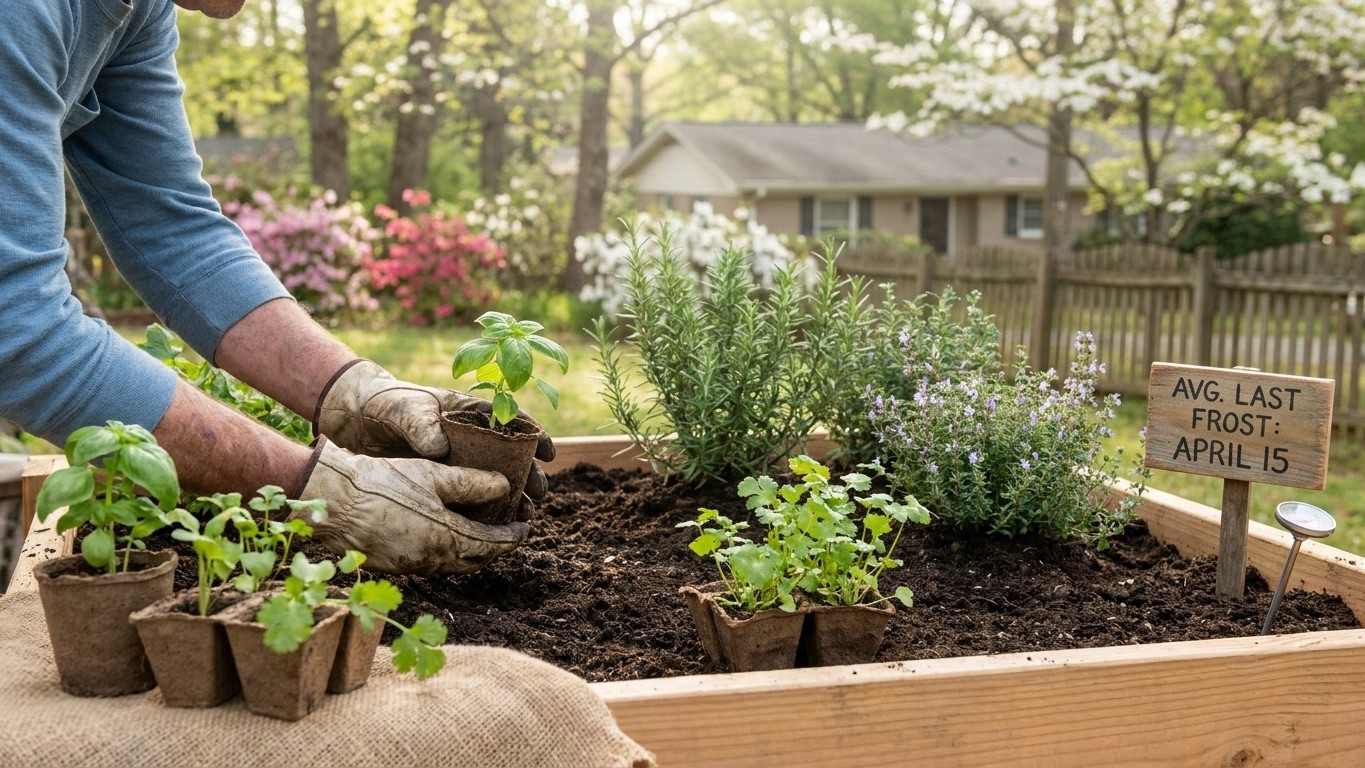

Most herbs go into Kansas soil after the last spring frost clears, which the reference station puts between April 4 and April 18. Tender herbs like basil wait until early May for warmer nights; hardy perennials such as chives, thyme, and oregano can go in two to three weeks ahead of that window.
The short answer for Kansas
Those dates, April 4 to April 18 for last spring frost and October 23 to November 2 for first fall frost, come from NOAA’s 1991-2020 Climate Normals recorded at the Wichita airport station. They’re not a promise. They mark the 30-70% probability band for a 32°F freeze, meaning frost still has a real chance of showing up on either side of that window in any given year. Treat mid-April as a coin flip, not a guarantee.
For tender annual herbs, basil, cilantro, dill grown for continuous cutting, that probability band matters. Transplant basil before April 18 and you’re gambling on a cold snap that happens in roughly three years out of ten. Most gardeners in the Wichita area wait until the last week of April or the first week of May, letting soil temperatures climb past the point where basil sulks instead of grows. Parsley and cilantro tolerate a light frost and can go in earlier, right at the front edge of that April 4 mark, since they’re grown from seed that germinates slowly anyway in cool soil.
Hardy perennial herbs work on a different clock. Chives, sage, thyme, oregano, and mint can be direct-seeded or transplanted from mid-March onward in most years, weeks before the official frost-free window opens, because established roots of these species shrug off a light freeze that would kill a basil seedling outright. The catch is establishment: a plant set out too early spends its first weeks just surviving instead of building the root mass it needs before summer heat arrives.
On the fall side, the October 23 to November 2 window marks when the growing season effectively closes for anything tender. Basil turns black at the first real frost inside that band. Parsley, chives, and thyme keep producing past it, often into November, since they tolerate several degrees below freezing without dying back to the ground. If you’re planning a fall-sown batch of cilantro or dill for a cool-season harvest, count backward from October 23, not November 2, to leave margin.
The frost-free stretch itself, from mid-April to late October, runs a little over six months at the reference station. That’s enough time for two full basil cycles if you succession-plant, but it’s tight for herbs that need a long, uninterrupted stretch of warmth without a hiccup, which is where the next section matters more than the calendar does.
What will not work here
The number that quietly rules out a whole category of herbs in Kansas isn’t the frost date. It’s the coldest month’s average daily minimum: 22.5°F. That’s not a record low, it’s the typical low on an average night in January, and it’s the figure that decides which perennials survive winter outdoors rather than which ones simply tolerate a late spring chill.
Rosemary is the classic casualty. Most rosemary cultivars start showing damage somewhere in the mid-teens and die outright well before temperatures reach the low single digits, which happens with some regularity across a Kansas winter even in a year that never sets a record. Planting rosemary in the ground here and expecting it back next April is optimistic at best. Bay laurel fails even harder; it’s rated for far milder winters than 22.5°F average lows will ever offer. Both belong in containers that come indoors by November, not in a perennial herb bed.
Summer brings a different failure mode. Kansas summers run hot and dry for long stretches, and herbs planted on a weekly watering schedule, the kind that works fine in a cooler, wetter climate, dry out and bolt before you notice. Cilantro is the most obvious victim: it bolts to seed within days once soil moisture drops and afternoon heat climbs, turning a leafy herb into a bitter, flowering stalk almost overnight. Basil handles heat better but still needs water more often than a once-a-week routine provides once daytime highs settle into the 90s for weeks at a stretch.
Humidity swings the other way and catches gardeners who plant too tight. Eastern Kansas summers can turn muggy for days at a time, and herbs packed close together, the way a seed packet’s spacing chart often suggests for cooler climates, trap moisture around their lower leaves. Basil and oregano planted at minimum spacing in a humid stretch are prone to fungal leaf spot and powdery mildew that thinner spacing would have avoided. Wider rows than the packet recommends, plus morning watering instead of evening, cut that risk substantially.
Put together, the herbs that struggle most in Kansas share one of two traits: they need a mild winter they will never get, or they need steady, gentle moisture that a Kansas July simply won’t provide without extra attention.
What changes across Kansas
Kansas spans USDA Hardiness Zone 5b to 7a, a range built entirely around one measurement: the average annual extreme minimum temperature. That’s a wide spread for one state, and it means there is no single answer to “when do I plant” that covers a garden in the northwest the same way it covers one in the southeast.
The colder end, 5b, sits mostly in the northern and higher-elevation parts of the state, where winter lows run harsher and the frost-free season starts later and ends sooner than the Wichita reference figures suggest. A gardener there should expect to push tender-herb transplant dates later than April 18, sometimes by a week or two, and pull in tender annuals for fall closer to the earlier edge of the October 23 window rather than the later one.
The warmer end, 7a, tends to show up in the south-central and southeast parts of the state, where winters run milder and the growing season stretches longer on both ends. A gardener there has more room to experiment with borderline perennials, and might get away with a light-mulch overwinter attempt on an herb that would fail outright further north, though the 22.5°F coldest-month figure still applies broadly enough that nothing rated for zone 8 or warmer should be trusted outdoors year-round anywhere in the state.
The gap between 5b and 7a isn’t cosmetic. It can mean a difference of two to three weeks in both spring planting dates and fall harvest deadlines between one side of Kansas and the other, plus a real difference in which perennial herbs survive winter at all. Rather than guess which end of that range your own garden falls into, the state’s hardiness zone map (searchable by ZIP code through USDA’s Plant Hardiness Zone Map tool) gives a direct answer for your address, and it’s worth checking before committing to a perennial herb bed.
Where to check this for your own county
Everything above describes Kansas as a whole, built from one reference weather station and a statewide hardiness range. That’s useful for planning, but it’s not the same as a recommendation built for your county’s soil, elevation, and microclimate.
Kansas State Research and Extension is the source built to fill that gap. The statewide extension service maintains local offices in individual counties, and each one publishes or can point you toward planting calendars calibrated to local frost history rather than a single airport’s 30-year average. That local calendar accounts for things this page can’t: whether your county sits in a river valley that traps cold air longer than the surrounding uplands, or on high ground that sees frost linger later into spring than the state figures suggest.
Two things are worth looking for specifically once you’re on the extension site. First, the local planting calendar for your county or region, which will give sowing and transplant windows adjusted for local conditions rather than the statewide range cited here. Second, any variety trial results for herbs, since K-State’s horticulture program periodically tests how specific basil, cilantro, or perennial herb varieties perform under Kansas conditions, and a variety proven in trials for your part of the state beats a generic recommendation every time.
A county-level recommendation from your local extension office will always outrank the statewide figures on this page. This article works from one reference station and a broad hardiness range that covers the whole state; the extension office works from decades of local observation specific to your soil and your microclimate. When the two disagree, trust the local office.
The Moon calendar is a separate, older custom: see when to plant herbs by the moon, written as tradition rather than fact.
Checking this against your own garden
No calendar date, including the ones above, replaces what your own garden tells you directly. Three simple signs matter more than any published frost date, and none require equipment beyond your own hands and eyes.
Soil warmth by feel is the first and most reliable check. Push a finger a few inches into the bed where you plan to transplant basil or direct-seed cilantro. If it feels cold to the touch, roughly the way a refrigerated drink feels, the soil hasn’t warmed enough for tender herb roots to establish, regardless of what the calendar says. Warm, slightly damp soil that feels closer to room temperature is the real green light.
The first true leaves on any seedling tell you whether conditions have actually supported growth, not just germination. Seed leaves (the first two that emerge) don’t count; wait for the next set, which look like miniature versions of the mature plant’s actual foliage. Their appearance signals the seedling has moved past its fragile earliest stage and into a phase where a light, unexpected frost is less likely to kill it outright.
For herbs like basil that flower if left too long, watch for the first flush of flower buds forming at the stem tips. That’s a signal the plant has shifted from leaf production to reproduction, usually triggered by heat stress or daylight changes specific to your yard’s exposure. Pinching those buds back extends your harvest, but their timing also tells you something about your own garden’s particular heat and light pattern, information no regional calendar can give you.