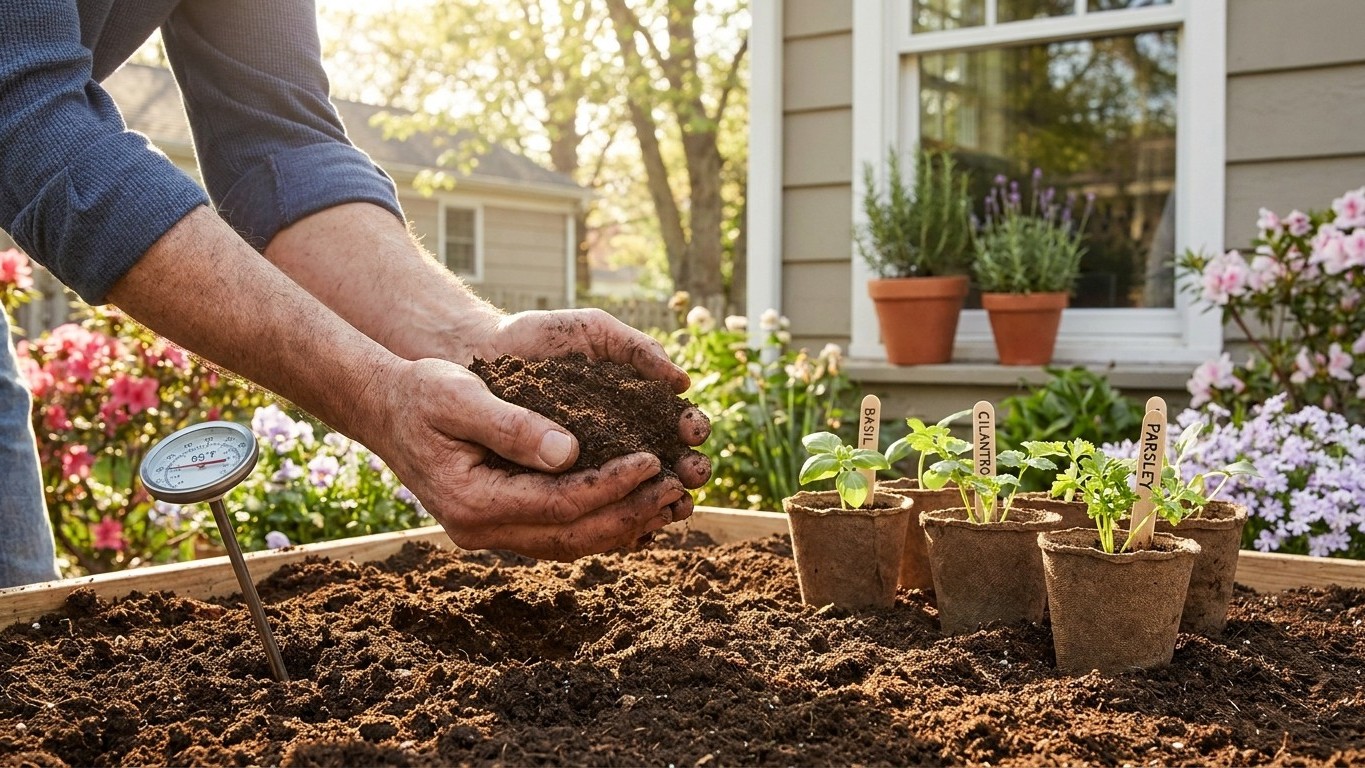

Most Kansas gardeners can put herb transplants in the ground by late April, once the soil itself has warmed rather than just the calendar page turning. The harder question isn’t planting day, though. It’s which herbs will survive a Kansas winter outdoors and which need a pot brought indoors, because the state’s hardiness zone splits from 5b to 7a depending on where you garden. That single fact reorganizes the whole herb bed before a seed goes into the ground.
When the soil is warm enough in Kansas

In Wichita, NOAA’s 1991-2020 Climate Normals put the last spring freeze at 32°F somewhere between April 4 and April 18, based on records from the airport weather station (USW00003928). That’s a probability band, not a guarantee. Read it as the point past which a freeze becomes less likely, not a date circled on the calendar where danger simply stops.
Herbs don’t actually respond to frost the way the date implies. What stops a tender seedling from taking off isn’t the leftover risk of ice on the windshield, it’s cold soil. Ground temperature lags behind air temperature by a couple of weeks in spring, so even after the last-frost window closes, soil in a shaded or clay-heavy bed may still sit too cool for roots to grow. This is why experienced gardeners wait for the dirt itself, checking it with a simple soil thermometer, rather than planting the moment the frost date passes on paper.
The frost dates above come from one station at one airport. Suburban yards and rural properties across Kansas typically see their last spring frost land later, sometimes by one to two weeks, especially in low-lying spots where cold air pools overnight. Anyone gardening outside the immediate Wichita area should treat April 18 as an optimistic marker and check frost records for their own county before committing tender plants to open ground.
Types of herbs and their timing
Tender annual herbs, the basil and cilantro types, have no cold tolerance at all and should wait until the soil has genuinely warmed, not just until the freeze risk statistically drops. Hardy perennial types, the thyme, sage, chive, and oregano types, tolerate a light frost and can go in as transplants a few weeks earlier, since a stray cold snap won’t set them back the way it would a basil seedling.
Several herbs carry a long-standing reputation for medicinal use. This page doesn’t evaluate those claims one way or another; it treats every herb here strictly as a culinary and garden plant, and readers looking into traditional or health uses should consult a qualified source rather than a growing guide.
How long the season lasts here
Pair the spring numbers with the fall side of the calendar. NOAA’s same Climate Normals dataset puts the first fall freeze at Wichita’s airport station between October 23 and November 2. Stack that against the April 4-18 spring window and the frost-free growing season runs from roughly 198 days, in the tightest case, to about 202 days in the most generous one. Either way, that’s close to six and a half months of workable ground.
A season that long changes the math on how many times you plant. Six and a half months is enough room to start fast-growing annual herbs like cilantro or dill in April, let them bolt or finish by midsummer, then reseed a second round in July or early August for a fall harvest before the November freeze closes things out. A shorter window, closer to the 198-day end, tightens that margin and makes the first sowing the one that has to count, since there’s less slack if it fails or gets planted late.
That length also shapes whether transplanting makes sense over direct seeding. With nearly seven months of frost-free ground available, there’s enough time to start slower herbs indoors and transplant them out once the soil has warmed, rather than direct-seeding everything and hoping the season is long enough to catch up. Herbs with taproots, like dill and cilantro, resent the disturbance of transplanting regardless of season length, so those are usually better sown directly even when time allows for the alternative.
Anyone planning a second sowing around midsummer should check timing against a fall freeze that could arrive as early as October 23, not November 2. Our guide to succession sowing walks through how to count backward from a expected frost date so a second planting has time to mature before cold shuts it down.
Heat and water in Kansas

Kansas summers run long stretches of afternoons well above 90°F, and rainfall through the growing season tends to arrive unevenly, in bursts rather than steady weekly totals. Neither of those facts is the deciding factor for herbs, though. Most culinary herbs, being native to Mediterranean hillsides or scrubby dry ground, tolerate summer heat better than they tolerate soggy roots, so a well-drained bed matters more here than shade cloth in most of the state.
The number that actually decides what stays in the ground year-round is winter, not summer. At the Wichita reference station, the coldest month has an average daily minimum temperature of 22.5°F, according to NOAA’s 1991-2020 Climate Normals. That figure, not the record low and not the monthly average, is what determines whether a perennial herb’s roots survive the winter outdoors or need to come inside.
Layered on top of that is the USDA Plant Hardiness Zone Map, which places Kansas across zones 5b to 7a. That’s a real range across the state, built on the average annual extreme minimum temperature, not a single number every gardener can use. A herb bed in the milder 7a pocket can keep a Mediterranean perennial in the ground through winter with mulch as insurance; the same plant in a colder 5b spot likely needs to be dug up, potted, and moved indoors before the first hard freeze, or treated as an annual and replaced each spring.
That zone range is also why a single answer for “does rosemary survive winter here” doesn’t exist for the whole state. It depends on which side of the 5b-7a split a given yard falls on, and gardeners near the zone boundary should check their specific county’s typical winter lows rather than assume the statewide range applies evenly.
Which herbs suit Kansas
None of this points to one right herb for Kansas gardens, but it does point to the right categories to lean on. The frost-free window of roughly 200 days favors annual herbs that mature quickly enough to fit two rounds, or that can be started indoors and transplanted once soil has warmed rather than direct-seeded and left to catch up. Types worth building a bed around include:
- Fast-maturing annual herbs (the basil, cilantro, and dill types), suited to succession sowing within the season’s six-plus months
- Woody Mediterranean perennial types (rosemary, thyme, sage, oregano), which need winter protection or container life in zone 5b areas but can often stay in the ground in warmer 7a pockets
- Herbaceous perennial types (chives, mint, tarragon), generally tolerant of the coldest-month lows across most of the state’s zone range
Given that Kansas summers deliver plenty of heat but not overwhelming humidity everywhere, disease pressure from mildew tends to be lower here than in wetter climates, which makes airflow and spacing a lower priority than winter protection when deciding what to plant permanently versus what to treat as seasonal.
What this page won’t do is name a specific variety. Cultivar performance depends on trials run in local soil and local weather, and the only recommendations worth trusting come from testing done in-state, not from a general growing guide. The Kansas State University Research and Extension service maintains that kind of trial data and can point to varieties actually proven to perform in Kansas conditions, county by county. That’s a more useful answer than any cultivar name this page could offer, since a variety’s success here has everything to do with where in the state it was tested and nothing to do with how it reads on a seed packet.