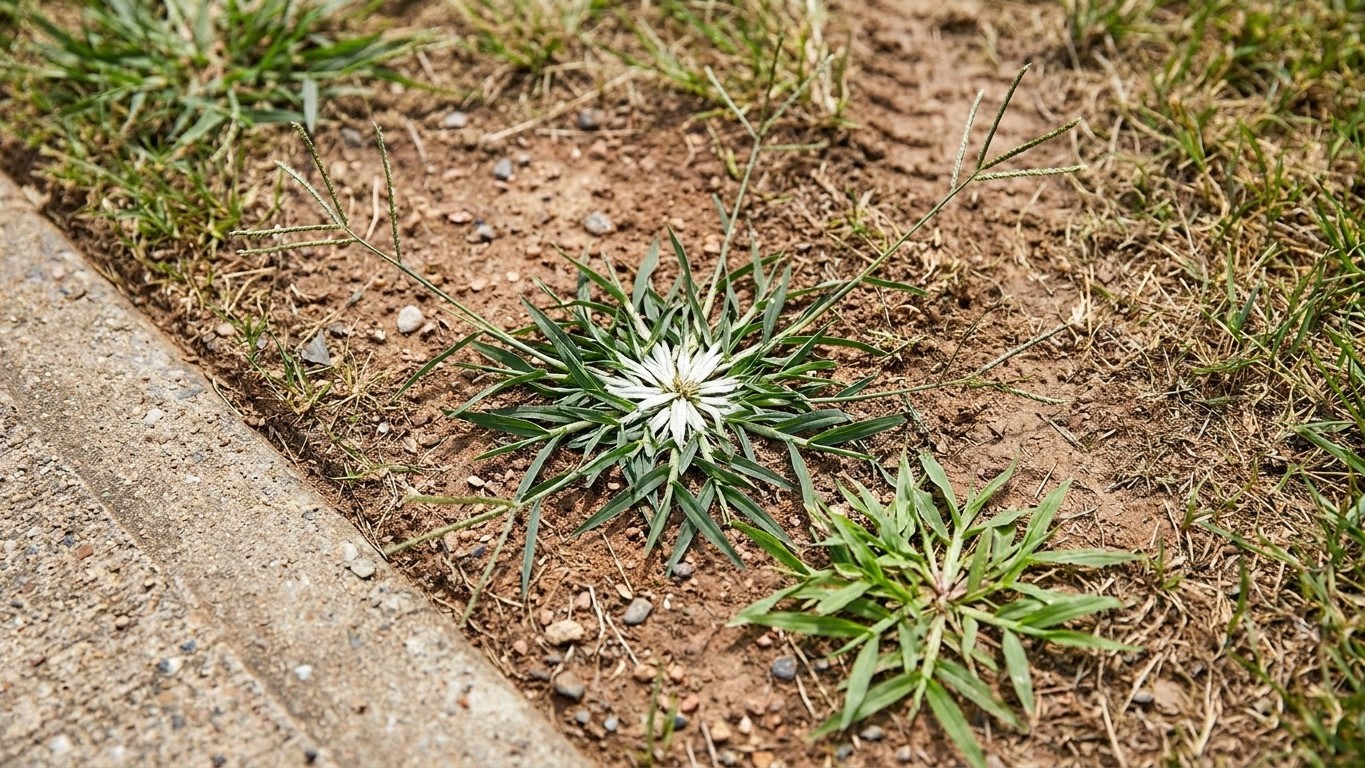

Kansas sits in the transition zone, so no single number fits every lawn. Cool-season turf gets mowed at 1.5 to 3.5 inches depending on species, while warm-season turf runs 1 to 2 inches. Tall fescue sits at the high end and bermudagrass at the low end. Mow one at the other’s height and you can lose the lawn within a season or two. Start by knowing what is growing in your yard, then adjust by season. K-State Research and Extension can help identify it.
The mowing height for Kansas lawns
Mowing height decides how much leaf a grass keeps to feed itself, how much shade reaches the soil, and, indirectly, how deep roots run. Kansas lawns split into two camps because neither grass family excels here. A cool-season lawn suffers in July. A warm-season lawn is brown from October to April. Both are planted across the state, and each has its own height.
| Grass | Family | Mowing height |
|---|---|---|
| Tall Fescue | Cool-season | 3 to 3.5 inches |
| Kentucky Bluegrass | Cool-season | 2 to 3 inches |
| Perennial Ryegrass | Cool-season | 1.5 to 2.5 inches |
| Zoysiagrass | Warm-season | 1 to 2 inches |
| Bermudagrass | Warm-season | 1 to 2 inches |
Cool-season grasses
Tall fescue is the tallest of the group at 3 to 3.5 inches, and it tolerates the least scalping. Kentucky bluegrass forgives a little more at 2 to 3 inches. Perennial ryegrass takes the lowest cut of the three, 1.5 to 2.5 inches. Mixed seed blends are common, so if your lawn is a blend, mow for the species that dominates. When in doubt, go toward the taller end. Neighbors in the same zone face the same fork, as the guide on how high to mow a lawn in Kentucky shows.
Warm-season grasses
Zoysiagrass and bermudagrass both sit at 1 to 2 inches. That is shorter than the lowest cool-season setting by a wide margin. These grasses spread by runners across the surface, and a low, dense canopy is what they are built for. Set a bermudagrass lawn at 3 inches and it turns stemmy and thin.
The trade-off is simple. Cool-season turf stays green through winter and struggles in summer heat. Warm-season turf handles July and goes tan once the cold arrives. Neither choice is wrong. The right height is the one that matches the grass you already have.
Raising the deck when the heat comes
Summer in Kansas looks wet on paper. NOAA’s 1991-2020 normals for the reference airport station show about 13.2 inches of rain across June, July and August, out of 34.3 inches for the year. June averages 4.93 inches, July 3.98 and August 4.3. July is the driest of the three, and it is also the month when a cool-season lawn is under the most stress.
Those are normals, not a forecast, and they describe one station, not your yard. A slope, a city heat island or a rain shadow can shift them. Two things then change how much of that rain your grass actually gets. Soil is the first. On sand, an inch of rain drains through within the day. On clay, the same inch can hold for a week. A sandy lawn can still need water every second day in a wet summer.
Heat is the second. Days at or above 90°F drive evaporation, and a single summer thunderstorm tends to run off hard ground rather than soak in. Four inches that arrive in two storms are not the same as four inches spread across a month. A rain gauge on your own plot settles it better than any regional average.
For cool-season lawns, the mower is a drought tool. Raise the deck to the top of your species range: 3.5 inches for tall fescue, 3 for Kentucky bluegrass, 2.5 for perennial ryegrass. Longer blades shade the soil, which slows evaporation and keeps roots cooler. Dropping the deck in July to “tidy up” does the opposite.
Warm-season lawns do not need the same adjustment. Heat is what zoysiagrass and bermudagrass are built for, so keep them inside their usual 1 to 2 inches rather than chasing a lower cut. Mowing them more often, not shorter, keeps them dense.
The one-third rule, and why it is not arbitrary
Never remove more than one-third of the blade in a single mowing. The rule is old and often repeated, and it has a mechanical reason behind it. The blade is the grass plant’s factory. A heavy cut strips away much of the leaf area that makes food, and the plant pulls from its reserves to rebuild. Do that repeatedly and roots stop growing while the crown works on regrowth.
The rule also tells you how often to mow. The calculation runs from your target height, and it is just arithmetic:
- Tall fescue held at 3.5 inches: mow before it reaches 5.25 inches.
- Kentucky bluegrass held at 3 inches: mow before it reaches 4.5 inches.
- Zoysiagrass held at 2 inches: mow before it reaches 3 inches.
- Bermudagrass held at 1.5 inches: mow before it reaches 2.25 inches.
The shorter the grass, the less room it gives you. A bermudagrass lawn kept at 1.5 inches overgrows its window in a few days of good growth, while a tall fescue lawn gives you more slack. That is why low-cut lawns are the higher-maintenance ones. A calendar day such as “every Saturday” matters less than watching the grass.
When a rainy week or a vacation lets the lawn run past the limit, do not cut it all the way down in one pass. Take off a third, wait a few days, and cut again. The second pass brings it back to height without shocking it. Clumps of long clippings left on the surface can also smother the turf beneath, which is a second reason to avoid the big one-pass cut. The broader basics of mowing a yard are covered in Mowing a Lawn.
The first and last cut of the year
The reference-city figures for last spring frost run from April 4 to April 18, and first fall frost from October 23 to November 2. They come from the NOAA NCEI 1991-2020 Climate Normals, at the 30-70% probability band for 32°F freezes. Those dates describe an airport weather station, not the whole state. Suburban and rural yards typically see the last spring frost later and the first fall frost earlier than that, often by one to two weeks, and more at elevation. Check your own county’s dates before you plan around them.
Cool-season grasses wake first. Mow once growth starts and the grass is tall enough to need it, and keep that early cut near the low end of the species range. Then let the deck climb through spring toward the summer setting. Warm-season lawns stay brown until they green up on their own schedule, so there is nothing to cut until the grass is actually growing. Mowing them while still dormant gains you nothing.
In fall, the rule is to keep mowing as long as the grass grows. A cool-season lawn is still active after the first frost date passes, so the mower should keep running at the normal height rather than being put away on a fixed date. Do not drop the deck for the final cut. Leaving the last pass at the regular setting keeps leaf area on the plant going into winter. Leaves that fall on the lawn need clearing or mulching, because a heavy mat on short grass blocks light.
Warm-season lawns reach the end of their year sooner. They turn brown from October to April, so their last cut comes before they go dormant, at a height inside the 1 to 2 inch range. Colder places end the season even earlier, as the guide on how high to mow a lawn in Quebec explains.
Common questions
What height should I use if I do not know my grass?
Look at when it is green. A lawn that is brown from October to April is warm-season, so mow at 1 to 2 inches. A lawn that stays green through the cold months is cool-season. At 3 inches, tall fescue and Kentucky bluegrass both sit inside their ranges.
Should I mow tall fescue at 3.5 inches all year?
Its range is 3 to 3.5 inches. Using the top of the range in summer makes sense because of the heat. In spring and fall, anywhere in the range works, as long as you stay within the one-third rule.
How often should I mow?
Let growth set the schedule, not the calendar. Mow when the grass reaches one-third above your target height. Shorter lawns, such as bermudagrass at 1.5 inches, reach that point sooner than tall fescue at 3.5 inches.
Do the frost dates apply to my yard?
They describe the reference-city weather station, which is not your lot. Suburban and rural yards often see the last spring frost one to two weeks later and the first fall frost one to two weeks earlier. Your county’s extension office can narrow it down.