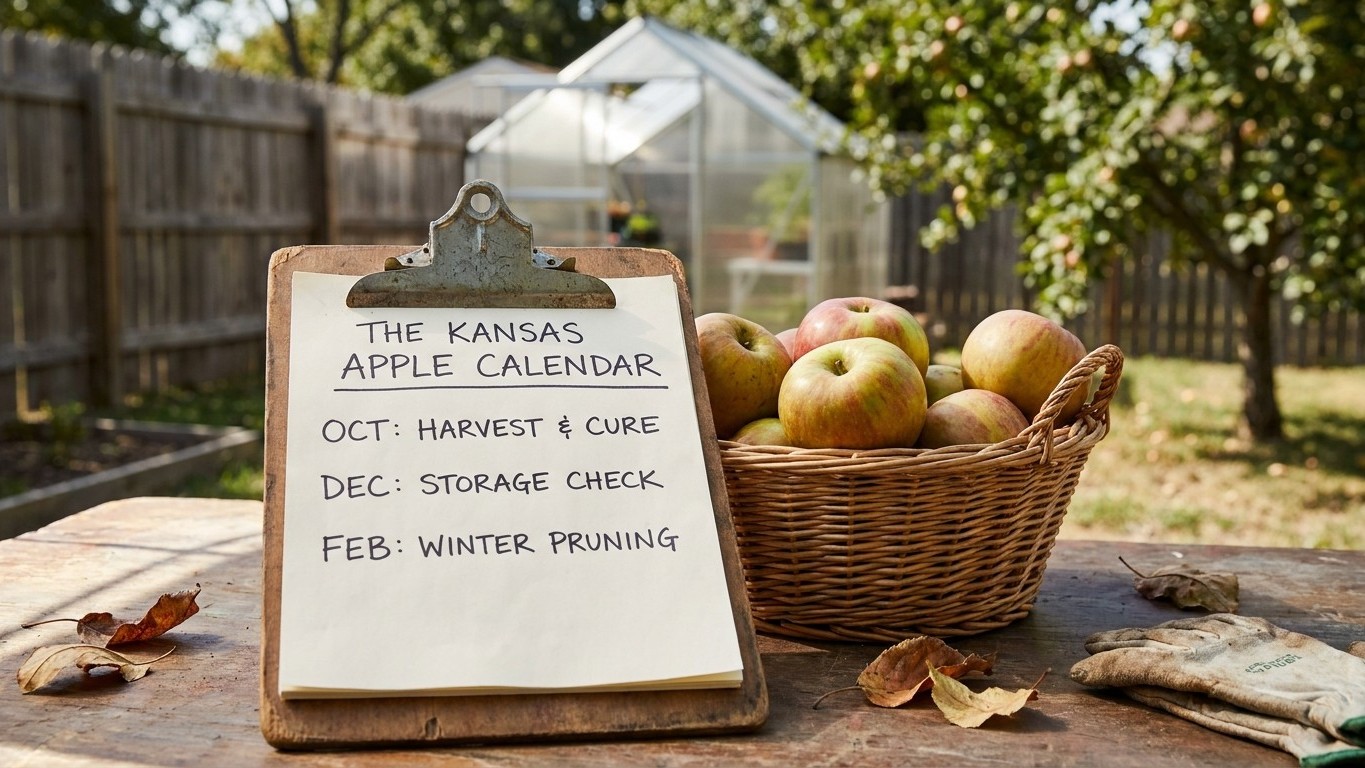

Kansas apple trees run on a bud-stage clock, not a wall calendar. NOAA’s 1991-2020 climate normals put Wichita’s last spring frost between April 4 and April 18, and the first fall frost between October 23 and November 2, and everything in between, dormant pruning, bloom, fruit set, harvest, has to fit inside that stretch. Check your tree’s actual bud stage against those Wichita dates before deciding whether a cold night this week is something to worry about.
The short answer for Kansas
You’re standing there wondering when to actually start moving on your apple tree, and the honest answer is: not on a date, but on what the buds look like right now. In Wichita, the last spring frost lands somewhere between April 4 and April 18 most years, and that window is the thing that decides everything else, pruning, bloom, whether a chilly night is a real threat or nothing at all. So walk out and check your buds against that stretch before you touch a pair of pruning shears or lose sleep over tonight’s forecast.
What the calendar depends on
What actually decides the outcome is which stage the tree is in when a cold night arrives, not which month happens to show on the calendar. A dormant tree shrugs off a hard freeze that would kill an open blossom outright. Wichita’s coldest month averages a nightly low of 21.9°F, per the same NOAA 1991-2020 normals, cold enough to satisfy the winter chilling requirement of every mainstream apple cultivar sold at a Kansas nursery, without dropping so low that hardiness itself becomes the limiting factor.
That’s the two-part filter every Kansas grower is working against: enough winter chill to force uniform bloom, and a frost-free bloom-to-harvest stretch long enough to finish the crop. For which cultivars actually fit that window without running into early frost or heavy scab pressure, see The Best Apple Varieties for Kansas. If you haven’t planted yet, the rootstock and site choices that set up everything below are covered in Growing Apples in Kansas.
Working through it

Each stage below is identified by what the buds and blossoms actually look like, not by a date, because green tip in a warm March can arrive before pink does in a cold April three counties over.
Dormancy

The tree sits leafless and tight-budded from leaf drop through late winter, spanning the period after Wichita’s first fall frost of October 23 to November 2 (NOAA 1991-2020 normals) until warmth starts pushing buds again. This is the window for structural pruning, since the wood is bare, disease pressure is low, and cuts heal before growth resumes.
Green tip

Bud scales split and a sliver of green leaf tissue shows through, usually weeks before the average last frost. This is when to apply dormant oil for scale and mite control, since the spray needs exposed green tissue to work and does nothing useful on a fully closed bud.
Pink

Flower clusters swell and show color before the petals separate. This stage is the one most likely to land squarely inside Wichita’s April 4 to April 18 last-frost window, and pink buds are considerably more cold-sensitive than the tight buds of green tip. A grower who checked the forecast casually at green tip needs to check it every night by pink.
Bloom

Full flower opening is the pollination stage and the most frost-sensitive point in the whole year. Because Wichita’s last-frost window runs all the way to April 18, an early-blooming cultivar can be in full flower on a night that still carries real freeze risk locally. This is the one stage where row cover, overhead irrigation for frost, or simply choosing a later-blooming cultivar actually earns its keep.
Petal fall

Petals brown and drop, and a small pale fruitlet becomes visible at the center of each spent blossom. Cold tolerance improves some over open bloom, but a hard freeze here still deforms or kills young fruitlets outright.
Fruit set

Fruitlets harden into small green marbles. This is the point to thin, pulling extras down to one fruit per cluster, since the tree is now committing real resources to whatever it’s carrying forward.
Harvest
Timing is set by the cultivar’s catalog days-to-maturity count from bloom, and it has to finish comfortably before Wichita’s first fall frost of October 23 to November 2 (NOAA 1991-2020 normals). Early cultivars clear that window with room to spare. Late keepers push right up against it, which is exactly why cultivar choice, covered in The Best Apple Varieties for Kansas, matters as much as any pruning decision above.
What changes across Kansas
The two frost windows above come from a single instrument at the Wichita airport, and NOAA’s own normals note that suburban and rural sites typically see a later last frost and an earlier first frost than the airport does, often by one to two weeks, with elevation widening that gap further still.
The high plains and elevation
Kansas rises from river-bottom country in the southeast to high plains near Goodland and Colby in the far west, and that elevation gain is the biggest reason a calendar built on Wichita’s numbers needs adjusting a few counties out. Higher ground tends to run bloom later into spring than Wichita does, which sounds like it buys safety from frost but often does the opposite. A late-blooming block at higher elevation can still be sitting at pink or full bloom on a night that would already be well past frost risk back at Wichita.
The Flint Hills and river valleys
The rolling terrain of the Flint Hills in east-central Kansas lets cold air drain downhill overnight and pool in low ground, so an orchard block planted in a valley bottom there sees harder, more frequent frost at bud break than one planted a hundred feet upslope on the same farm. The same drainage effect shows up in any river-bottom planting, where the lowest ground is reliably the coldest ground on a clear, still night.
Southeast Kansas
The river-bottom country toward the Missouri and Oklahoma borders generally carries the mildest and longest frost-free stretch in the state, which is also where fire blight and apple scab pressure tends to run highest, thanks to the added humidity. None of this changes which stage matters, dormancy, green tip, pink, bloom, petal fall, fruit set, harvest, but it does change which calendar week each stage is likely to land in for your own county, which is exactly why the Wichita dates are a reference point, not a rule.
The mistakes this climate punishes
Most losses trace back to the tree’s stage colliding with the wrong end of Wichita’s frost windows, or with a grower’s own management calendar.
Spring mistakes
- Trusting the average and skipping frost protection at bloom: Wichita’s last-frost window runs all the way to April 18, so a tree in full bloom in the first half of April is still inside a real chance of a freeze that season, and a lost bloom is a lost crop, not a smaller one.
- Choosing a very early-blooming cultivar without checking its habit against that window: a selection that flowers a week or two ahead of a mid-season type has effectively moved itself deeper into the frost-risk tail, even in an otherwise unremarkable year.
- Pruning hard after green tip instead of during dormancy: cutting into a tree that has already broken bud diverts energy it needed for bloom and fruit set into wound response instead.
Fall and winter mistakes
- Fertilizing after midsummer: nitrogen applied in July or August pushes soft new growth that hasn’t hardened off by the time Wichita’s first fall frost arrives, October 23 to November 2 per NOAA’s normals, and that soft tissue is what dies back first and invites canker the following spring.
- Assuming a mild-seeming winter is too warm to satisfy chilling: Wichita’s coldest month averages a nightly low of 21.9°F under NOAA’s 1991-2020 normals, plenty cold to meet the chill requirement of cultivars sold locally, so a stalled or uneven bloom is far more often a late frost or a disease problem than a chilling shortfall.
Checking this against your county
Every date and threshold above is tied to the Wichita airport instrument, and K-State Research and Extension keeps county-based horticulture agents who can tell you how far your own orchard’s frost history actually runs from those numbers, and which local spray calendar addresses your county’s own scab and fire blight pressure. Start at K-State Research and Extension before locking in a pruning or spray schedule built only on Wichita’s figures.
Common questions
When do apple trees actually bloom in Kansas?
Bloom follows accumulated warmth after dormancy breaks, not a fixed date, so it shifts by a couple of weeks from year to year and by cultivar. At Wichita, bloom generally lands inside or just after NOAA’s last-frost window of April 4 to April 18 (1991-2020 normals), but an early-flowering cultivar or a warm March can pull that earlier, and elevation or terrain differences a few counties away can shift it further still.
Can frost still hit my apple tree after it’s already flowering?
Yes, and this is the riskiest stretch of the whole year. Wichita’s own last-frost window, per NOAA’s 1991-2020 normals, extends to April 18, which means a tree that bloomed on April 5 can still face a freeze two weeks later, and an open blossom has far less cold tolerance than a dormant bud does.
How many chill hours does an apple tree need in Kansas?
That varies by cultivar and is printed on the nursery tag or catalog listing, not fixed for the whole state. What NOAA’s normals do confirm is that Wichita’s coldest month averages a nightly low of 21.9°F, cold enough to accumulate the chilling that mainstream apple cultivars sold in Kansas nurseries are bred for, so a stalled bloom is more often a late-frost or disease issue than a chilling shortfall.
What month should I expect to pick apples in Kansas?
There’s no single month, since harvest is set by the cultivar’s days-to-maturity count from bloom, printed on the catalog tag rather than tied to a calendar date. What’s fixed is the outer boundary: the crop needs to finish before Wichita’s first fall frost, which NOAA’s 1991-2020 normals put between October 23 and November 2, and a late-keeping cultivar planted in a shorter-season part of the state should be checked against that boundary before you commit to it.