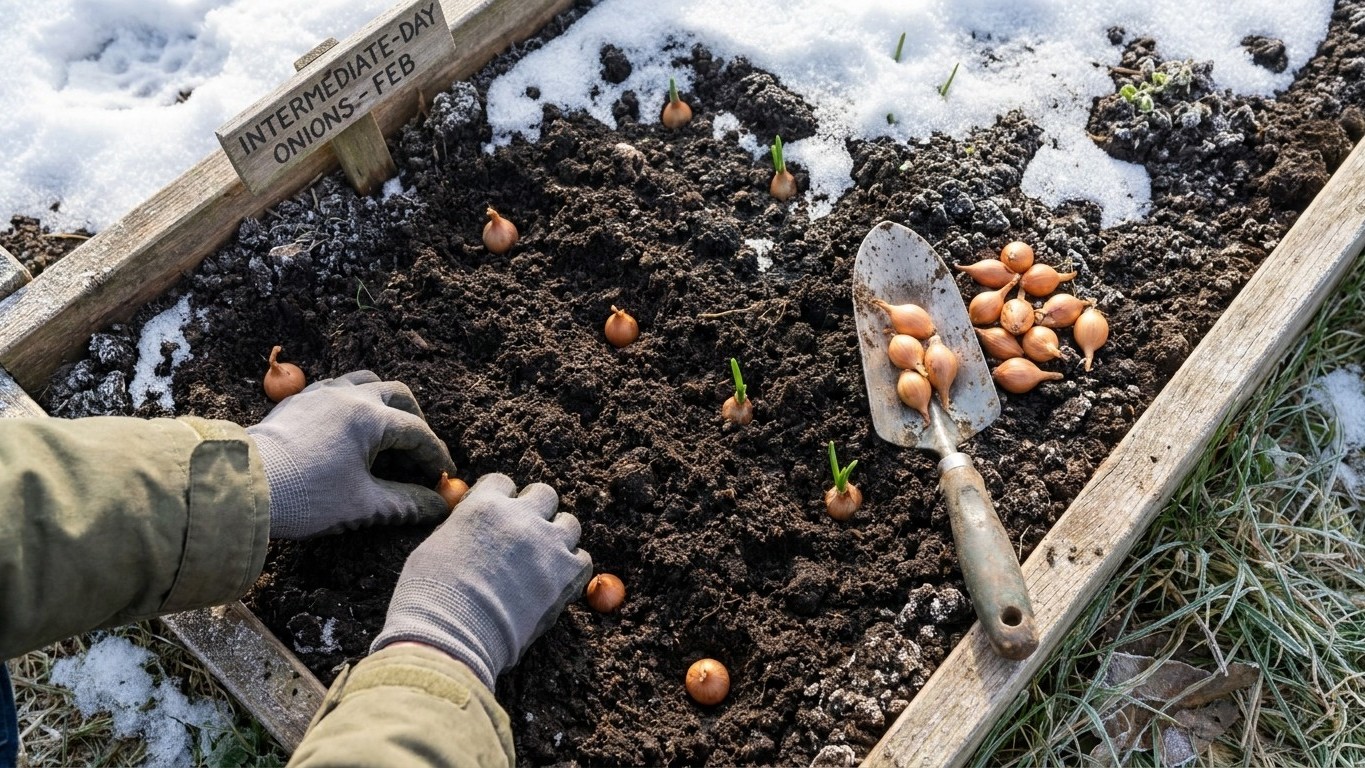

Kansas onions go into the ground in late winter to early spring, not in fall. At 37.65 degrees north, the reference latitude for Wichita, the state gets 14 hours and 36 minutes of daylight on the summer solstice, right in the range that puts Kansas gardens in intermediate-day onion territory. That single number, day length rather than temperature, decides which varieties will actually bulb here, when to plant them, and why a set tucked into the soil in April gives you a smaller harvest than one planted in February.
The short answer for Kansas

Onions do not respond to warm soil the way tomatoes or peppers do. They respond to how many hours of daylight they’re getting, and the trigger that flips a plant from growing leaves to building a bulb is a specific day-length threshold written into each variety. In Kansas, at 37.65 degrees north with 14 hours 36 minutes of daylight on the longest day, the state sits squarely in the intermediate-day zone, sometimes called day-neutral. That means the workhorse varieties for this state are intermediate-day types, plus a handful of long-day varieties whose range stretches far enough south to include Kansas: Bridger, Cabernet, Calibra, Candy, Elsye, Expression, Monastrell, Red Long of Tropea, Scout, Sierra Blanca, Walla Walla Sweet, and White Castle.
Because Kansas isn’t a mild-winter state, the planting calendar looks different from what a gardener in coastal Georgia or south Texas would use. In those places, onions go into the ground in fall, spend winter as small overwintering plants, and bulb up as spring days lengthen. Kansas winters are too hard for that approach with reliable results; the plants would rather freeze out than sit tight until spring. So Kansas gardeners start onions from sets or transplants in late winter to early spring, timed to the last hard freeze in their area, giving the plants a long stretch of increasing daylight to build size before the bulbing trigger kicks in around the solstice.
That timing matters more than most gardeners assume. An onion plant only gets one shot at building bulb size, and it happens over a fixed window tied to the calendar, not to when you happened to get around to planting. Plant early, and the onion has more weeks of leaf growth banked before day length says “stop growing leaves, start building bulb.” Plant late, and it has fewer. The plant doesn’t wait for you to catch up. It bulbs on schedule regardless of how small it still is, which is exactly the mechanism the next section explains in more detail.
What will not work here
The biggest misunderstanding about onion timing in Kansas is thinking that planting late just pushes the harvest date back. It doesn’t. Bulbing starts on a day-length schedule that has nothing to do with the calendar date you put seed or sets in the ground. Whatever size the plant has reached by the time day length crosses that variety’s threshold is, more or less, the size the bulb will be. Plant six weeks late and you don’t get onions six weeks later. You get onions that are smaller, because the plant had six fewer weeks of leaf growth to convert into bulb size before the trigger fired.
The same day-length rule is also why variety choice matters as much as timing. A handful of varieties are published for latitudes that simply do not match Kansas, and planting them here doesn’t produce a smaller version of a good onion. It produces no crop at all, or a crop that bulbed far too early to be worth growing.
- Gabriella (short-day, rated for 20-35N) will start bulbing while the plant is still tiny, because Kansas days get far longer than this variety expects, giving marble-sized onions instead of a real harvest.
- Madalyn (short-day, rated for 20-35N) has the same problem: the day-length trigger fires long before the plant has grown enough leaf mass to support a decent bulb.
- Red Rock (short-day, rated for 30-36N) sits just south of Kansas and reacts the same way here, bulbing early and small.
- Frontier (long-day, rated for 40-50N) needs day length that Kansas summers never reach, so the plant just keeps making leaves all season and eventually rots in the ground.
- Powell (long-day, rated for 43-47N) waits for a daylight trigger this far south, and it never arrives.
- Red Carpet (long-day, rated for 40-45N) is built for northern summers with longer days than Kansas provides.
- Redwing (long-day, rated for 43-65N) is a far-north variety that will grow leaves indefinitely here and never bulb.
- Safrane (long-day, rated for 42-50N) needs a longer summer day than this latitude offers.
- Talon (long-day, rated for 42-50N) has the same requirement and the same result: leaves, then rot, no bulb.
None of these are “may struggle” situations. The short-day varieties bulb too early and stay small. The long-day varieties never bulb at all. Planting either group in Kansas wastes a season of garden space on a crop that was never going to work at this latitude.
What changes across Kansas
Kansas is not one latitude, and treating the whole state like Wichita ignores real geography. The state runs from around 37 degrees north at the Oklahoma border up to roughly 40 degrees north at the Nebraska line, a spread of about three degrees. That’s enough to shift a gardener from solidly intermediate-day territory into the blurred edge of the long-day zone.
Wichita, the reference city for the 37.65-degree figure used throughout this page, sits close to the southern part of the state. A gardener near the Nebraska border is farther north and gets more daylight on the summer solstice than Wichita does, which nudges several long-day varieties from “won’t work” into “might work at the edge of their range.”
| Location | Approximate latitude | What changes |
|---|---|---|
| Southern Kansas (near Wichita, reference city) | 37.65N | Solidly intermediate-day; long-day varieties rated 38N and above are unreliable |
| Northern Kansas (near Nebraska border) | ~40N | Slightly longer summer days; borderline long-day varieties (38N lower bound) become worth trying |
That northern edge is where varieties like Ailsa Craig, Barolo, Blush, New York Early, Patterson, Red Long of Florence, and Rossa di Milano come into play. All of them are published with a lower latitude bound of 38 degrees north, just above the Wichita reference figure. That’s a continuum, not a hard line, so a gardener in Manhattan, Kansas or up near the Nebraska border is close enough to that threshold that these varieties may bulb successfully, while the same varieties planted near the Oklahoma border are a genuine gamble. Nobody should read a single statewide recommendation and assume it applies with equal confidence from one end of Kansas to the other.
Sweet now, or onions that last
Kansas gardeners land in the middle of a trade-off that has nothing to do with luck and everything to do with chemistry. The compounds that make an onion sharp and eye-watering, volatile sulfur compounds, are the same compounds that protect the bulb from decay once it’s cured and sitting in storage. A sweet onion has fewer of those compounds. That’s exactly what makes it mild enough to eat raw, and exactly why it won’t make it through winter in a pantry. University of Missouri Extension puts it plainly: sweet onions do not store as well as the more pungent types.
Day length lines up with this trade-off almost perfectly. Shorter-day varieties tend to run sweeter and milder; longer-day varieties tend to run sharper and keep longer. Since Kansas sits in the intermediate-day zone with access to both intermediate and long-day varieties, gardeners here actually get to choose sides of that trade-off rather than being stuck with one.
A variety like Candy leans sweet and mild, good on a burger in July but not something to count on by January. A long-day type such as Walla Walla Sweet or Bridger, both rated for this latitude, sits further toward the pungent, long-keeping end, or at least keeps better than the sweet intermediate types. The practical upshot for a Kansas pantry: plant some of both if the garden has room, eat the sweet ones first because they won’t wait, and count on the sharper varieties to still be sound in March when the sweet ones are long gone.
Checking this against your own garden
Every figure on this page comes from one reference point, Wichita at 37.65 degrees north, and a state that spans roughly three degrees of latitude means no single number describes every backyard in Kansas equally well. Before committing a season’s worth of garden space to a specific variety or planting date, it’s worth confirming a few things locally.
- Look up your own latitude if you garden well north or south of Wichita, since even one or two degrees shifts which borderline varieties are worth trying.
- Check your local average last-frost date, since that, not the calendar month, sets the earliest safe planting window for sets or transplants.
- Call your county extension office, part of the Kansas State University Research and Extension system, for planting dates calibrated to your specific county rather than a statewide average.
- Ask that office whether recent winters have shifted local frost dates, since averages drift over time and a county office tracks that better than any general guide.
- Note your garden’s microclimate, since a south-facing slope or a low frost pocket can push your practical planting window a week or two either direction from the county norm.