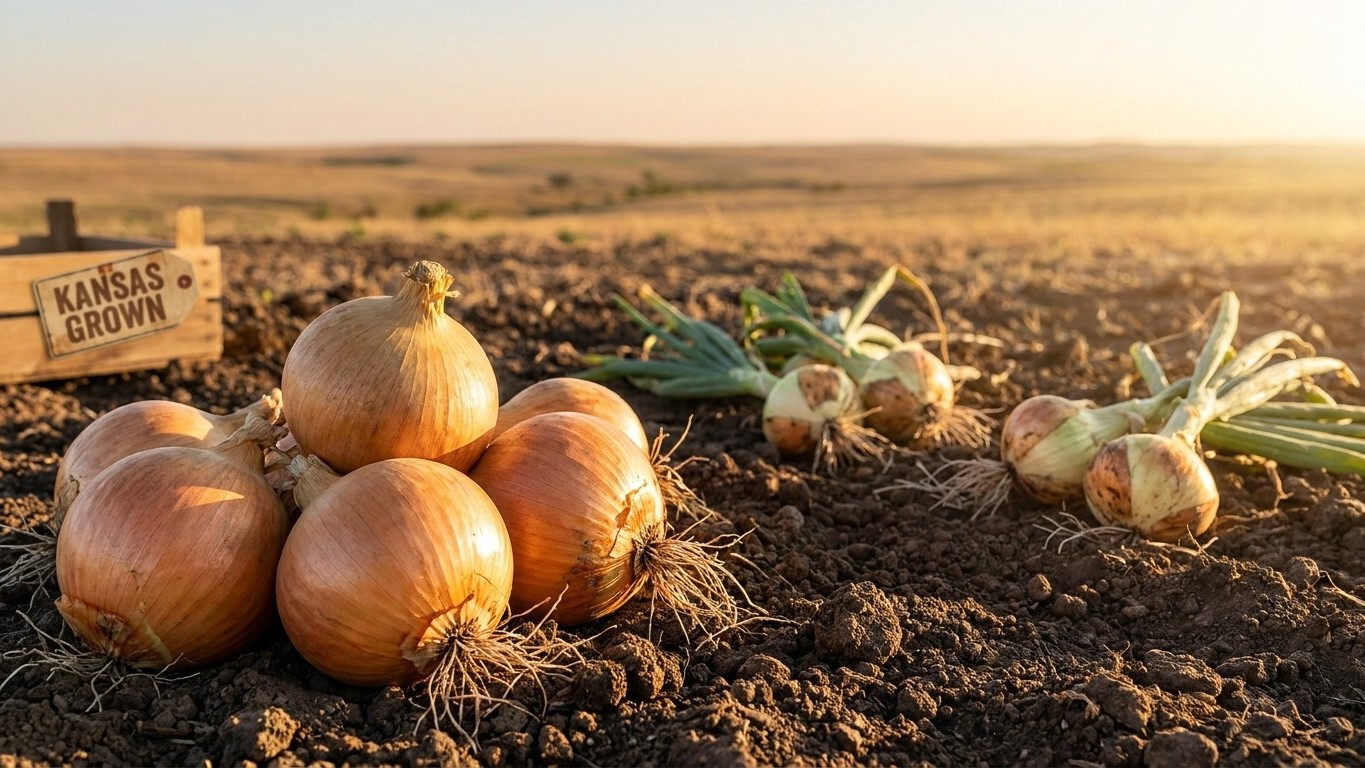

At 37.65 degrees north, Wichita gets 14 hours and 36 minutes of daylight on the longest day of the year. That’s enough light to push intermediate-day onions into bulbing, and enough for a handful of long-day varieties at the low end of their range. It is not enough for most long-day types, and it’s already too much for short-day onions, which start bulbing too early and stay small. That single number decides almost everything about Growing Onions in Kansas.
How long your longest day is

Two figures matter more than soil, fertilizer, or how much water you give an onion patch: the latitude of your garden and the number of daylight hours it receives at the June solstice. For the reference station near Wichita, that’s 37.65 degrees north and 14 hours 36 minutes of daylight on the longest day. Onions don’t measure temperature to decide when to stop growing leaves and start forming a bulb. They measure the length of the day. A short-day onion is genetically wired to bulb once daylight hits roughly 12 hours, according to Clemson Cooperative Extension’s Home & Garden Information Center. A long-day onion waits for 14 to 16 hours, and it will not bulb at all if that threshold is never reached where it’s planted.
At 14 hours 36 minutes, Wichita sits comfortably inside intermediate-day territory. That’s the group of varieties bred to bulb somewhere between 12 and 14 hours, give or take, which makes them the safest default choice for most of Kansas. A few long-day varieties whose published range dips down to 35 degrees north will also bulb here, though they’re working near the bottom of their comfort zone. Short-day onions, on the other hand, are already past their trigger point by early summer here. They’ll bulb, but they’ll bulb small, because the plant hasn’t had time to build enough leaf mass first. Knowing When to Plant Onions in Kansas helps make sure your chosen variety has enough time to reach that leaf mass before the daylight trigger kicks in.
Here’s the complication: Kansas is not a single point on a map. The state runs from about 37 degrees north at the Oklahoma border to 40 degrees north at the Nebraska line, a spread of nearly three full degrees of latitude. That’s enough to shift daylight hours meaningfully. A gardener in Liberal, near the southern border, sees a shorter longest day than someone in Atchison, up near the northeast corner. If you garden near either edge of the state, it’s worth checking your own latitude rather than assuming the Wichita figure applies exactly to your yard. The general rule holds statewide, but the margins move.
Which varieties bulb in Kansas
Twelve varieties documented on this site have a published latitude range that covers 37.65 degrees north, which means they’re built to bulb reliably in Kansas conditions. You can see the full breakdown in The Best Onion Varieties for Kansas, which includes both intermediate-day and long-day types, since the low end of the long-day range overlaps with what Kansas daylight actually provides.
- Bridger (long-day, 35-50N)
- Cabernet (intermediate-day, 35-45N)
- Calibra (intermediate-day, 35-45N)
- Candy (intermediate-day, 33-40N)
- Elsye (intermediate-day, 32-45N)
- Expression (intermediate-day, 32-45N)
- Monastrell (intermediate-day, 35-46N)
- Red Long of Tropea (intermediate-day, 35-48N)
- Scout (intermediate-day, 32-46N)
- Sierra Blanca (intermediate-day, 32-45N)
- Walla Walla Sweet (long-day, 35-55N)
- White Castle (short-day, 30-38N)
That last one, White Castle, is a short-day type sitting right at the northern edge of its published range. It will bulb here, but expect smaller onions than you’d get further south, since Kansas daylight already exceeds its ideal trigger point by the time bulbing starts.
A second set of seven varieties falls within about 1.5 degrees of a published boundary, which puts them in a genuine gray zone: Ailsa Craig, Barolo, Blush, New York Early, Patterson, Red Long of Florence, and Rossa di Milano all list a lower bound of 38 degrees north, just barely above Wichita’s 37.65. These may bulb in Kansas, particularly in the northern part of the state, but they’re working at the edge of their range rather than in the middle of it. Treat them as a gamble worth trying in a small trial bed, not a guaranteed crop.
Then there’s the list that matters most, because it’s the one that explains a failed onion patch. Nine varieties will not bulb in Kansas at all:
- Gabriella (short-day, 20-35N)
- Madalyn (short-day, 20-35N)
- Red Rock (short-day, 30-36N)
- Frontier (long-day, 40-50N)
- Powell (long-day, 43-47N)
- Red Carpet (long-day, 40-45N)
- Redwing (long-day, 43-65N)
- Safrane (long-day, 42-50N)
- Talon (long-day, 42-50N)
The short-day trio (Gabriella, Madalyn, Red Rock) is bred for latitudes well south of Kansas, so those onions bulb far too early here, giving tiny bulbs on plants that never got the chance to grow. The long-day group runs the opposite failure. Frontier, Powell, Red Carpet, Redwing, Safrane, and Talon are all bred for daylight hours that Kansas summers simply don’t deliver. Plant any of them here and you’ll get exactly what a lot of frustrated gardeners have already seen from a mislabeled bag of sets: healthy green tops all summer, then a plant that never swells at the base, and eventually rots in the ground because it kept waiting for a daylight trigger that was never coming.
When to plant onions in Kansas
Planting time follows day length, and day length is exactly why Kansas timing looks different from a garden in Georgia or one in Minnesota. In mild-winter states, onions often go into the ground in fall and overwinter as small plants. Kansas winters are generally too cold for that approach to be reliable, so the standard window is late winter into early spring, timed around the last expected frost.
At the Wichita reference station, the last spring frost typically falls between April 4 and April 18, based on NOAA’s 1991-2020 climate normals for 32-degree freeze probability. Onion sets and transplants tolerate a light frost better than most garden vegetables, so many Kansas gardeners get plants or sets into the ground three to four weeks before that window closes, often in early to mid-March, so the plants have maximum daylight time to build leaves before the bulbing trigger kicks in during early summer.
On the other end of the season, the first fall frost at the same station arrives between October 23 and November 2. That date matters less for planting and more for harvest and curing, since onions need to be out of the ground and drying before hard freezes set in.
Both of those windows come from an airport weather station, and that distinction matters more than it sounds. Airport stations tend to sit in open, paved, heat-retaining terrain, which skews their readings warmer than a shaded suburban yard or a low-lying rural garden. In practice, that means many home gardens across Kansas see their last spring frost arrive later than the April 4-18 window, and their first fall frost arrive earlier than October 23-November 2, sometimes by one to two weeks. Gardens at higher elevation or in low frost pockets should push even further from these dates. Treat the NOAA figures as a starting frame for planning, not a guarantee for your specific plot. Check your own county extension office or a local frost record before setting a firm planting date.
Sweet onions or onions that keep
Kansas sits in a spot where the answer isn’t fully one thing or the other, and that’s actually useful information for planning a pantry. The tradeoff between sweetness and storage life isn’t a matter of luck or variety marketing. It’s chemistry. University of Missouri Extension notes that, as a rule, sweet onions do not store as well as more pungent types, and the reason is that pungency comes from volatile sulfur compounds. Those compounds give an onion its bite, and they’re also the compounds that help protect the bulb during long storage. A sweet onion has fewer of them, which makes it better fresh off the cutting board and worse three months into winter.
That chemistry lines up with day length in a way that’s easy to remember: short-day onions, grown in the South, tend to run sweeter and store for a shorter window. Long-day onions, grown farther north, tend to run sharper and keep longer, sometimes well into late winter. Kansas, sitting in intermediate-day territory, produces onions that land somewhere in the middle of that spectrum rather than firmly at either end.
What that means for a Kansas garden is a realistic choice rather than a guaranteed outcome in either direction. A variety like Candy, bred for sweetness, will taste great in a summer salad but won’t last on a shelf the way a sharper variety would. Something like Scout or Monastrell, more toward the pungent, storage-friendly side of the intermediate-day group, will hold up longer in a cool, dry spot, but it won’t have the mild bite of a sweet onion eaten fresh in July.
A pantry stocked with a sweet variety in March is a pantry that’s already empty of onions. A pantry stocked with a sharper, intermediate-day type is more likely to still have a few sound bulbs left, softened a little, maybe starting to sprout, but usable. If the goal is onions that carry a Kansas household through winter cooking, lean toward the pungent end of the intermediate-day list. If the goal is a few weeks of good raw onion in summer sandwiches, plant the sweet ones and plan to use them fast.