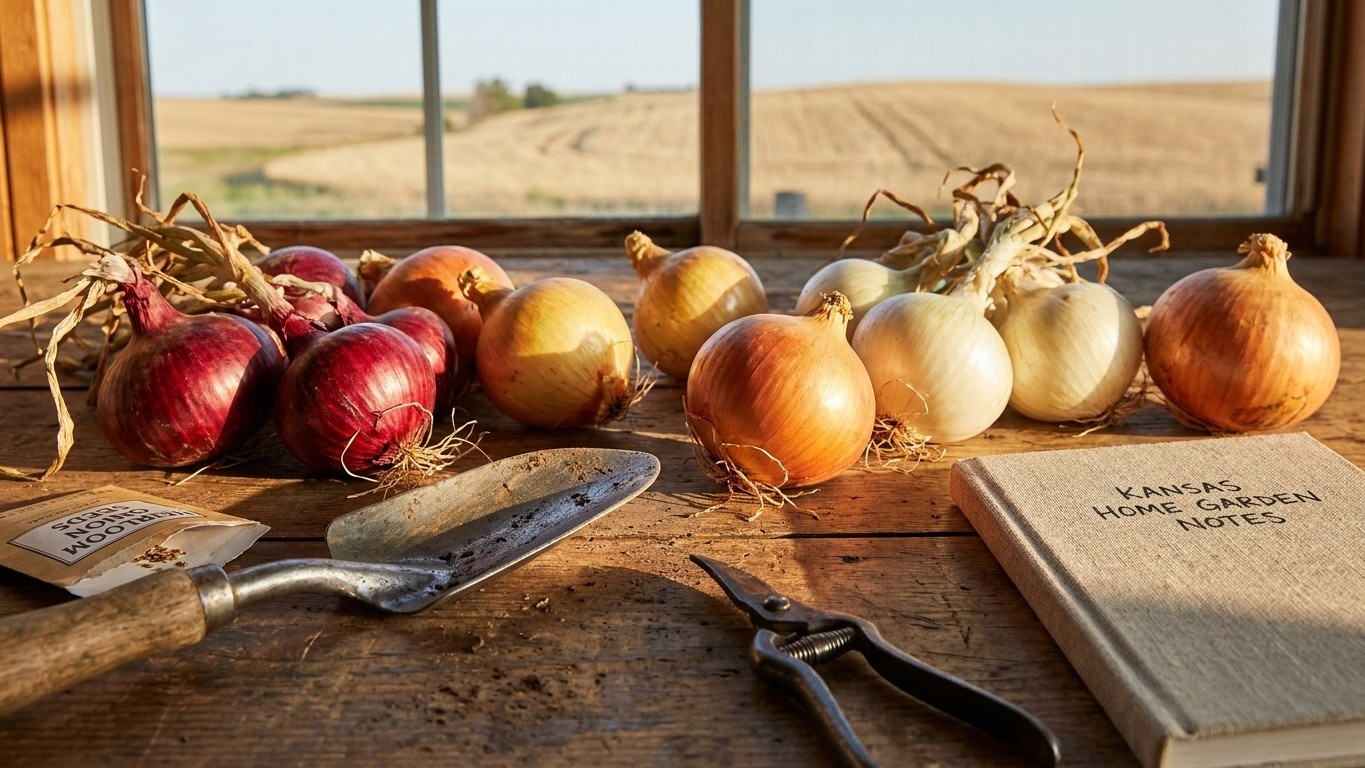

At 37.65 degrees north, Kansas gardens sit in intermediate-day onion territory, with 14 hours and 36 minutes of daylight on the longest day of the year. That number decides which onions will actually form bulbs here, and it rules out more varieties than most seed racks let on. Nine intermediate-day varieties are built for exactly this latitude, and two long-day types stretch far enough south to work too.
The short answer for Kansas

Onions do not respond to heat, frost dates, or soil temperature when it comes to bulbing. They respond to day length. Once the number of daylight hours crosses a variety’s built-in threshold, the plant stops putting energy into leaves and starts building a bulb underground. At Wichita’s 37.65N, the longest day tops out at 14 hours 36 minutes, which places Kansas squarely in the intermediate-day category, the group bred to bulb somewhere between 12 and 14 hours of daylight rather than waiting for the 14-to-16-hour trigger that long-day types need.
Nine intermediate-day varieties have published ranges that cover this latitude: Cabernet, Calibra, Candy, Elsye, Expression, Monastrell, Red Long of Tropea, Scout, and Sierra Blanca. These are the safest bets for a Kansas garden regardless of whether you’re planting in Wichita, Topeka, or Dodge City, because their bulbing window brackets the state’s actual daylight numbers with room to spare.
Two long-day varieties also reach this far south on their published range: Bridger (35 to 50N) and Walla Walla Sweet (35 to 55N). Both will bulb in Kansas, though they sit at the southern edge of their comfort zone, so expect them to perform more reliably the farther north you garden within the state. There’s also White Castle, a short-day type rated for 30 to 38N, which just barely includes Wichita’s latitude, though it has no dedicated variety page on this site and tends to bulb early and small this far north compared to how it performs in true short-day territory like the Gulf Coast.
The practical takeaway: build your onion bed around the intermediate-day nine, treat Bridger and Walla Walla Sweet as reliable long-day additions, and skip anything rated as a strict short-day variety unless you’re gardening in the very southern tier of the state.
What will not work here
This is the part seed catalogs rarely spell out, and it’s the difference between a harvest and a wasted growing season. Plant a variety outside its published latitude range and you don’t get a smaller onion. Depending on which direction you missed the range, you get either a stunted bulb or no bulb at all.
Three short-day varieties are rated for latitudes well below Kansas, and planting them here means the plant starts bulbing while it’s still tiny, because short-day types trigger at around 12 hours of daylight, a threshold Kansas blows past early in the season:
- Gabriella (short-day, 20-35N) — bulbs while the plant is still small, giving undersized onions instead of a proper harvest
- Madalyn (short-day, 20-35N) — same early-trigger problem, bred for latitudes far south of Kansas
- Red Rock (short-day, 30-36N) — closest of the three to Kansas but still south of the state’s southern border, with the same small-bulb outcome
On the opposite end, six long-day varieties are rated for latitudes above Kansas, meaning the state’s summer days never get long enough to flip the bulbing switch:
- Frontier (long-day, 40-50N) — needs more daylight hours than Kansas summers provide
- Powell (long-day, 43-47N) — bred for latitudes well north of the state
- Red Carpet (long-day, 40-45N) — the threshold sits above what Kansas summers deliver
- Redwing (long-day, 43-65N) — built for northern-tier and Canadian daylight hours
- Safrane (long-day, 42-50N) — same story, daylight ceiling too low here
- Talon (long-day, 42-50N) — requires hours of daylight Kansas summers never reach
Plant any of these six in a Kansas garden and the result isn’t a small onion. It’s leaves all season, followed by rot as the plant runs out of growing season still waiting for a daylight trigger that never arrives. That’s a variety mistake, not a fertilizer or watering problem, and no amount of feeding fixes it.
What changes across Kansas
Kansas isn’t one latitude. The state runs from roughly 37N at the Oklahoma border to about 40N at the Nebraska line, a spread of nearly three degrees. That’s enough to shift a gardener from solidly intermediate-day territory into the blurred edge of long-day country.
The figures in this article come from Wichita, sitting at 37.65N, close to the state’s southern tier. A gardener near the Nebraska border gets noticeably more daylight on the summer solstice than one near the Oklahoma line, which nudges northern Kansas gardens toward the blurred zone for several long-day varieties whose published ranges start at 38N: Ailsa Craig, Barolo, Blush, New York Early, Patterson, Red Long of Florence, and Rossa di Milano. These aren’t a flat yes for northern Kansas, but they’re worth trying there in a way they aren’t in Wichita or points south, since 38N sits right at their published lower bound.
| Location | Latitude | Daylight, longest day | What changes |
|---|---|---|---|
| Southern Kansas border | ~37N | Slightly less than 14h36 | Intermediate-day varieties remain the safest choice; blurred-zone long-day types are less likely to bulb reliably |
| Wichita (reference city) | 37.65N | 14h 36m | Baseline figures used throughout this article |
| Northern Kansas border | ~40N | Slightly more than 14h36 | Blurred-zone long-day varieties (38-45N and wider) become more reliable |
If you garden near either edge of the state, don’t lean entirely on Wichita’s numbers. A grower in Goodland or a grower in Coffeyville is technically in the same state, but not in the same daylight window, and that difference is exactly what decides whether a borderline variety bulbs or just makes leaves.
Sweet now, or onions that last
Kansas gardeners sitting in intermediate-day territory face a trade-off that has nothing to do with luck and everything to do with chemistry. The compounds that give an onion its sharp bite, volatile sulfur compounds, are the same compounds that protect the bulb during months in storage. Breed the sulfur out for a milder, sweeter onion, and you also breed out its ability to keep past a few weeks on the counter.
University of Missouri Extension puts it plainly: as a rule, sweet onions do not store as well as the more pungent types. That’s not a marketing distinction between “mild” and “strong” onions. It’s a direct trade between flavor now and shelf life later.
Because Kansas falls in the intermediate zone rather than deep short-day or deep long-day territory, the state’s growers get a middle ground rather than an extreme in either direction. True short-day varieties, bred for the Deep South, tend to run sweeter and shorter-keeping because the plant races through a shorter growing window before daylight triggers bulbing. Long-day varieties, bred for northern summers with much longer growing seasons, build up more sulfur compounds and last well into winter.
Growing mostly intermediate-day varieties like Candy or Cabernet gives a Kansas pantry onions that hold reasonably well into early winter, without the deep-storage life of a true northern long-day onion like those grown in Minnesota or the Dakotas. If you want onions that make it to March, lean toward Bridger or Walla Walla Sweet’s long-day cousins where your latitude allows it, understanding that Walla Walla Sweet itself trades toward the sweet, short-keeping end despite being long-day. If you’d rather eat your onions fresh through fall, the sweeter intermediate types serve that purpose well and simply won’t be the ones left in the root cellar come late winter.
Checking this against your own garden
Every figure in this article traces back to Wichita’s 37.65N, and that number is a starting point, not a guarantee for every backyard in the state. Before you commit a season to a particular variety, a few checks take less than an hour and can save a wasted planting:
- Look up your own latitude if you’re gardening well north or south of Wichita, particularly near the Nebraska or Oklahoma border
- Confirm your local frost dates rather than relying on a statewide average, since Kansas’s western high plains and eastern lowlands don’t share the same last-frost window
- Call your county extension office and ask which onion varieties local growers have had success with, since they track regional performance data that a single reference city can’t capture
- Check the published latitude range on the seed packet or catalog listing against your own location before planting, especially for any variety in the blurred zone near 38N
None of this takes the place of the daylight math above, but it grounds it in your actual backyard rather than a weather station reading at Wichita’s airport.