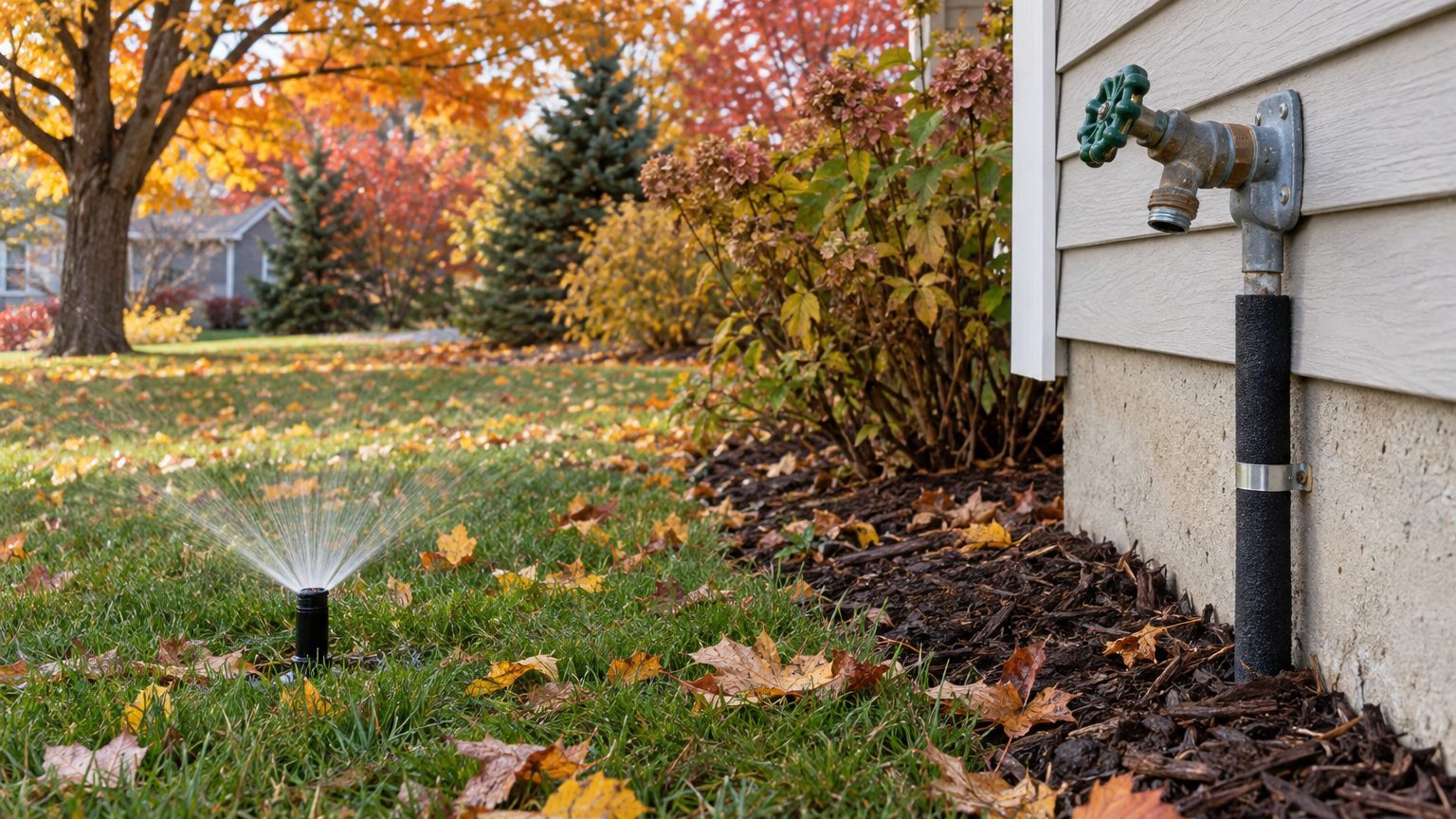

In Kansas, sprinkler lines and outdoor faucets need to be emptied in late October at the latest, ahead of the first hard freeze. That is the point where water left in pipes, valves and spigots can turn to ice and split them. Nights here run well below 32°F in midwinter, so a drained system is the only reliable protection. Most damage stays hidden until spring, when a split fitting starts spraying.
When to do it in Kansas
In Wichita, the reference point for Kansas timing, finish before the October 23 to November 2 first-frost window opens, and follow the rule of before the first hard freeze, not after the first light one. A light frost bruises tomato leaves and does little else. A hard freeze, with hours of sub-freezing air, is what cracks brass, PVC and the plastic bodies of valves.
What the October 23 to November 2 range means
The range comes from NOAA NCEI’s 1991-2020 Climate Normals for the Wichita airport station. It marks the band of dates where the probability of a 32°F freeze sits between 30 and 70 percent. That makes it a band of odds rather than a deadline. Some autumns bring the first freeze before October 23, and the early edge of the range is the safer target.
The figure describes an airport, and airports are warm. Suburban and rural lots usually see their first fall frost earlier than the airport does, often by one to two weeks, and more at higher elevation. Colder northern Kansas runs earlier still, so fall shutdown tasks move earlier as you go north. Look up the normals for the weather station nearest your county, or ask your county extension office what local records show. Broader state-level timing questions are covered in the Kansas guides.
Why Kansas does not get a shortcut
Some mild-winter states can skip the full blowout because the air rarely stays below freezing for long. Kansas is not one of them. NOAA’s 1991-2020 Normals for Wichita put the mean daily minimum of the coldest month at 22.5°F. That is an average night, so the cold nights run lower. The USDA Plant Hardiness Zone Map 2023 places Kansas in a range of 5b to 7a, and your own zone depends on where in the state you live.
Water left in a line through nights like those will freeze. The work cannot be treated as optional, only scheduled. Pick a dry, mild afternoon well ahead of the window, finish the sprinkler lines and the faucets in the same session, and keep the forecast open in another tab. If a hard freeze appears in the extended outlook before your target date, that forecast replaces the calendar.
Sprinkler lines: drain or blow out
Why trapped water splits things
Water expands as it turns to ice, and a closed pipe has nowhere to put the extra volume. The buried pipe itself often survives. What fails first are the parts that hold the most water and sit closest to the surface: the above-ground backflow preventer where the system ties into the house supply, the valves in their boxes, the risers, and the shallow fittings under the heads. A crack the width of a hair is enough. You will not see it until the system is pressurized in spring and water sprays from a place that was dry the previous fall.
Three ways to empty a system
| Method | How it works | Where it falls short |
|---|---|---|
| Manual drain | You open drain valves at the low points of the system and let gravity empty the lines. | Works only if the system was built with drain valves at every low point, and you have to find and open all of them. |
| Automatic drain | Valves open on their own when line pressure drops and release water. | Relies on slope and clean valve seats. Water can pool in low spots and flat stretches, and a stuck valve either leaks or stays shut. |
| Compressed-air blowout | Air pushed through each zone forces water out of the heads. | Needs enough air volume and careful pressure control, and it can damage parts if done carelessly. |
For Kansas, a compressed-air blowout is the method to plan around. With nights this far below freezing, you want a method that clears water from every head and fitting, not one that depends on terrain. Manual and automatic drains help, but neither reliably empties a system with uneven ground or long runs.
Doing a blowout safely, or handing it off
The basic sequence is short. Close the water supply to the irrigation system, set the controller to off or rain mode, and connect the compressor to the blowout port. Work one zone at a time, starting with the zone farthest from the connection. Run air until the heads stop spitting water and only mist remains, then move on. Cycle through all zones a second time. Running a single zone on air for too long wears the head internals, and every fitting has a pressure rating, so check the manufacturer’s maximum before connecting. Wear eye protection and keep your face clear of the heads.
A professional is the sensible choice in several situations. A small hardware-store compressor often cannot supply enough air volume, and volume matters more than pressure here. You may not know where the drain points or blowout port are, the lines may run over hills, or the backflow preventer may need service. Whichever route you take, book or schedule the blowout to land before the October 23 to November 2 window, and earlier in colder northern Kansas. When the lines are empty, the irrigation season is over, and the yard’s other fall chores come next, starting with Winterizing a Lawn.
Outdoor faucets and hoses
The shutdown order
Outdoor taps are the easiest part of the job and the most often skipped. The whole task is turning valves and pulling hoses off. In order:
- Disconnect every hose, along with splitters, hose-end timers and spray nozzles. Drain each hose and coil it for storage.
- Find the interior shutoff that feeds the outside faucet. Depending on the house, it may sit in a basement, crawl space, garage or utility closet. Close it.
- Open the outside faucet and leave it open so the water between the two valves drains out.
- Leave the outside faucet open all winter so any remaining moisture has room to expand.
Pull the hoses and drain the faucets before the October 23 to November 2 window, and sooner in northern Kansas where the first freeze comes earlier. The step-by-step version of this routine is laid out in Winterizing Outdoor Faucets Before the First Freeze.
Why a frost-free faucet still fails
A frost-free faucet has a long stem that puts the shutoff seat deep inside the heated wall, so the part you can see is supposed to drain itself. That works only when the water can run out of the barrel. With a hose attached, even a coiled hose with the nozzle closed, water stays trapped in the tube. It freezes, expands, and splits the pipe, usually inside the wall where you cannot see it. The faucet looks fine all winter, and the failure announces itself with a spring leak behind the drywall.
That is why the hose has to come off even if the faucet is rated for freezing weather. An insulated cover only slows heat loss and does not replace draining. More on how these fixtures work is in Frost-Free Outdoor Taps.
Some problems are a plumber’s job. If the faucet keeps dripping after the interior valve is closed, there is no interior shutoff at all, or the spigot does not tip slightly downward to drain, the fix involves cutting, soldering or replacing parts. Anything beyond turning valves belongs to a licensed plumber.
What goes wrong here
Because the first-frost band is a spread of odds, the most common failure is the early cold snap. A warm October leads people to assume they have time, and then one clear, calm night drops below freezing before the hoses are off or the lines are drained. The damage is the same as in a midwinter freeze, only it hits a system that is still full of water and still pressurized. If a hard freeze shows up in the forecast before October 23, do the whole shutdown that week rather than waiting for the window to open.
The forgotten hose
A hose left on a frost-free faucet is the classic case. In spring it appears as water running inside the house when the line is first turned on, a stain on the ceiling below the faucet, or a wet patch on a basement wall. The faucet itself may look untouched. Prevention is a habit: pull every hose and check the spots people forget, including the one behind the shed, the garage-side tap and the faucet used only for the garden. If a pipe freezes anyway, Frozen Pipes covers what to do before it splits.
The flooded valve box
Irrigation valves sit in boxes in the lawn, and those boxes collect water. A box that is full or poorly drained can freeze solid around the valves, cracking bodies and fittings even after a good blowout. The spring signs are a zone that will not shut off, a valve that weeps, or a soggy patch around the box lid. In fall, open each box, look for standing water and debris, and make sure the lid sits properly. A system left with the supply closed and the drain points open has the best chance of staying dry.
Common questions
Can I wait until November to winterize sprinklers in Kansas?
It is a gamble. Wichita’s first-frost range of October 23 to November 2, from NOAA’s 1991-2020 Normals, means November falls inside or after the window. Suburban and rural properties tend to freeze earlier than the airport, so finish ahead of the range.
Is a light frost enough to damage sprinkler lines?
Usually not. A light frost brushes leaves and surfaces. Damage comes from a hard freeze that lasts for hours, and above-ground parts like the backflow preventer are the first to give. Do not use a mild frost as a reason to delay.
Do frost-free faucets still need winterizing?
Yes, at least by removing the hose. A frost-free faucet drains itself only when nothing is attached, so a connected hose can trap water and split the pipe inside the wall.
How do I find my county’s date?
Start with the nearest NOAA weather station and compare it with the Wichita figures. Expect your date to land earlier if you are rural, higher up, or in northern Kansas. USDA zones run from 5b to 7a across Kansas, so your own area may differ from the reference city.