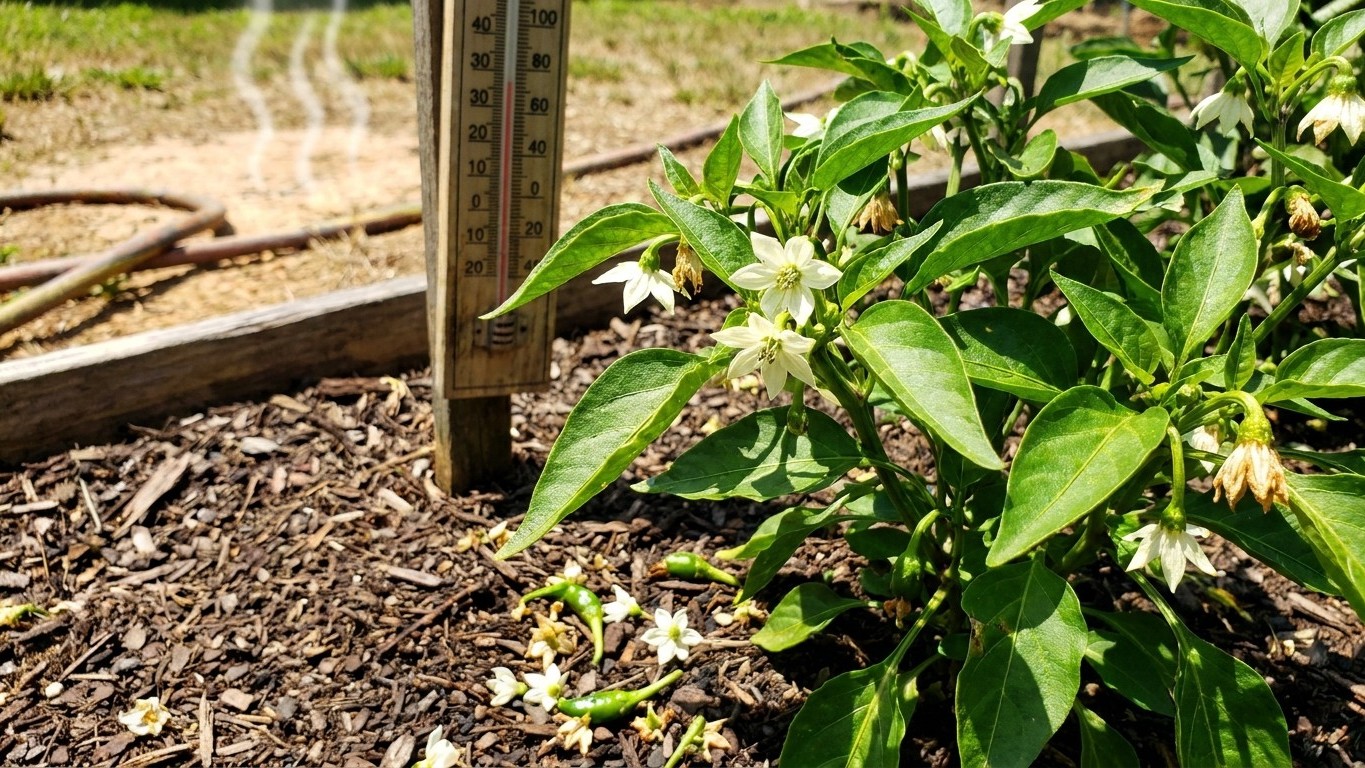

Peppers stop setting fruit in Kansas gardens for one of two reasons: the afternoons get too hot for pollen to stay viable, or a stretch of chilly nights stalls flower development before it can finish. Both extremes can show up in the same growing season here, which is why a plant loaded with blossoms in June can still hand you an empty basket by August. Timing the transplant and watching the calendar closely enough narrows that gap.
The short answer
Wichita’s climate normals record 57.6 days a year at or above 90°F, an average drawn from three decades of data covering 1991 through 2020. That’s not a handful of scorching afternoons, it’s close to two full months where the mercury crosses the threshold at which pepper pollen turns sterile before it ever reaches the stigma. A pepper plant doesn’t need a heat wave to fail; a single 90-plus afternoon during flowering can drop that day’s blossoms even while the plant otherwise looks perfectly healthy.
Set against a growing season that runs roughly from mid-spring to mid-fall, that many 90-degree days means a meaningful share of the outdoor season carries some risk of blossom drop from heat alone. That doesn’t mean every plant fails. A pepper plant flowers continuously through summer, so the cooler days in between still get pollinated normally. But it does mean the plant needs staying power, and gardeners who set out a single wave of transplants and expect steady fruit straight through August are working against the data.
The other failure point sits at the opposite extreme, and it matters just as much. Nights that drop below 55°F slow flower and fruit development to a crawl, sometimes stopping it outright. Kansas nights can dip into that range in early spring, right after transplant, and again as fall approaches, well before the daytime heat lets up. This is where the record for Kansas gets thinner: this site’s climate data for the state covers daytime heat load, the 90-degree count above, but does not carry summer overnight low temperatures for any reference station. That gap is worth naming plainly rather than papering over. A gardener can’t reliably infer nighttime lows from latitude, from the coldest month of the year, or from any daytime figure. The only dependable fix is watching your own thermometer through the growing season, especially in the weeks right after transplant and again as nights turn cool ahead of the first fall frost.
Put those two thresholds together and the real flowering window for Kansas peppers is narrower than the frost-free season suggests. The frost-free calendar tells you when it’s safe to have plants outdoors. It doesn’t tell you when those plants will actually set fruit.
When to start seed here
Pepper transplants need 8 to 10 weeks indoors before they’re ready to go into the ground, and they shouldn’t move outside until the soil has warmed to 60°F and the frost risk has passed, according to Utah State University Extension’s guidance on growing peppers. Working backward from your local last-frost date turns that general rule into an actual date on your calendar.
- Find your last spring frost date. Wichita’s 1991-2020 climate normals put the 32°F freeze-probability window at April 4 to April 18. That’s the reference-station figure, not a state-wide guarantee: suburban and rural gardens away from the airport station typically see their last frost later, often by one to two weeks, and more at elevation. Check your own county extension office or a local frost record before locking in a date.
- Add a buffer for soil warming. Air temperature crossing above freezing doesn’t mean the ground has caught up. Soil temperature is the stricter test, since pepper roots stall in cold ground even when the air feels warm enough for shirtsleeves. A soil thermometer pushed a few inches deep on a sunny afternoon gives a far more reliable reading than the day’s forecast high. In most Kansas locations, that 60°F soil threshold trails the last frost date by one to three weeks.
- Set your transplant target date. If your last frost falls somewhere in the April 4 to April 18 window and your soil reaches 60°F roughly one to three weeks after that, a reasonable transplant target lands in late April to mid-May, adjusted for your specific ground and county.
- Count backward 8 to 10 weeks. From a late April to mid-May transplant target, indoor seed-starting falls somewhere in late February to early March, shifting earlier or later depending on where your county sits relative to the reference station.
That arithmetic is portable. Swap in your own frost date and soil-warming estimate, and the same 8-to-10-week countback applies no matter which Kansas county you garden in. What doesn’t change is the sequence: frost date, then soil temperature, then seed-start date, always worked backward from the transplant target rather than forward from a fixed calendar day.
What goes wrong here
- Blossom drop in a hot spell: when afternoon highs push past 90°F during flowering, which happens on 57.6 days a year on average around Wichita, pollen viability drops and open flowers fall off without setting fruit. The plant isn’t damaged, it’s simply skipping that round of flowers. Light afternoon shade during the hottest stretch, kept up with even soil moisture so heat stress doesn’t compound, gives the plant room to push out a new flush once temperatures ease. Waiting it out costs nothing; pulling a plant that’s just pausing does.
- Blossom drop in a cool night: the same failure shows up at the opposite temperature extreme, with flowers dropping when nights run cold enough to stall development. Because this site’s Kansas data doesn’t include summer overnight lows, the only reliable check is your own thermometer, watched through late spring right after transplant and again as nights cool going into fall. A frost cloth or lightweight row cover thrown over plants on a night that’s shaping up unusually cool for the season is cheap insurance against a lost flush of flowers.
- Sunscald on exposed fruit: Kansas summer sun is intense enough that fruit left exposed on a plant with thin or wind-damaged foliage can develop soft, sunken, papery patches on the side facing direct sun. Keeping the plant’s leaf canopy intact, rather than pruning it hard mid-season, is the simplest prevention, since the leaves themselves shade the developing fruit.
- Blossom-end rot: a dark, leathery patch at the fruit’s blossom end usually traces back to uneven watering rather than a true calcium shortage in most home garden soil. Long dry stretches followed by a heavy soaking, common during a Kansas hot spell, interrupt the calcium uptake fruit needs while it’s forming. Even, consistent watering through the hottest weeks, rather than infrequent deep soakings, is the most direct fix.
Common questions
Can I still get pepper fruit if my summer nights stay above 55°F all season? Yes, and it puts you in a better position than gardens where nights run cool, since heat then becomes the only limiting factor to track. Watch the 90-degree stretches during flowering and expect blossom drop to ease once those pass.
Does misting flowers help pollination during a hot spell? Extra moisture on the foliage doesn’t change pollen viability once the temperature has already crossed the failure threshold. The more reliable response is patience: wait for a cooler run of days and let the next flush of flowers set normally.
Should I start a second round of pepper seed for a fall crop? It’s possible in principle, but the arithmetic has to run the other direction, counting forward from a fall transplant date back through 8 to 10 weeks of indoor growing, and checking that flowering wouldn’t land in a stretch of nights already dropping toward the 55°F mark. Given how tight that window gets in a shorter fall season, most Kansas gardeners get more reliable results focusing effort on the spring planting.
How long after flowering should I expect ripe fruit? Utah State University Extension puts the span at 35 to 45 days, counted from when the flower opens, not from the sowing or transplant date. That distinction matters when a plant looks quiet: a flower that opened during a 90-plus stretch may simply be waiting its turn behind a cooler round of blossoms that set successfully.