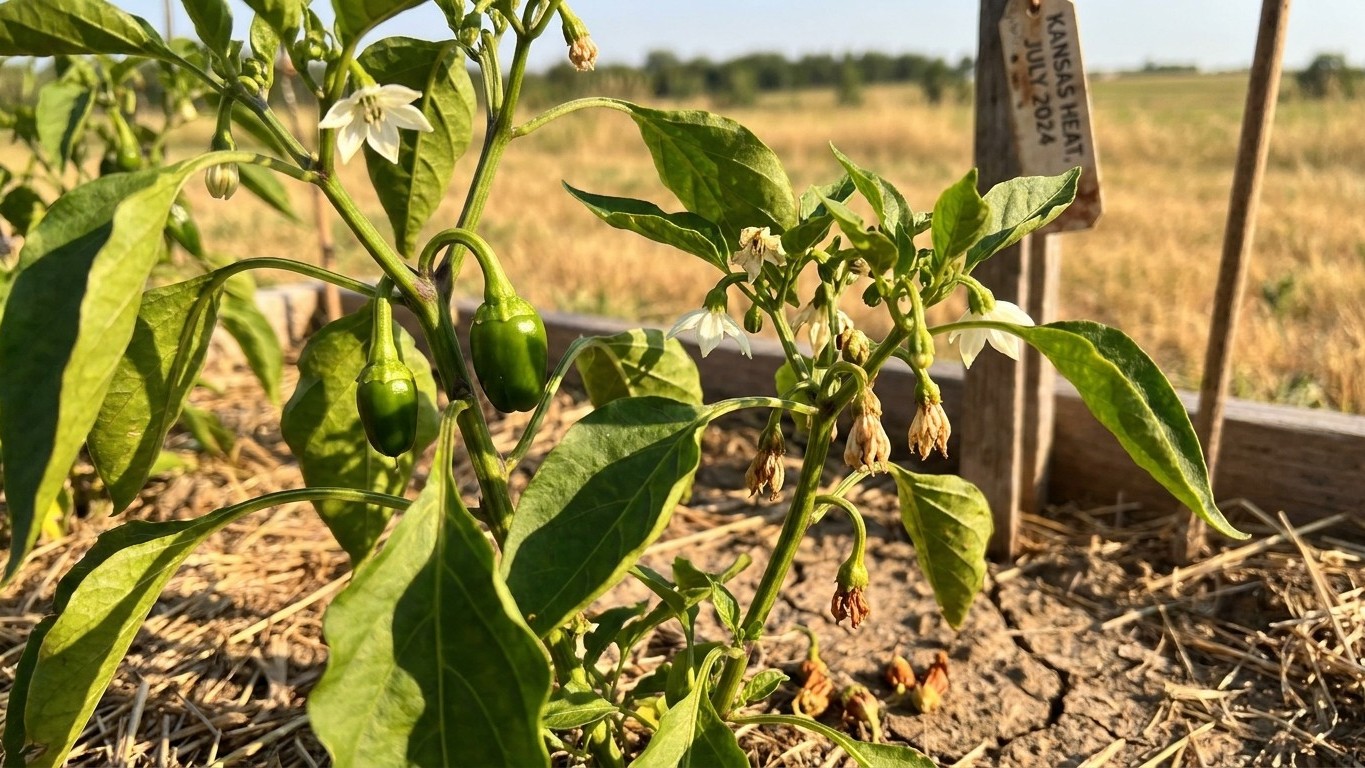

Peppers set fruit inside a narrow temperature window, and Kansas summers test both edges of it. Transplant only after frost has passed and soil has warmed to 60 F, starting seed 8 to 10 weeks earlier indoors. The reference station at Wichita logs 57.6 days a year at or above 90 F, a heat load that pushes fruit set toward failure during the hottest stretches. Night temperatures matter just as much, but this site does not track them, so that half of the equation is on you.
The short answer

Start with the number that actually shapes a Kansas pepper season: 57.6 days a year at or above 90 F, based on NOAA NCEI Climate Normals for 1991-2020 at the Wichita reference station. That’s not a handful of scorching afternoons. It’s close to two months, scattered mostly across July and August, when daytime highs sit in the range where pepper flowers abort before they ever become fruit. Choosing among Pepper Varieties That Ripen in a Kansas Season can help offset the fruit lost during that stretch.
The heat end
Pepper plants don’t stop growing in that heat, and they often keep flowering too. What stops is fertilization. Pollen becomes less viable, blossoms drop at the stem, and a plant that looks loaded with flowers in mid-July can end August with surprisingly few peppers to show for it. Gardeners in south-central Kansas, closer to the Wichita normals, tend to see this most sharply in the back half of summer. Gardeners farther north or at higher elevation inside the state may see somewhat fewer 90-degree days, but the mechanism doesn’t change: cross a threshold, and fruit set slows or stops until conditions ease.
The cool end you have to watch yourself
Fruit set fails on the low side too. Nights below 55 F cause the same kind of blossom drop as extreme daytime heat, just through a different mechanism. This site carries daytime heat data for Kansas, but it does not carry summer night minima, and there’s no reliable way to guess those numbers from latitude or from how cold the state gets in January. A river valley, a low spot in a yard, or an open field can all run several degrees cooler overnight than a in-town location just a few miles away. If your peppers are setting fruit fine during a mild week and then stall, check your own overnight lows with a simple min-max thermometer before assuming heat is to blame — see Why Peppers Fail to Set Fruit in Kansas for the full breakdown. It might be the opposite problem.
When to start seed here
The timing question comes down to counting backward from two fixed points: your last spring frost and the date your soil actually reaches 60 F. Here’s how that arithmetic works using the Wichita reference figures.
- Start with the frost window. At the Wichita reference station, the last spring freeze (32 F) falls somewhere between April 4 and April 18, based on the 1991-2020 NOAA NCEI 30-70% probability band. That’s a range, not a promise, and it comes from an airport weather station, not from your backyard.
- Adjust for where you actually garden. Suburban and rural sites typically see their last frost later than the reference station, often by one to two weeks, and more at higher elevation. A gardener outside town should treat late April, not early April, as the safer working target.
- Wait for soil, not just for the calendar. Air temperature can feel warm while soil at transplant depth is still cold. Peppers need soil at 60 F before they go in the ground; a simple soil thermometer pushed a few inches down tells you more than any date on a seed packet.
- Count back 8 to 10 weeks from your realistic transplant date to find your indoor seed-starting window. If your soil and frost risk both clear by early-to-mid May, that puts seed-starting somewhere in early-to-mid March, adjusted forward if your site tends to lag behind the reference station.
Why the range matters more than a single date
Treating April 4 as a hard start date is where a lot of Kansas pepper seasons go wrong. The two-week spread between April 4 and April 18 already reflects normal year-to-year variation at one station; layer on a slower-warming rural yard and the real safe window can run into late April or beyond. Redo this math for your own county rather than borrowing someone else’s date wholesale, and check your soil before you check the calendar.
What goes wrong here
Four failures, four fixes
- Blossom drop from heat. Once days repeatedly push past 90 F, flowers fall off the stem without setting fruit. Afternoon shade cloth in the 30 to 40 percent range, deep mulch to keep root zones cooler, and watering in the morning rather than midday all reduce the stress that triggers the drop.
- Blossom drop from cool nights. The same symptom, opposite cause: nights below 55 F stall fertilization just as effectively as extreme heat. If flowers are dropping early in the season, hold off blaming heat and check your overnight lows instead. Row cover on cool spring nights and choosing a planting site with some reflected warmth, near a south-facing wall for example, can buy a few critical degrees.
- Sunscald. Kansas sun is intense, and fruit left exposed after heat stress thins out the plant’s leaf cover develops pale, blistered patches on the side facing the sun. Keeping foliage full by avoiding heavy pruning, and adding shade cloth during the worst afternoon hours, protects fruit that would otherwise scald on the vine.
- Blossom-end rot. Irregular watering, especially the swing between a dry week and a heavy soak during a hot spell, interferes with calcium uptake and shows up as a dark, sunken patch on the fruit’s bottom end. Consistent watering on a schedule, plus mulch to even out soil moisture, prevents most cases without needing a calcium spray.
Checking this against your own county
Everything above comes from a single reference station and a set of general thresholds published by Utah State University Extension. Neither one accounts for your specific soil, your yard’s microclimate, or how your particular county’s frost dates compare to Wichita’s. For that level of detail, K-State Research and Extension (ksre.k-state.edu) maintains county-level offices across Kansas that track local frost data, soil conditions, and variety performance specific to your area. A phone call or visit to your county’s office will tell you how much earlier or later your own transplant window runs compared to the Wichita normals used here, and that’s worth confirming before you commit a whole flat of pepper seedlings to a date on a website.
Common questions
What temperature stops pepper fruit set? Fruit set fails at both ends: nights below 55 F and days above 90 F. Either extreme can cause flowers to drop before they turn into fruit, according to Utah State University Extension.
When should I start pepper seeds indoors in Kansas? Count back 8 to 10 weeks from your expected transplant date, which itself depends on your last frost and when your soil reaches 60 F. At the Wichita reference station, that points toward early-to-mid March for many gardeners, though rural sites often need to shift later.
How many days does Kansas typically stay above 90 F? At the Wichita reference station, NOAA NCEI Climate Normals for 1991-2020 record an average of 57.6 days a year at or above 90 F. Other parts of the state may run somewhat higher or lower, but this site does not carry those additional figures.
Can I still grow peppers if my nights stay above 55 F all summer? That’s the goal for good fruit set, but this site does not track summer night minima for Kansas. Watch your own overnight lows with a thermometer rather than assuming based on the season or your location’s latitude.