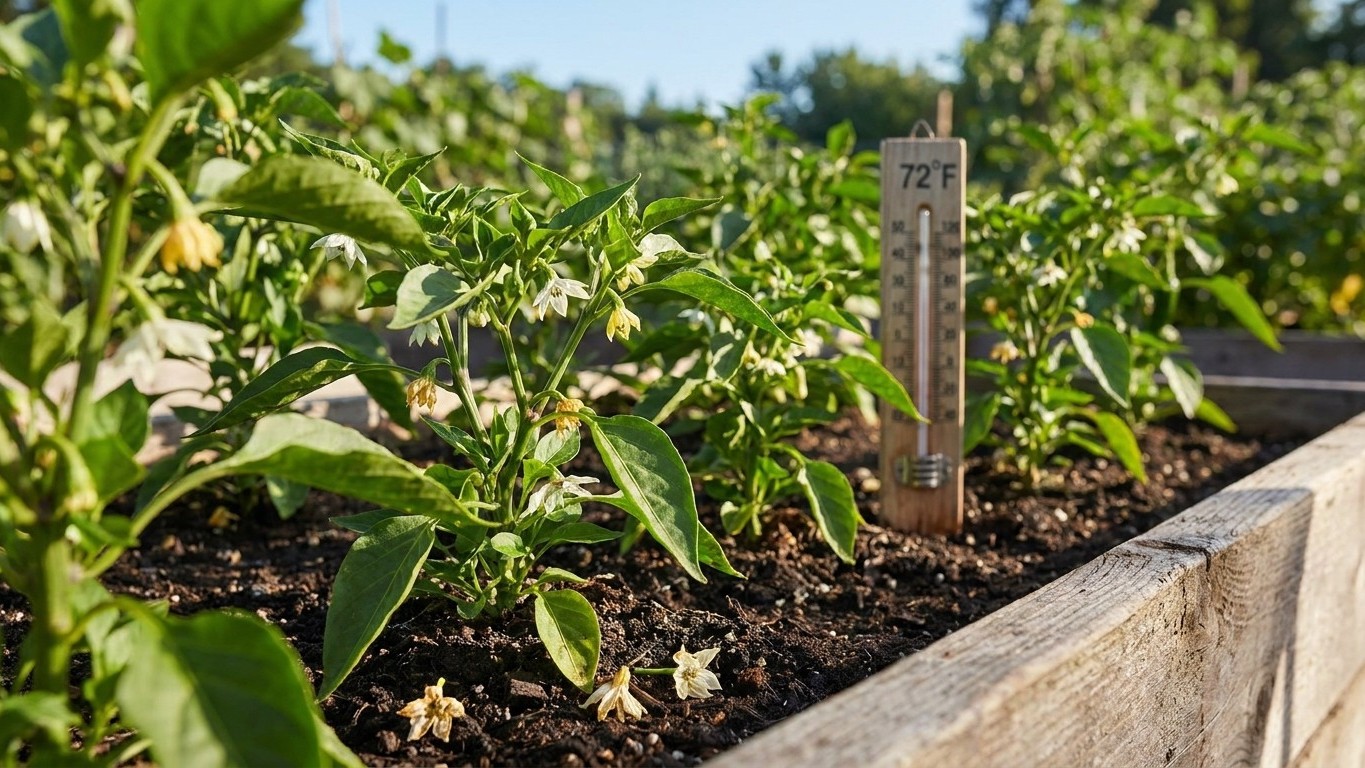

In Kansas, start pepper seed indoors roughly eight to ten weeks before your local transplant date, which itself falls after the last spring frost and once soil warms to 60 F. For the Wichita area, that frost window runs April 4 to April 18, so seed-starting typically lands in mid-to-late February. Your county may differ, and the arithmetic below shows how to check.
The short answer
Wichita averages 57.6 days a year at or above 90 F, based on NOAA NCEI Climate Normals from 1991 to 2020. That’s nearly two months of the growing season where afternoon heat climbs past the threshold that stresses a pepper plant. This matters because pepper fruit set fails on the hot end just as reliably as it fails on the cold end: once daytime temperatures push above 90 F, flowers often drop before they’re pollinated, according to Utah State University Extension. With more than 57 days a year crossing that line in south-central Kansas, a gardener who times a planting for early June instead of late April can watch a plant flower for weeks without setting a single pod.
The flip side gets less attention but matters just as much. Fruit set also fails when nights drop below 55 F, and that threshold isn’t something this site tracks for any Kansas location. Days above 90 F come from a fixed climate record; overnight lows in June or July depend on local terrain, wind exposure, and whether a garden sits in a low spot that collects cold air. A yard three miles from another can run five degrees cooler at 4 a.m. for reasons no statewide dataset captures. The only way to know your own risk is to watch your own thermometer through the transplant window, particularly in the first few weeks after peppers go into the ground, when a late cool snap can undo an otherwise good start.
There’s a second layer to the heat problem. Utah State Extension notes that peppers need roughly 35 to 45 days from flowering to ripen fruit, not from sowing or transplanting. That means a heat spell hitting during flowering, not during germination or vegetative growth, is what actually costs a harvest. A plant that germinated fine in March and grew well through May can still lose its first flush of blooms if a 90-plus-degree stretch lands in July right when it starts to flower. Kansas gardeners who time their seed start correctly but ignore the flowering window can still end up with a plant that’s healthy, tall, and nearly fruitless.
Put together, the short answer is this: seed-starting timing gets you a plant that’s ready to transplant at the right calendar moment, but it doesn’t protect that plant from a 90-degree week or a cool night once it’s flowering. Both ends of the temperature range have to be managed separately, and only one of them (the hot one) has a number attached to it here.
When to start seed here
Working backward from transplant to seed-starting date isn’t complicated, but each step depends on a number specific to your location, not a statewide guess. Here’s the sequence, using the Wichita-area frost data as the working example.
- Start with the local last-frost window. For the Wichita reference station, NOAA NCEI’s 1991-2020 normals put the 32 F freeze probability window at April 4 to April 18. That’s a 30 to 70 percent probability band, not a guarantee, and it comes from one airport weather station.
- Adjust for your actual garden, not the airport. Suburban and rural sites typically see their last frost later than an airport station, sometimes by one to two weeks, and more if the garden sits at higher elevation or in a low-lying area that collects cold air overnight. A gardener outside Wichita proper should treat April 18 as an early-case estimate, not a target date.
- Don’t transplant on the frost date alone. Utah State Extension is specific that the trigger isn’t the calendar, it’s the soil: transplant once soil temperature reaches 60 F, and only after frost risk has passed. Air temperature can feel warm on a day when six inches of soil is still cold from a wet spring, so a soil thermometer pushed a few inches down is worth more than a calendar page.
- Count backward 8 to 10 weeks from your real transplant date. If your soil hits 60 F and frost risk is gone in early May, for example, counting back eight weeks lands seed-starting in early March; counting back ten weeks pushes it to mid-February. The gap between those two numbers is intentional; use the longer lead time if you’re growing a variety you suspect matures slowly, and the shorter one if you’re working with limited indoor light and don’t want leggy, over-mature transplants sitting in small pots for too long.
- Re-check the date every year, not just once. Frost windows shift year to year even though the normals stay fixed, and soil warms at different rates depending on spring rainfall and cloud cover. Treat the arithmetic above as a method to repeat annually, not a fixed date to write on a calendar and forget.
The net result for most Kansas gardeners outside the Wichita metro is a seed-starting window somewhere between mid-February and mid-March, with the exact week depending on how much later your local frost date runs compared to the airport station and how quickly your particular garden’s soil warms in spring.
What goes wrong here
- Blossom drop from a hot spell. When daytime temperatures push above 90 F during flowering, and Kansas averages 57.6 such days a year, flowers abort before setting fruit. There’s no fix for the heat itself, but shade cloth over the plants during the hottest afternoon hours can lower leaf and flower temperature enough to save a flush of blooms. Timing the flowering stage to land in June rather than late July, by adjusting the seed-start and transplant dates, is the more reliable long-term fix.
- Blossom drop from a cool night. Fruit set also fails when nights drop below 55 F, a threshold this site doesn’t track for any specific Kansas location because summer night minima aren’t part of the climate normals data used here. Early in the season, especially in the first two to three weeks after transplant, watch your own overnight lows directly rather than assuming the frost-free date means nights are warm enough. Row cover pulled over plants on a night that’s forecast to dip low can buy a few critical degrees.
- Sunscald on exposed fruit. Kansas summer sun is strong enough that fruit exposed after a plant loses leaves to wind damage, disease, or over-aggressive pruning can develop pale, papery patches on the side facing the sun. The remedy is mostly preventive: avoid stripping foliage, and if a plant does lose leaf cover, use light shade cloth over the exposed fruit rather than leaving it bare through peak afternoon sun.
- Blossom-end rot from uneven watering. This shows up as a sunken, leathery patch at the fruit’s blossom end, and it’s driven by inconsistent soil moisture more than by any single hot day. In a climate with 57.6 days a year above 90 F, soil can swing from soaked to bone-dry fast during a heat spell, disrupting the calcium uptake plants need for fruit development. Mulching to hold moisture and watering on a steady schedule, rather than only when the plant looks wilted, reduces the swings that cause it.
Common questions
Can I start pepper seed earlier than 8 to 10 weeks before transplant?
Starting much earlier tends to produce leggy, root-bound transplants sitting in small containers too long before the soil is ready, which sets them back rather than getting them ahead. The 8 to 10 week window from Utah State Extension is meant to have plants at the right size, not just alive, when transplant conditions arrive.
What if my soil hits 60 F well before the last frost date?
Soil temperature and frost risk don’t always move together, and Utah State Extension’s guidance requires both conditions: soil at 60 F and frost risk passed. Transplanting into warm soil ahead of a possible late frost still risks losing the whole planting to a single cold night.
Does the 57.6 days above 90 F apply to my whole county?
That figure comes from the Wichita reference station in NOAA’s 1991-2020 Climate Normals, and it represents that specific location. Areas farther from that station, especially with different elevation or terrain, will run a somewhat different count, though the general pattern of a long, hot summer window holds across most of the state.
Why does the 35 to 45 day fruit maturity window matter if I’ve already timed my transplant right?
Because that window runs from flowering, not from seed-starting or transplanting. A plant transplanted at the perfect moment can still hit its flowering stage during a heat spell weeks later, and a good seed-starting schedule doesn’t by itself protect the flowering stage from a run of 90-degree days.