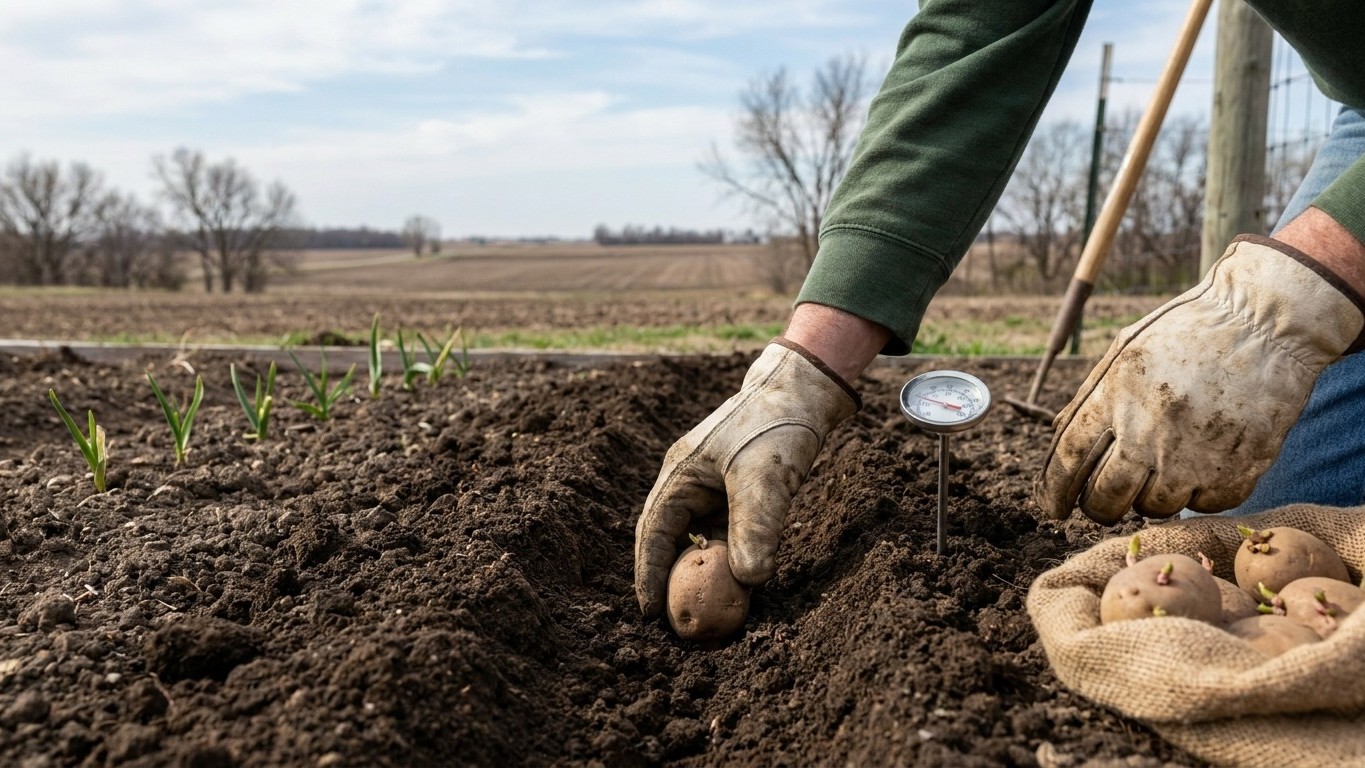

For most Kansas gardens, the safest choice is an early-season variety planted as soon as soil hits 50°F, roughly two to three weeks before the last spring frost. That timing lets the crop finish sizing before summer soil temperatures climb past 90°F, the point at which tuber growth stalls according to Utah State University Extension. Mid-season and late varieties can work too, but only in cooler pockets of the state.
The short answer
At the Wichita airport weather station, NOAA’s 1991-2020 Climate Normals put the last spring frost somewhere between April 4 and April 18, depending on the year. That eight-to-fourteen-day spread matters more than most seed catalogs let on, because it sets the outer edge of when a Kansas gardener can safely put seed potatoes in the ground. Push too early and a hard freeze can knock back emerging shoots. Wait too long and the plant runs straight into the state’s long stretch of summer heat before the tubers have finished filling out.
Utah State University Extension and the University of Maine Cooperative Extension, the two sources behind the horticultural guidance on this page, agree on the mechanism even though they were written for different climates: potatoes go in the ground as soon as soil temperature reaches 50°F, which lands 14 to 21 days before the last frost date. In Kansas, working backward from that April 4 to April 18 window, soil often reaches planting temperature in mid-to-late March across much of the state, sometimes earlier in the south, sometimes later in the northern tier or at elevation.
That planting window is the whole story for variety choice. Because Kansas summers routinely push soil temperatures above the 90°F threshold where tuber set and fill shut down, early-season varieties have the best odds of finishing before the heat arrives. Kennebec and Red Pontiac are commonly grown early-to-mid types suited to boiling and general kitchen use. Yukon Gold, another widely planted early variety, is often chosen for baking and roasting. Russet types, which run mid-season to late, are prized for baking but need a longer stretch of cool soil to size properly, something that’s harder to guarantee once early summer heat sets in across most of the state.
None of this means late varieties are off the table everywhere in Kansas. Gardeners in shaded microclimates, at higher elevation, or in the northern counties where soil warms more slowly may get an extra couple of weeks of cool soil before the 90°F ceiling closes the window. But for the state as a whole, early-season varieties dug in early summer, before soil temperatures peak, remain the dependable answer.
What actually decides it
Variety selection in Kansas isn’t really about taste preference or catalog description. It comes down to two overlapping clocks: how fast the soil warms in spring, and how soon it gets too hot for the tubers to keep sizing. Understanding both clocks lets a gardener reason through a county or a season this page never specifically addresses.
The spring warming clock
Soil temperature, not the calendar, is what triggers safe planting. Utah State University Extension and the University of Maine Cooperative Extension both point to 50°F soil as the planting trigger, arriving 14 to 21 days ahead of the last frost date. In a state as wide as Kansas, that 50°F mark shows up on different days in different counties. Sandy soils in exposed, sunny spots warm faster than heavy clay in a shaded low spot. A gardener who checks their own soil with a simple thermometer, rather than relying on a fixed calendar date, will time planting more accurately than one who copies a schedule built for a different region.
The summer heat ceiling
The second clock is the one gardeners tend to ignore until it’s too late: soil above 90°F stops tuber set and fill, according to Utah State University Extension. Watering more doesn’t reverse it. Shade cloth helps the plant survive, but it doesn’t restart tuber sizing once soil temperature has crossed that line. This is why season class, not variety flavor or skin color, is the decision that matters most. An early-season variety planted at the first safe soil-warming window has weeks of cool-to-moderate soil to build tubers before the ceiling hits. A late-season variety planted on the same date is still trying to size tubers when soil temperature is already working against it.
Why days-to-maturity numbers don’t help here
Neither Utah State nor the University of Maine publishes a fixed days-to-maturity figure for individual varieties, and for good reason: maturity speed shifts with soil temperature, moisture, and sunlight, none of which behave the same from one Kansas county to the next. What both sources do publish is season class: early, mid-season, or late. That classification is the more honest tool, because it describes a variety’s relationship to the heat ceiling rather than a number that would vary by location anyway.
How to do it
- Check your own soil temperature with a probe thermometer starting in early spring, rather than relying on a fixed date, since warming speed varies by soil type and sun exposure.
- Confirm your area’s typical last frost window by checking local data; the Wichita airport station’s 1991-2020 range of April 4 to April 18 is a reference point, not a guarantee, and gardens away from that station often see frost linger later.
- Plant seed potatoes once soil reaches 50°F, which falls 14 to 21 days before your area’s expected last frost date, per Utah State University Extension and the University of Maine Cooperative Extension.
- Choose certified seed potatoes rather than saved or grocery-store tubers; uncertified seed commonly carries virus that reduces yield and can persist in the soil for future plantings.
- Favor early-season varieties for most Kansas locations, since they have the best chance of finishing tuber fill before soil temperatures climb past the 90°F ceiling.
- Hill soil around the stems as plants grow, which helps keep developing tubers shaded and slightly cooler than bare, sun-exposed soil.
- Water consistently through the growing period, understanding that irrigation supports the plant but cannot reverse the tuber-fill slowdown once soil temperature exceeds 90°F.
- Dig the crop as soon as the plant signals maturity (foliage yellowing and dying back) rather than leaving tubers in increasingly warm soil.
What goes wrong
- Planting by calendar date instead of soil temperature. A gardener who plants on a fixed date regardless of conditions risks either frost damage on shoots or missing the cool window entirely. Check soil temperature directly and plant once it holds near 50°F.
- Choosing a late-season variety in a hot part of the state. Late types need more cool soil days than most Kansas locations reliably offer before the 90°F ceiling arrives. Switch to an early-season variety unless the garden sits in a consistently cooler microclimate.
- Using saved tubers from a previous harvest or store-bought potatoes as seed. Uncertified seed frequently carries virus that weakens the plant and can spread into the soil. Buy certified seed potatoes each season instead.
- Assuming extra watering will fix stalled tuber growth in midsummer heat. Once soil crosses 90°F, watering keeps the plant alive but does not restart tuber sizing. Plan the harvest date around the heat ceiling rather than trying to water through it.
- Treating the NOAA frost window as a guarantee for the whole state. The April 4 to April 18 range comes from one airport station; outlying gardens, especially at elevation or in low-lying frost pockets, often see frost linger a week or two beyond that window. Track local conditions rather than a single reference point.
- Leaving tubers in the ground after foliage dies back. Soil left exposed to full summer sun keeps warming even after the plant signals it’s done. Harvest promptly once tops yellow and collapse.
Common questions
Can I grow a fall crop of potatoes in Kansas?
Neither source used on this page addresses fall cropping specifically, so no figure is published here for a second planting window. What is established is the heat ceiling itself: any planting timed so that tuber fill happens while soil is above 90°F will struggle regardless of season.
Do Russet varieties work anywhere in Kansas?
Russets, generally a mid-season to late type, can succeed in cooler microclimates or higher elevations where soil stays below the 90°F ceiling longer into the season. In most of the state’s lower, more exposed ground, an early-season variety is the more dependable choice.
Why does certified seed matter so much for a home garden?
Uncertified seed, including saved tubers or store-bought potatoes, commonly carries virus that reduces vigor and yield, and that virus can linger in garden soil for future seasons. Certified seed is inspected specifically to avoid that risk.
Is the April 4 to April 18 frost window the same across all of Kansas?
No. That range comes from the Wichita airport weather station’s 1991-2020 NOAA Climate Normals. Gardens in other counties, especially those away from that specific station or at different elevations, often see their last frost occur later, sometimes by a week or two.