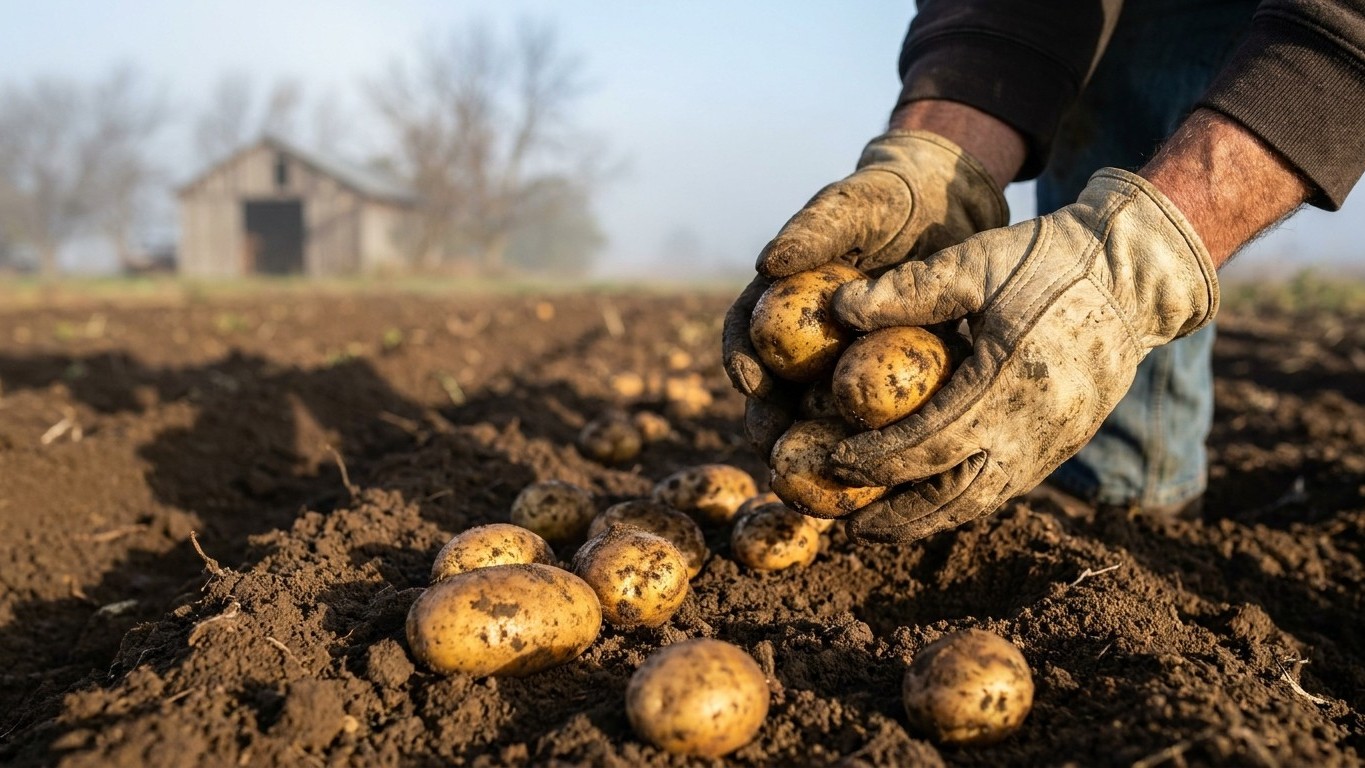

In Kansas, potatoes need to come out of the ground before that October 23 to November 2 frost window closes in, then cure for two to three weeks in a cool, humid spot before moving to storage. The tricky part isn’t harvest, it’s finding a space that holds 40-45 F all winter without freezing, since a Kansas garage or shed often can’t do that once the mean minimum drops to 22.5 F in the coldest month.
The short answer
Two numbers frame everything about growing and keeping potatoes in Kansas. The first fall frost typically arrives between October 23 and November 2, based on NOAA NCEI’s 1991-2020 Climate Normals for the Wichita reference station. The second number matters more once the crop is dug: the mean daily minimum temperature in the coldest month sits at 22.5 F, also from NOAA NCEI’s Wichita-based normals. That’s not the record low for the season, it’s the average low on an ordinary cold-month night, and it’s the figure that decides whether your storage space works at all.
Those figures come from an airport weather station, and they shift by a week or two in either direction depending on where you actually garden. A low-lying rural plot along a creek bottom can see frost a week or more before the Wichita date. A sheltered suburban yard against a south-facing wall might dodge frost past the window’s end. Treat October 23 to November 2 as a planning target, not a guarantee, and watch your own local forecast as the date approaches.
Potatoes should come out of the ground before that frost window closes, once the vines have died back on their own or been cut down roughly two weeks ahead of digging to let the skins set. Digging into frozen or nearly frozen ground damages tubers and invites rot in storage, so the harvest push in Kansas really runs through most of October.
Once the crop is out, the storage question becomes a math problem. Utah State University Extension recommends holding stored potatoes at 40-45 F in the dark. An unheated Kansas garage or detached shed, sitting through a month where the average low is 22.5 F, will not hold that range on its own. Overnight temperatures inside an uninsulated structure track close to outdoor air, meaning the crop risks freezing rather than merely getting too cold. That single gap, between what storage needs and what an unheated Kansas outbuilding delivers in January, is the reason so many home growers lose part of their harvest to freezing rather than to rot or sprouting.
Curing, and where
Utah State University Extension calls for curing at 55-60 F with high humidity for two to three weeks before potatoes go into long-term storage. That step lets cut and bruised skin heal over, which cuts down on storage rot later. The catch in Kansas is timing: harvest typically happens in October, when daytime highs can still climb well past 60 F, even as nights start dipping toward frost. Finding a spot that sits consistently in that 55-60 F band, rather than swinging widely between a warm afternoon and a cool night, takes some hunting.
A shaded porch works for part of the curing window in early October but tends to run too warm on sunny afternoons and too exposed to sudden cold snaps late in the month. A detached garage, especially one without insulation, often overshoots into the 70s on warm October days. The more reliable options tend to be below-grade or otherwise buffered from outdoor swings.
- Brush off excess soil without washing the tubers, then set them somewhere shaded and out of direct sun for the first few hours after digging.
- Move them to a basement corner, root cellar, or similarly buffered space where temperatures run closer to 55-60 F even as outdoor highs and lows swing widely in October.
- Spread the potatoes in a single layer, or in shallow crates, so air moves around each tuber rather than trapping moisture against the skin.
- Hold humidity high during this stage, since Utah State University Extension pairs the 55-60 F curing temperature with high humidity, not the drier air that suits long-term storage.
- Check daily for the first week, watching for soft spots or a sour smell, both signs a tuber should be pulled and used right away rather than left to finish curing with the rest.
- After two to three weeks, once cut skins have healed and outer layers feel dry to the touch, move the batch toward its winter storage spot rather than leaving it in the curing space through the first hard frost.
A basement, particularly an older one with a dirt or unfinished concrete floor, tends to run closest to that 55-60 F target through most of the Kansas curing window. A garage works only if it’s attached to the house and gets some residual heat, since a detached, unheated garage in October already runs too cold overnight for reliable curing by the time the month’s later frosts approach.
Storing through this winter
Once cured, potatoes need to go dark and cool for the rest of the winter. Utah State University Extension puts the target at 40-45 F, while the University of Maine Cooperative Extension recommends 38 F at 95 percent humidity for longer-term storage. Both ranges sit well above the 22.5 F mean minimum Kansas sees in its coldest month, which means the storage question isn’t really about hitting the right temperature during a mild stretch, it’s about holding that range through the coldest nights of January and February without either freezing or creeping too warm.
An uninsulated garage or shed fails on the cold end. Once outdoor lows regularly sit near 22.5 F, an unheated outbuilding with no thermal mass will track close to that same number overnight, well below both the 40-45 F and 38 F targets, and potentially cold enough to freeze tubers outright. Freezing turns starches to sugars and breaks down cell structure, leaving potatoes soft, sweet-tasting, and unusable once thawed.
A basement usually solves the cold-end problem simply because it sits below grade, buffered by surrounding soil that stays warmer than outdoor air even during a hard cold snap. The remaining challenge is the opposite one: a heated basement near the furnace or water heater can easily run warmer than 45 F, which pushes potatoes toward early sprouting rather than freezing. The fix is usually a corner farthest from any heat source, ideally near an outside wall but not near a window or vent that lets in direct light.
Root cellars, where they exist, tend to track closest to the 38-45 F band through a Kansas winter without added insulation or heat, since they combine below-grade placement with typically no interior heat source at all. Where a dedicated root cellar isn’t available, an insulated cooler placed in a basement, or a well-insulated chest in an unheated but not freezing space, can approximate the same range, provided someone checks it periodically during the coldest stretches of the season.
What goes wrong here
- Freezing in an unheated garage or shed. Once nightly lows track near the 22.5 F coldest-month average, an uninsulated outbuilding offers no real buffer against outdoor air. Move stored potatoes to a basement or insulated space before the first hard cold snap of the season rather than after.
- Curing in a spot that’s really too warm. An October garage or sunny porch can swing well past the 55-60 F range Utah State University Extension recommends, especially on unseasonably warm afternoons. Track actual temperatures in the curing spot for a few days before committing the whole harvest to it.
- Digging too close to the frost window without checking the local date. The October 23 to November 2 range comes from a single reference station, and a rural or low-lying garden can see frost a week or more earlier. Watch local forecasts in early October rather than relying on the regional date alone.
- A too-warm basement corner near the furnace. Sprouting shows up faster than most growers expect once storage temperature creeps past 45 F. Relocate the crop to the coolest, darkest corner available, away from heating equipment and any south-facing window.
- Skipping the fungal and pest checks before storage. Damaged or diseased tubers spread rot to healthy ones in a shared storage container. Sort carefully after curing, and treat any recurring soil-borne disease or insect pressure in the growing bed with an appropriate fungicide or appropriate insecticide the following season rather than hoping storage conditions alone will solve it.
Common questions
Can potatoes handle a light frost still in the ground?
The vines themselves are killed by frost, which is often used deliberately to signal it’s time to stop watering and start counting down to harvest. The tubers underground are more insulated, but leaving them in soil that approaches freezing for extended periods risks cold damage, so digging before the local frost date arrives is the safer approach.
How do I know if my storage space is too warm?
Sprouting is the clearest sign. If potatoes begin producing eyes or shoots within a few weeks of going into storage, the space is likely running above the 40-45 F range Utah State University Extension recommends, and a cooler location should be found for the remainder of the batch.
Does a root cellar need to be dug specifically for potatoes?
No. Any below-grade space that stays consistently cool and dark, whether a basement corner, an old cellar, or a buried container, can serve the same function, as long as it holds temperatures in the range the University of Maine Cooperative Extension and Utah State University Extension describe.
Should I wash potatoes before storing them?
No. Excess soil can be brushed off, but washing introduces moisture that promotes rot during curing and storage. Tubers should go into the curing space with skins intact and dry, and any full cleaning should wait until just before use.