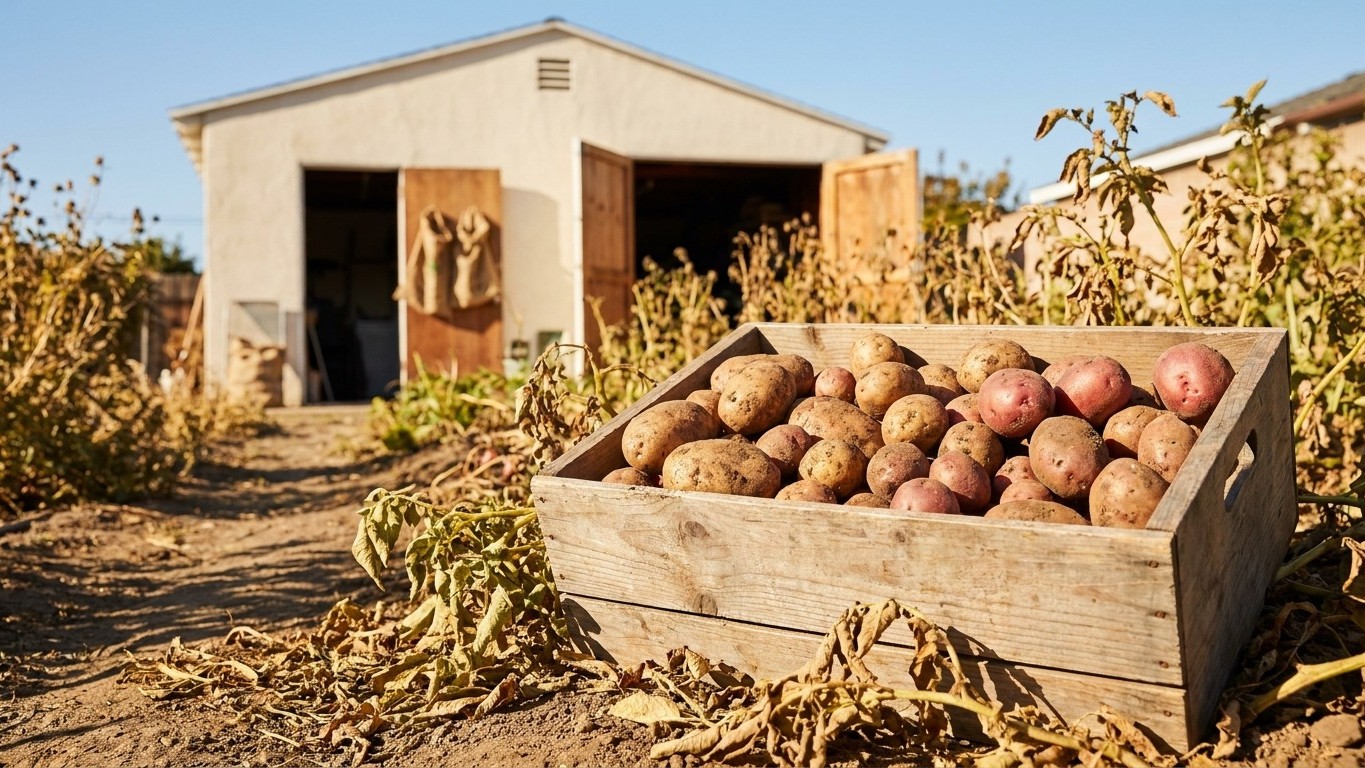

The Colorado potato beetle is the pest most likely to strip a Kansas potato patch bare, and it starts feeding as soon as young foliage appears in spring. Blister beetles and grasshoppers show up later, in smaller but still damaging numbers. K-State Research and Extension documents all three for this territory, and the timing lines up with the region’s last-frost window.
Which pests attack potato in Kansas
K-State Research and Extension documents ten insect species for this territory: Bagworm (Thyridopteryx ephemeraeformis), Blister beetle (Epicauta spp.), Colorado potato beetle, Grasshopper, Harlequin bug, Pine sawyer beetle, Spotted cucumber beetle, Squash bug (Anasa tristis), Squash vine borer, and Striped cucumber beetle. Naming the full list matters, because a gardener searching for potato trouble deserves to know what’s actually on record for the state, not a shortened version.
Most of that list has nothing to do with a potato hill. Bagworm builds its spindle-shaped cases on junipers and arborvitae, not on herbaceous vegetable foliage. Harlequin bug targets the cabbage family, cole crops like collards and kale, and largely ignores potato leaves. Pine sawyer beetle is a wood borer that develops in stressed or dying conifers, so it never crosses paths with a vegetable bed at all. Squash bug, squash vine borer, striped cucumber beetle, and spotted cucumber beetle are cucurbit specialists, drawn to squash, cucumber, and melon vines by the specific chemical cues those plants give off. None of them feed on potato in any documented way here.
That leaves three species that actually do feed on potato: Colorado potato beetle, blister beetle, and grasshopper. The Colorado potato beetle is the specialist of the group, built to eat solanaceous foliage (potato, tomato, eggplant) and little else. Blister beetles are more opportunistic, moving into a garden in clusters and stripping leaves fast once they arrive. Grasshoppers are generalists that will chew on potato foliage along with almost anything green nearby, especially when populations spike or when nearby field edges dry out and push them toward irrigated garden beds.
When each one shows up, and what it does first
Kansas potato planting typically tracks the region’s spring frost pattern, and that pattern is uneven even within the state. The reference weather station used for this territory, near Wichita, shows a last spring frost window of April 4 to April 18. Gardens outside that immediate area, especially at higher elevation or farther from the urban heat pocket around the airport, often see their own last frost run one to two weeks later, which shifts everything that follows.
The Colorado potato beetle is the first to act. Adults overwinter in the soil near last season’s potato patch and walk toward the new planting as soon as foliage breaks the surface in the weeks following that frost window. The first sign is rarely the beetle itself. It’s small, ragged holes chewed into young leaves, followed quickly by the discovery of bright orange-yellow egg clusters glued to the undersides of leaves. Left alone, those eggs hatch into humpbacked red larvae that do more damage than the adults ever did.
Blister beetles arrive later, once plants have filled out with mature foliage. They tend to show up in tight groups rather than scattered individuals, which means damage can go from minor to severe within a matter of days. The first noticeable sign is usually a section of the plant stripped down to leaf veins while the rest of the row looks untouched, a telltale sign of a cluster feeding in one spot rather than a pest spread evenly across the patch.
Grasshoppers become a factor later in the season, particularly as surrounding vegetation dries out and pushes them toward whatever stays green, which is often the irrigated garden. Their feeding looks like ragged notches taken from leaf edges rather than the fine perforations left by beetle larvae, and it tends to worsen through late summer as grasshopper populations peak.
Telling the damage apart from everything else
Not every chewed or discolored potato leaf means an insect is at work. Drought stress, nutrient shortages, foliar disease, and simple mechanical injury from hoeing or hail can all produce marks that look like pest damage at first glance. The single detail that separates insect feeding from everything else is the presence of the insect, its eggs, or its droppings on the plant itself, not the shape of the damage alone.
| Symptom | Possible cause | What tells them apart |
|---|---|---|
| Small round holes in young leaves | Colorado potato beetle adults, or hail bruising | Beetle feeding leaves ragged edges and chew marks; hail damage tends to be uniform across the whole plant, not concentrated on new growth |
| Leaves stripped to the veins in one section | Blister beetle cluster feeding, or wind/mechanical injury | Insect feeding leaves the plant’s woody veins intact and untouched; mechanical injury tends to tear or bruise the vein tissue as well |
| Ragged notches along leaf edges | Grasshopper feeding, or nutrient deficiency yellowing | Grasshopper damage is physical tissue loss; deficiency shows as color change with the leaf tissue still intact |
| Wilting despite regular watering | Root-feeding insects, disease, or drought stress | None of the three documented potato pests here feed on roots, so root wilt points away from insects and toward soil moisture or disease |
A magnifying glass and a slow walk through the row settle most of these questions faster than guessing. When the cause still isn’t clear, a local extension office can look at a sample or a photo and separate insect damage from disease or environmental stress, which matters because the fix for each is completely different.
What actually works here, and what is a waste of time
On a season this short, timing beats almost everything else. Covering young potato plants before beetles walk in from the soil, not after the first holes appear, is the single decision that does the most good. Since Colorado potato beetle adults move on foot rather than flying in from a distance, a physical barrier placed at planting and removed once plants are large enough to tolerate some feeding keeps the first wave out entirely.
Hand-picking adults and crushing the yellow-orange egg clusters works well for Colorado potato beetle specifically, because a home garden’s plant count is small enough to check by hand a few times a week. It works far less well for grasshoppers, which move in from surrounding fields in numbers no amount of hand-picking can keep pace with once a dry season pushes them toward greener ground.
Crop rotation helps break the overwintering cycle for Colorado potato beetle, since adults emerge from soil near where potatoes grew the previous season. Planting potatoes in a different bed each year, even a modest shift of a few feet, reduces how many overwintered beetles find the new crop right away.
What wastes effort is treating a garden the same way every year regardless of what’s actually feeding on it. Blister beetle clusters and scattered grasshopper feeding call for different responses than a steady Colorado potato beetle population, and guessing wrong means either doing nothing about a real problem or spending effort on a pest that was never really the issue. This is also where a local extension office earns its keep, since they know which control methods are actually labeled and legal to use in Kansas for a given pest.
Where to check this for your own county
Everything above reflects what’s documented for Kansas as a whole, and a statewide list is never the same thing as what’s crawling on one particular potato hill. The gesture that matters most before doing anything else: contact the local county office of K-State Research and Extension and describe or show what’s actually on the plant.
Pest pressure shifts across the state for reasons that have nothing to do with the species list itself. A garden near a large grain field will see grasshopper pressure a suburban lot several miles away never experiences. A garden that’s grown potatoes in the same spot for years will carry a heavier Colorado potato beetle population than one where the crop rotates. None of that shows up in a statewide document, because it depends on the specific plot, its history, and what’s growing nearby.
County extension offices also track local emergence timing than a single state-line reference frost date can, since actual frost dates and planting windows shift by a week or two depending on elevation and local terrain. That local knowledge is worth more than any general calendar, because it comes from watching the actual county season year after year rather than a single weather station’s thirty-year average.
The next step is simple: bring a sample, a clear photo, or even just a description of the damage pattern to the county office before deciding on a fix. It costs nothing and it turns a guess into an identification.
Common questions
Does Kansas have a serious Colorado potato beetle problem every year?
Pressure varies by year and by location within the state, since it depends on how many beetles survived the winter nearby. K-State Research and Extension documents the species as present statewide, but a county office can speak to local severity better than a general list can.
Are blister beetles dangerous to touch?
Blister beetles can cause skin irritation on contact for some people, which is part of why hand-picking them calls for more caution than picking Colorado potato beetle larvae does. A local extension office can advise on safe handling for the species found in a given area.
Do grasshoppers prefer potato over other garden crops?
No. Grasshoppers are generalist feeders and will move to potato foliage mainly when surrounding vegetation has dried out or when populations are especially high, not because potato is a preferred host.
Should uncertified seed potatoes be a concern separate from insect pests?
Yes. Uncertified seed potatoes can carry plant viruses regardless of what insects are present in a given season, and that risk exists independent of anything covered here. Starting with certified seed removes that variable entirely.