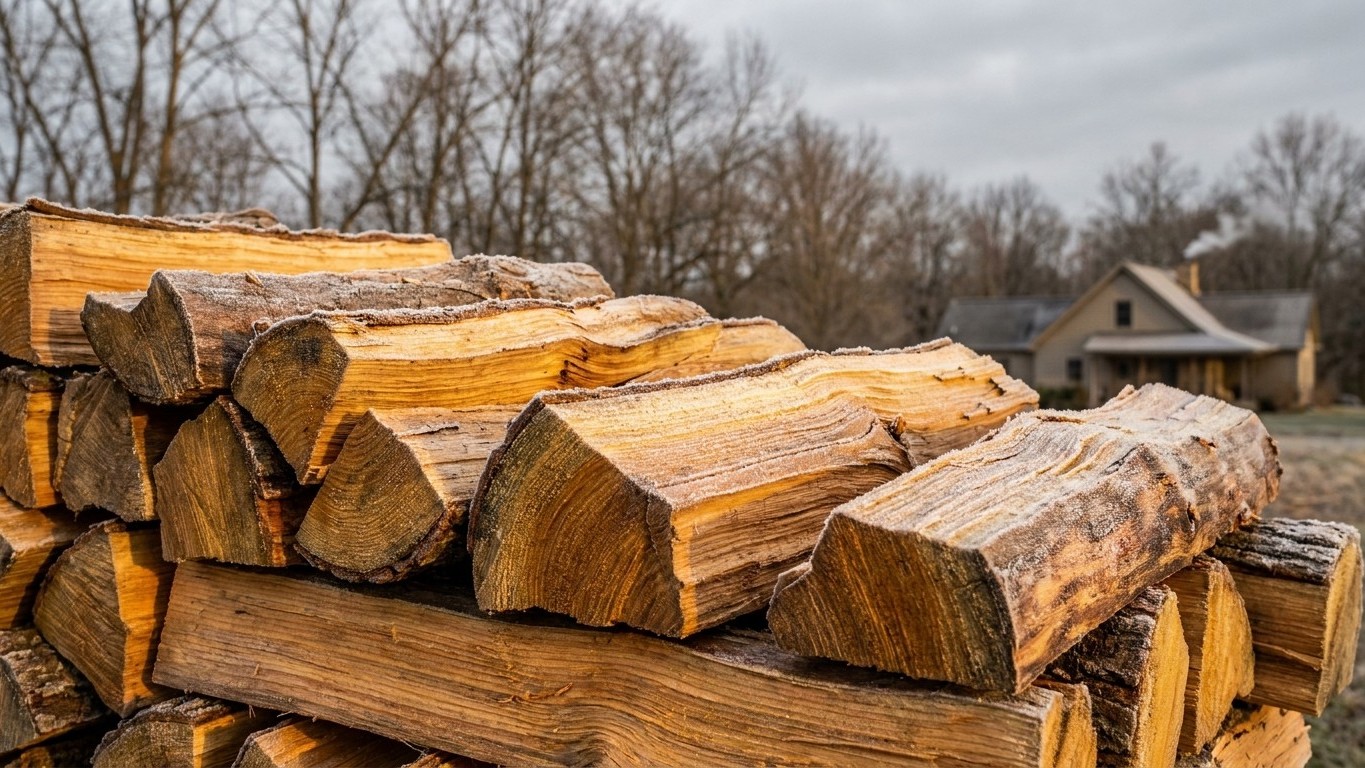

Kentucky winters hover in that stubborn middle zone: cold enough that a fireplace isn’t just for looks, but not the kind of cold that turns firewood into a survival question. The average low in the coldest month at Louisville sits at 27.8°F, which tells you almost everything about how much wood you’ll burn, which species are worth chasing down, and how long you need to plan ahead before the first hard freeze.
How cold it actually gets here

That 27.8°F figure comes from NOAA’s Climate Normals for 1991-2020, measured at the Louisville reference station. It’s not the record low some radio host mentions during a polar vortex. It’s the average nightly minimum across the entire coldest month, meaning on a typical January night in central Kentucky, the mercury settles a few degrees below freezing and stays there until sunrise.
That number matters more than it sounds. A winter that bottoms out in the high 20s isn’t the brutal, pipes-freeze-solid cold of the upper Midwest or northern New England, but it’s also nowhere near the mild 40s-and-up range where a wood fire is purely a lifestyle choice. Kentucky sits squarely in the working zone: cold enough that a house heated partly or entirely by wood needs a real plan, not a Pinterest board.
What does heating through a winter like this actually require? It means fires most nights from roughly late November through early March, sometimes longer in the eastern mountains where elevation adds a few degrees of extra bite. It means a stove or insert that’s actually sized for sustained use, not just weekend ambiance. And it means the wood itself needs to carry real heat, not just crackle nicely.
Not survival cold, but not decorative either
If your reference city were sitting above 40°F for its coldest-month low, this whole page would read differently. You’d be shopping for wood that smells good and burns pretty, because the furnace was doing the real work anyway. Louisville’s 27.8°F rules that out. Wood heat here is functional. It offsets real heating bills, and for the households that lean on it as a primary source, running out in February isn’t an inconvenience. It’s a cold house.
That’s the frame for everything below: which species to prioritize, how much to stack, and why the drying process in this particular climate trips up more people than the species choice ever does.
Which woods are worth the effort here
Once you accept that Kentucky winters demand real heat output, density becomes the deciding factor. A cord is a fixed volume, always 4 feet by 4 feet by 8 feet, or 128 cubic feet stacked. That measurement never changes. What changes is how much wood mass actually fits inside that volume, and denser species pack more burnable material into the same stack. A cord of dense, well-seasoned hardwood carries roughly 20 million BTU, according to Michigan State University Extension, which is the rough equivalent of 145 gallons of #2 fuel oil or 215 gallons of LP gas. A cord of lighter, punkier wood delivers noticeably less, even though it takes up the identical space in your woodshed.
Among the hardwoods commonly available in Kentucky, red oak stands out for a different reason: it’s dense and burns long, which makes it a strong candidate for the coldest overnight stretches when you need a fire that’s still holding coals at 5 a.m. The tradeoff is that it dries slowly. Its cell structure resists moisture loss more than most other hardwoods, so it needs extra time on the stack before it’s ready to burn, a point worth remembering when we get to seasoning below.
Lighter, faster-burning woods still earn their place in the woodpile. They’re not what you bank a January night on, but they’re what gets a cold firebox going quickly, and they’re useful in the shoulder months of October and April when you want heat for an hour or two, not an all-night burn. Trying to hold an overnight fire on quick-burning wood alone usually means waking up to cold ashes.
Availability beats the spec sheet
None of this matters if you can’t actually source the wood seasoned. A dense species that’s only available green, or only sold in rounds nobody’s split, is worse for your winter than a lighter wood you can get properly dried and stacked. Local firewood sellers and co-ops vary a lot across the state, so ask directly how long a load has been split and stacked, not just what species it is.
| Wood category | Approx. BTU per cord (seasoned) | Smoke | Sparks |
|---|---|---|---|
| Dense hardwood, well seasoned (e.g., red oak) | about 20 million | Low, clean burn | Few, steady coals |
| Same wood, green/unseasoned | Noticeably less usable heat | Heavy, often visible white smoke | More popping and hissing as moisture escapes |
The gap between those two rows is bigger than the gap between most species. That’s the real lesson: seasoning changes the outcome more than the label on the wood does.
How much wood a winter takes
Nobody can hand you a single “cords per winter” number that fits your house, and any published figure that claims to should be treated with suspicion. It ignores the three things that actually decide the answer: how cold your winter runs, how tightly your house holds heat, and whether wood is carrying the whole heating load or just supplementing a furnace.
Here’s the mechanism that makes those variables matter so much. Take two houses in the same town, both facing that 27.8°F average low. One has decent insulation, sealed windows, and a tight envelope. The other has drafty older windows, thin attic insulation, and gaps around the foundation. The second house can easily burn double the wood of the first just to hold the same indoor temperature, even though they’re sitting under the identical outdoor climate. Insulation, not weather, is often the bigger lever.
Run your own estimate against these variables rather than trusting a generic number:
- Local winter severity: how close your area sits to that 27.8°F coldest-month average, and whether you’re in a milder western county or a colder eastern highland pocket.
- House tightness: insulation quality, window age, and whether cold air is finding its way in around doors and the attic.
- Role of the wood heat: whether it’s your main source of heat for the season or a supplement to a furnace or heat pump running most nights anyway.
Homeowners using wood as a genuine primary heat source in a house with average insulation typically land somewhere in the range of three to five cords for a full Kentucky winter, but that range can swing wider in either direction once you factor in the two variables above. The only reliable way to know your number is to track what you actually burn one full season and adjust from there.
Drying wood in this climate
Species selection gets more attention than it deserves. Seasoning decides more of your firewood’s actual performance than which tree it came from. The target, regardless of what’s growing in your county, is 20 percent moisture content or less. Green wood fresh off the saw can sit above 60 percent moisture, and every bit of that water has to boil off inside your firebox before the wood gives you any usable heat. That’s energy you paid for in cutting, splitting, and hauling, spent just evaporating water instead of warming your living room.
Kentucky’s humid summers slow that process down compared to drier western states. What actually dries wood isn’t sun exposure, it’s airflow and time. Wood that’s split and stacked loosely, off the ground, with wind able to move through the rows, sheds moisture steadily through a full summer. Wood left in round, unsplit logs, or piled tight against a wall with no air movement, can sit at high moisture well into the following winter no matter how many months pass.
Red oak deserves a specific warning here, since it’s one of the more common dense hardwoods burned across the state. Its cell structure holds moisture longer than most other species, so a stack of red oak needs more time than the standard one-summer rule of thumb, especially in a humid year.
The most common mistake in Kentucky firewood planning isn’t picking the wrong species. It’s timing. Wood cut and split in spring for the winter that follows almost never reaches 20 percent moisture in time, particularly if it’s a denser species like red oak. That wood needs a full summer season stacked properly, which means the wood burning well this winter should have already been split and stacked since last spring or earlier. Planning a full year ahead, not a few months, is what actually keeps a Kentucky woodpile ready when that 27.8°F January night arrives.