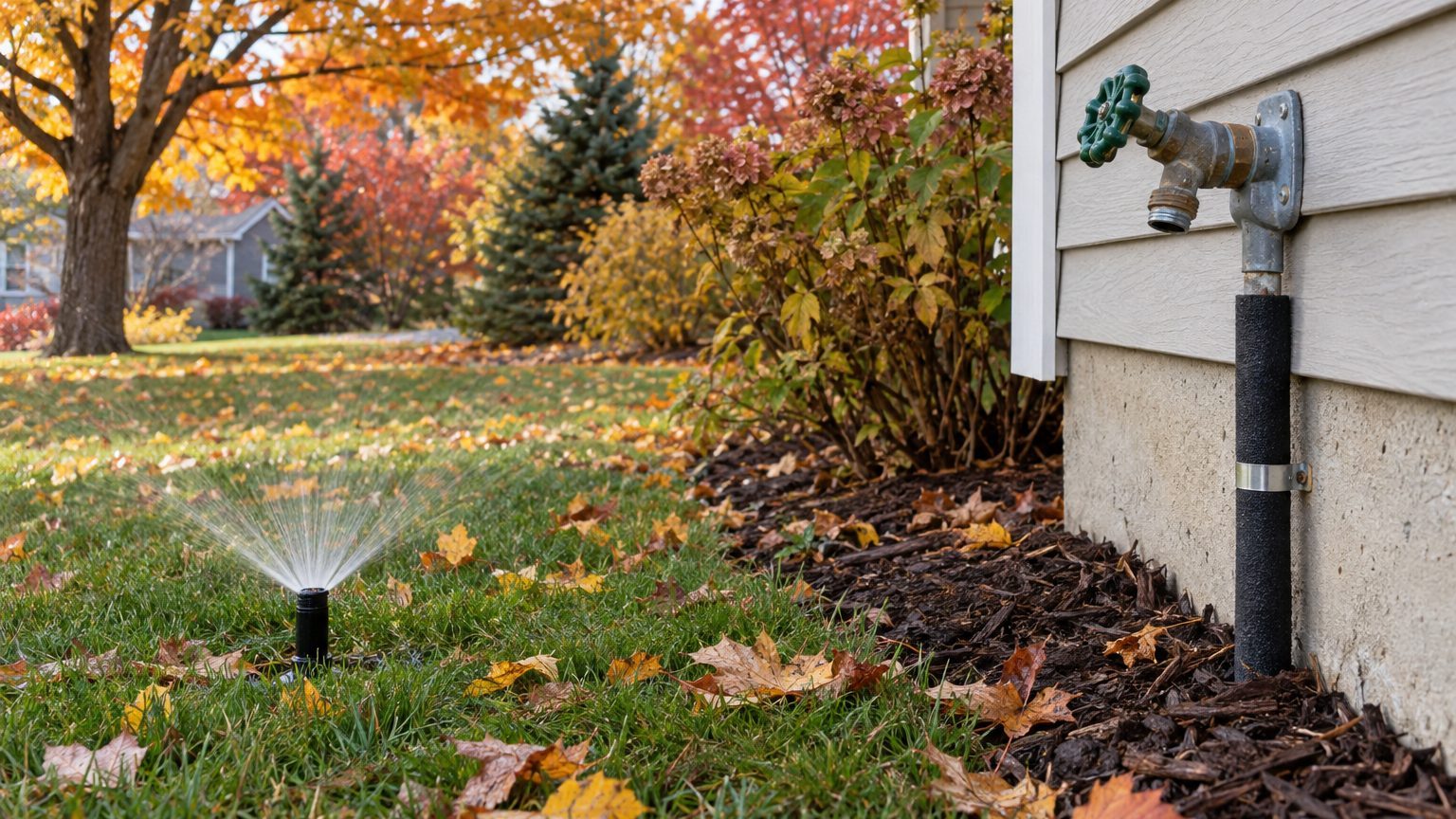

Kentucky winters are cold enough to split pipe. Louisville’s average low in its coldest month is 27.8°F (NOAA NCEI 1991-2020 Climate Normals), so below-freezing nights are routine here, not rare. Sprinkler lines, backflow devices and outdoor spigots all need attention every fall. The calendar is tighter than most people expect, because the first freeze tends to arrive before anyone has found a free Saturday.
When to do it in Kentucky
Finish before the first hard freeze, not after the first light one. In Louisville, NOAA’s 1991-2020 normals put the first fall freeze at 32°F somewhere between November 2 and November 12 (the band where the odds run from 30 to 70 percent), so the work belongs in the weeks leading up to that window.
Finish sprinklers and faucets in the weeks before November 2 to November 12, and earlier if you live in rural or northern Kentucky.
Reading the frost window
That range comes from the Louisville reference station, and the National Weather Service in Louisville cautions that the station does not mirror the countryside around it. Rural parts of Jefferson County run on a tighter fall window. The same direction holds across the state: the farther north you go, and the higher the ground, the earlier the first fall freeze arrives. Fall tasks like draining move earlier with it, never later. A property on a ridge or in a cold hollow should treat the front end of the Louisville range as its deadline, or go a bit ahead of it.
USDA’s 2023 Plant Hardiness Zone Map, which is built on average annual extreme minimum temperature, sorts Kentucky into zones 6a-7a. That tells you conditions differ from county to county, but it says nothing about when the first freeze lands. For scheduling water shutoffs, use the frost window and your own local forecast, not the zone number.
Why a light frost is not the signal
A light frost that whitens the grass at dawn and is gone by 9 a.m. rarely hurts plumbing. Pipes freeze when the cold lasts: several hours below 32°F, or several nights in a row, long enough to pull heat out of exposed pipe, aboveground backflow assemblies and spigots that stick out of a wall. The trouble is that the first light frost and the first damaging freeze can sit only days apart. Some years the pattern is a dusting of frost in late October and a hard drop right after. Waiting for the light frost to “tell you it’s time” leaves almost no margin.
The full job is warranted in Kentucky. With a coldest-month average low of 27.8°F, this is not a climate where you can skip the blowout and hope. A practical sequence: drain and disconnect the faucets first, since that takes minutes, then clear the sprinkler system. If the extended forecast starts showing lows at or near freezing for consecutive nights and the sprinklers are still full, you are already late.
Lawn chores can follow once the water is dealt with; the fall list in Winterizing a Lawn covers that side of the season.
Sprinkler lines: drain or blow out
Why frozen water splits the system
Water expands as it turns to ice. Inside a rigid pipe, a fitting or a valve body, that expansion has nowhere to go, so the plastic cracks at its weakest point. The failures are rarely dramatic in winter. They show up in spring, when pressure returns and the crack becomes a geyser or a soggy patch of lawn. Sprinkler heads, the valves in their boxes, and the backflow preventer near the house are the usual victims, because they hold small pockets of water that cannot escape and sit higher or shallower than the buried lines.
Three ways to clear the lines
A manual drain relies on drain valves at the low points of the system. You open them, let gravity pull the water out, and close them again in spring. It works only if the system was installed with those valves and with pipe sloped toward them, and it tends to leave water in the heads and in the valves themselves.
An automatic drain valve opens by itself when line pressure drops and lets the water out at low spots. It is convenient, but a stuck valve or a pocket of water in a sagging section of pipe can undo the effect. Where a typical night in the coldest month sits below freezing, relying on automatic drains alone is a gamble.
A compressed-air blowout is the thorough option. The water supply is shut off, an air compressor is connected at the blowout port, and air is pushed through one zone at a time until only mist comes out of the heads. It reaches the water that gravity leaves behind. For Kentucky’s winters, this is the method the climate calls for, with manual drains as a backup on systems built for them.
Done badly, a blowout does its own damage. Air that is too strong for the pipe or the heads can burst fittings, and running a single zone for too long heats the plastic. Work in short cycles, stay clear of the backflow device and pipes while they are pressurized, wear eye protection, and stay within the pressure rating printed on your pipe and heads. Set the controller to its off or rain mode afterward so it does not try to run a dry system.
When a professional is the sensible choice
Hire it out when the system has no blowout port, when it has many zones or drip lines, when the yard has steep slopes with water pooling low, or when you cannot confirm the pressure rating of what is buried. A compressor that is too small for the pipe volume can leave water behind, and a mistake costs far more than the visit. Book the blowout before the November 2 to November 12 freeze window opens, because irrigation contractors fill up in the last weeks of October and early November, and the first cold snap sends everyone calling at once.
Outdoor faucets and hoses
This is the quickest part of the job, and the part most often skipped. It takes about the time of a coffee break and involves nothing beyond turning valves and unscrewing hoses.
Start by pulling every hose off every spigot, along with splitters, sprayers and timers. Coil the hoses and store them in a garage or shed with the ends open. Next, find the interior shutoff valve for each outdoor faucet. It is usually in a basement, crawl space or utility room, on the pipe leading to the wall where the spigot sits. Turn it off. Then go outside and open the spigot all the way, and leave it open for the winter. That lets any water left in the pipe drain out and gives ice room to expand if a little remains.
If you are unsure which valve controls which faucet, test it: close the valve, open the outside spigot, and see whether it stops running. If water keeps coming, you have the wrong valve or the valve is not sealing. That is a job for a plumber, not a reason to start tightening or replacing parts.
Why a frost-free faucet still fails with a hose attached
A frost-free faucet has a long stem that puts the shutoff valve inside the heated part of the wall, so the water in the exposed part drains away. That design only works when the water can run out. A hose left on the spigot holds water in the barrel, and the closed end of the hose blocks the drain. When temperatures fall, that trapped water freezes and splits the pipe, often inside the wall where you cannot see it. You find out in spring, when you turn the faucet on and water sprays behind the siding or drips from the ceiling below. The same thing happens if the faucet was installed level or tilted slightly upward, because gravity then cannot clear the barrel. Details on how these work are in Frost-Free Outdoor Taps, and a full walk-through of the routine is in Winterizing Outdoor Faucets Before the First Freeze.
An insulated faucet cover adds a few degrees of protection during a cold night, but it does not replace draining. Anything past turning valves and removing hoses, such as repairing a drip, moving a shutoff or insulating pipe inside a wall, belongs to a licensed plumber. Disconnect every hose before the first hard freeze, in the weeks ahead of November 2 to November 12.
What goes wrong here
Kentucky’s fall can swing from warm afternoons to a freeze within the same week. The NOAA normals describe the odds of a 32°F freeze rising from 30 percent to 70 percent between November 2 and November 12, so in a meaningful share of years the first freeze arrives before the window even opens, and rural spots see it sooner.
The early cold snap
The most common failure is simple: the freeze comes in the last week of October, and the sprinklers are still full. In spring this shows up as one or more cracked heads, a lateral line that gushes when the zone turns on, or a backflow device with a split body. Prevention is about order of operations. If a freeze is in the forecast, drain and disconnect the faucets first, shut off the supply to the sprinkler system, and drain what you can by hand. Then schedule the blowout for the first workable day.
The forgotten hose and the flooded valve box
One hose left on one spigot is enough to split a pipe. The clue in spring is water dripping from the interior side of the wall, under the sink near the exterior wall, or a spigot that runs but delivers weak flow because the line is partly blocked. If water appears inside the house, shut off the interior valve and call a plumber; Frozen Pipes explains the damage that follows a split line.
Valve boxes are the quiet problem. They sit below grade and can fill with groundwater or runoff, especially in low spots or clay soil. A box full of water that freezes can crack valve bodies and solenoids. In spring, the signs are a zone that will not shut off, a valve that leaks, or standing water around the lid. A blowout that actually clears the valves is the best prevention. Boxes that flood every year need drainage fixes from an irrigation contractor.
If a freeze shows up in the forecast before the work is done, drain the faucets first and the sprinklers second. When spring comes, turn the water on slowly, one zone at a time, and walk the yard looking for geysers or soft ground. More seasonal timing for the state is in the Kentucky guides.
Common questions
Is it too late if the first frost has already passed?
Not necessarily. A light frost does not mean the pipes have frozen. If the first frost came before the November 2 to November 12 window, drain the faucets and disconnect the hoses immediately, then clear the sprinklers on the next dry day. After the window has passed, treat the job as urgent, because the odds of a hard freeze are no longer low.
Do I still need a blowout if I have automatic drain valves?
Usually yes. Automatic drains open when pressure drops, but they can stick, and they cannot pull water out of sagging pipe, heads or valves. With an average coldest-month low of 27.8°F at Louisville, the extra step of compressed air is inexpensive insurance compared with a cracked valve in spring.
Should I leave the outdoor faucet open all winter?
Yes, once the interior shutoff is closed and the hose is off. An open spigot lets leftover water drain out and gives any remaining moisture room to expand. If the spigot is closed and the interior valve leaks slightly, trapped water has nowhere to go.
Does Louisville’s frost date apply to my rural property?
It is a starting point, not a promise. The National Weather Service in Louisville notes that the city’s station does not match the surrounding countryside, and rural Jefferson County runs on a tighter fall window. Farther north or higher up, the first freeze comes earlier still. Plan to finish before the start of the November 2 to November 12 range, and ask your county extension office for the local pattern.