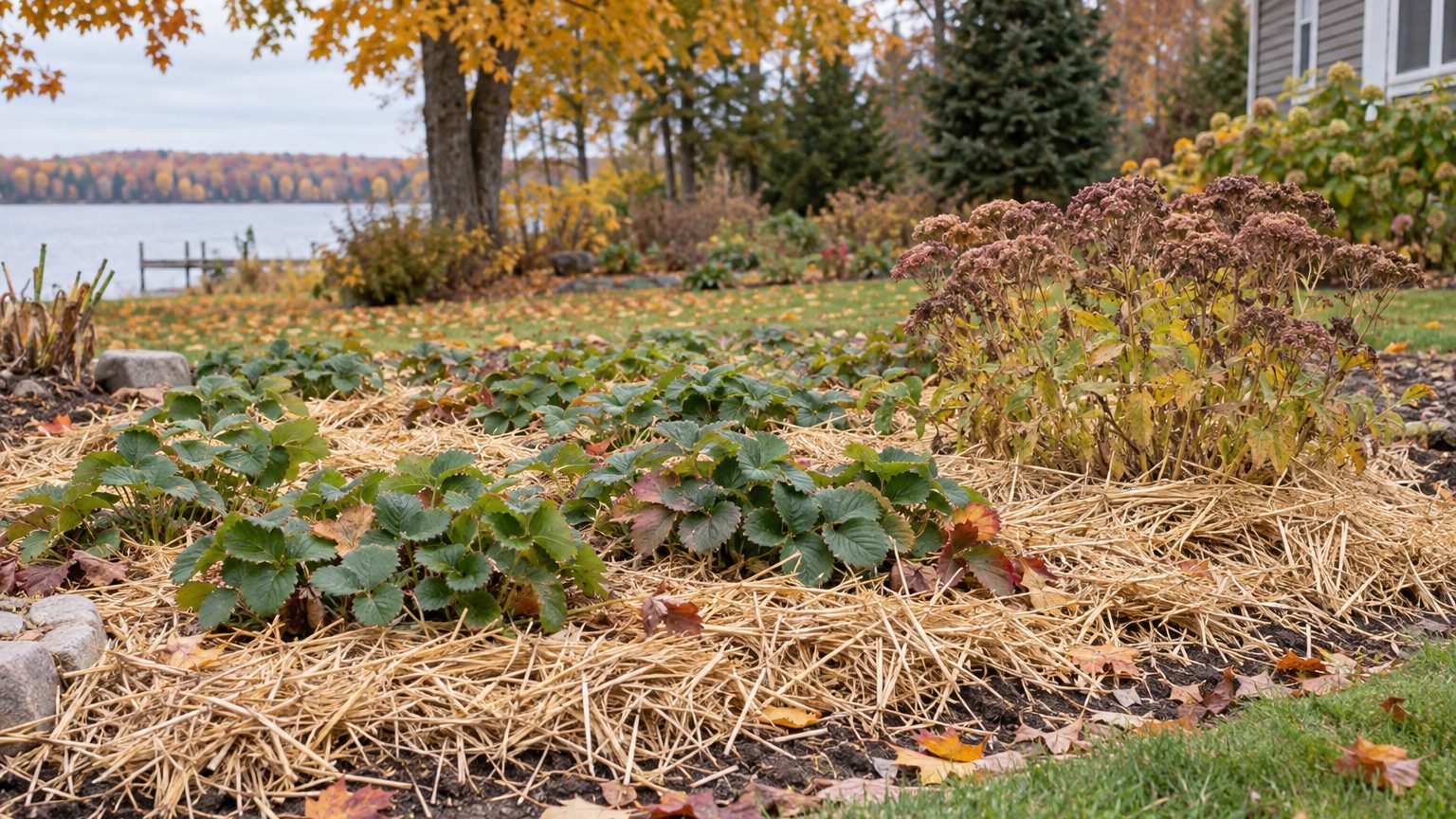

Wait until the ground has started to freeze. In Louisville, NOAA’s 1991-2020 Climate Normals put the first fall freeze between November 2 and November 12, and winter mulch goes down after that window, not at the first cold snap. Strawberries get a loose layer of clean straw over the crowns. Borderline perennials get a ring of mulch that stays off the crown. Both come back off in spring as growth starts.
When to put winter mulch down in Kentucky
Winter mulch does not keep plants warm. Its job is to keep the soil frozen, so it stays at one steady temperature instead of thawing on a mild afternoon and refreezing that night. Those repeated swings are what push shallow roots and crowns up out of the ground. Mulch spread in early October, while the soil still holds summer heat, does the opposite. It insulates warm ground, keeps plants from going fully dormant, and gives mice and voles a cozy place to settle in before the weather turns.
Kentucky winters do bring the swings that mulch is meant to buffer. NOAA NCEI’s 1991-2020 Climate Normals for Louisville show a mean daily minimum of 27.8°F in the coldest month. Nights in January and February spend most of their time below freezing, and afternoons still climb above it often enough to thaw the surface. That is the pattern that heaves strawberry crowns and young perennials.
The same NOAA normals give a first fall freeze (the 30-70% probability band for 32°F) of November 2 to November 12. Mulch after that first-frost range has passed and the ground has begun to freeze, which in a typical Louisville-area year means late November into early December. The first frost is a trigger to start watching, not the day to spread anything. A frost kills tender foliage, but the soil underneath is still warm.
Skip the calendar and read the ground. Mulch when nights are holding below freezing, the top of the soil is crusty in the morning, and a trowel meets resistance at the surface. Perennial tops will have gone dormant by then. If a warm spell comes through in early December, wait it out. A week of mild weather over unfrozen soil is not a reason to rush.
Rural and northern gardens run earlier
The Louisville numbers come with a caution from the National Weather Service in Louisville. Its urban station is slower to get frost than the rural parts of Jefferson County around it, so country gardens should expect a tighter frost-free season and a first freeze toward the early end of that range, or ahead of it. Farther north in the state and at higher elevations, the first fall frost also arrives sooner, so the mulching window moves earlier there too. The USDA Plant Hardiness Zone Map (2023) puts Kentucky at 6a-7a, which is a statewide spread, so treat the Louisville dates as a starting point and adjust to your own frost record. Local dates are laid out in First and Last Frost Dates in Kentucky, and more state-specific advice lives in the Kentucky guides.
Strawberries
A strawberry plant keeps its growing point, the crown, right at the soil surface. Nothing protects it from a hard freeze except the soil around it and whatever you lay over it. Bare cold can injure the crown directly, and heaving can lift it out of the ground so the roots sit exposed to wind and drying air. Kentucky is prone to this because winter rarely delivers the steady snow blanket that colder states count on. Cold arrives on bare ground, thaws, and returns.
The standard cover is clean straw. Wheat or oat straw works because it is light, airy and slow to mat. Look for straw that is truly clean, meaning free of seed heads, since hay or seedy straw will fill the bed with weeds by May. Shredded leaves can work in a pinch, but whole leaves pack down into a wet sheet over the crowns, and that is how rot starts.
Depth is where people overdo it. NC State Extension’s Gardener Handbook says: “A 2-inch to 3-inch layer of mulch suppresses most annual weed seeds and makes it easy to hand-pull any that do germinate.” That passage is about weeds, but the range makes a sound ceiling for straw too. Spread enough to hide the crowns and leaves, and stop at the top of that range. Straw fluffs up and settles, so a pile far deeper than that does not buy extra protection. It only holds more water against the plants.
Timing follows the same rule as everything else here. Wait for the freeze, then cover. For most Kentucky gardens that means after the November 2 to November 12 first-frost range from NOAA has passed and the ground is firm in the mornings. The plants will look flattened and a bit sad by then, and that is fine, because they are dormant.
Spring is the other half of the job. Pull the straw back off the crowns when new growth starts, which shows up as pale yellowish leaves pushing through the straw, not on a fixed calendar date. Rake it into the aisles, where it keeps berries clean and the weeds down, and keep it handy. If a frost is forecast after the covers are off, drape some back over the plants for the night, especially once blossoms appear, since open flowers are the part a late freeze kills. Compare your timing with the last-frost range on the Kentucky frost dates page and see Growing Strawberries for bed care through the rest of the year.
Perennials and borderline plants
Most established perennials in a Kentucky garden do not need winter mulch. Daylilies, hostas, sedum, coneflower and the like were built for this climate, which the USDA Plant Hardiness Zone Map (2023) puts at 6a-7a. That map rests on a single variable, the average annual extreme minimum temperature, so it says nothing about thaw cycles, wet soil or wind. Louisville’s mean coldest-month minimum of 27.8°F (NOAA NCEI Climate Normals 1991-2020) is mild by northern standards. Where winter mulch pays off is on plants that are new, shallow-rooted, or a stretch for the zone.
Here is who benefits most:
- Perennials planted this fall, whose roots have not yet anchored into the surrounding soil
- Shallow-rooted plants that tend to lift in thaws, such as coral bells and hardy mums
- Borderline plants, including rosemary and some lavenders, that can fail in a cold or wet Kentucky winter
Depth matters as much as timing. NC State Extension gives the range for general use as “A 2-inch to 3-inch layer,” and for woody plants says: “Provide a 3-inch layer of mulch to reduce water loss and maintain uniform soil moisture and temperature around roots.” Treat those as the limit and not the starting point. More is not better, and deep mulch is how a ring becomes a volcano.
Shape matters too. Make a ring or doughnut around the plant, not a pile on top of it. Leave a gap of bare soil right at the crown or stems so the base can breathe and shed water. Mulch heaped against a crown holds moisture there all winter, which invites rot and gives voles a roof. Shredded leaves, pine bark or straw all work for the ring. Spread a 2-inch to 3-inch ring after the ground has started to freeze, and keep it off the crown.
Lavender and rosemary need a different touch. Both want dry crowns and sharp drainage, so mulch only lightly around them, and never against the stems. Wet is more dangerous than cold for them. Gardeners who bring herbs through the winter will find more in Getting Perennial Herbs Through the Winter, and the general mechanics of ring mulching are covered in Mulching Without Killing the Plant.
What goes wrong
Mulching too early is the most common mistake, and it looks like nothing at first. The straw goes on in October, the plants stay green and active under it, and the first real freeze catches them still growing. Soft, unhardened tissue is the first to die. The fix is to hold off. Wait until the ground has started to freeze, after the November 2 to November 12 first-frost range. Rural and northern gardens, where frost comes earlier, can start earlier.
Matted mulch is the second problem. Whole leaves, wet grass clippings and fine compost press into a dense layer that sheds air but holds water. Under it, crowns turn mushy and brown, and by spring the plant is gone or limp. Choose airy materials (clean straw, shredded leaves, coarse bark) and fluff the layer after a heavy wet spell if it has packed down.
Voles and mice are the third. A thick layer of mulch laid over unfrozen ground is the ideal winter shelter, and they will happily chew crowns, roots and bark while they stay under it. The risks come down to depth and timing: keep to the 2-inch to 3-inch range, keep mulch pulled back from stems and trunks, and wait for the cold to arrive so rodents have already settled elsewhere.
The last mistake is forgetting spring. Straw left on strawberry crowns after growth begins blanches the new leaves, slows flowering and keeps the crowns wet. Check the beds when the weather first softens, and uncover as soon as you see yellowish growth pushing up. Keep the straw nearby for cold nights, because a frost after uncovering can hit open blooms.
Common questions
Is it too early to mulch strawberries in October?
Yes. Straw laid over warm soil keeps plants growing when they should be hardening off, and it gives rodents shelter before they need it. Wait until after the first-frost range of November 2 to November 12 (NOAA NCEI 1991-2020 normals for Louisville), then mulch once nights hold below freezing and the soil surface is firm in the morning.
Should I use straw or shredded leaves?
Clean straw is the better choice for strawberries because it stays loose and airy. Shredded leaves are fine for a perennial ring, but whole leaves mat into a wet sheet that rots crowns. Whatever you pick, keep it to the 2-inch to 3-inch range that NC State Extension gives for mulch depth, and avoid anything full of weed seed.
When do I take the mulch off in spring?
Go by the plant, not the date. For strawberries, pull the straw off the crowns when new pale-yellow growth starts to push through, then rake it into the aisles and keep it ready for frost nights. For perennials, pull the ring back from the crown as shoots appear. Last-frost ranges for your area are on the Kentucky frost dates page.
Do rural gardens mulch at the same time as Louisville?
Roughly, but expect to be earlier. NWS Louisville warns that its urban station is slower to see frost than the rural parts of Jefferson County, so country gardens face a tighter frost-free season. Farther north and at higher elevation, first frost also comes sooner and the mulching window moves with it. Check what your own garden records, because a low spot can frost well before a hilltop a mile away.