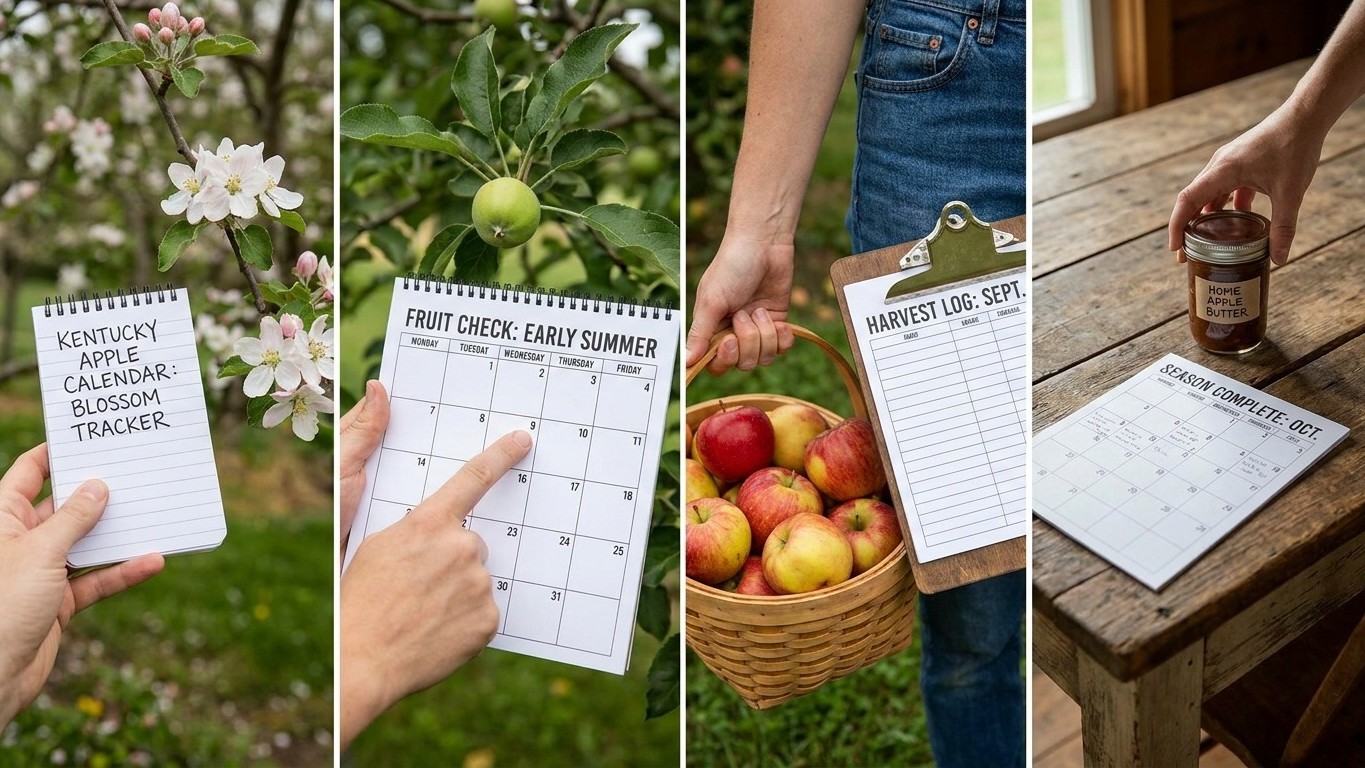

Kentucky’s apple trees don’t lose winters — they lose bloom weeks. The cold here almost never gets low enough to hurt the wood itself; what actually costs you a crop is the flower opening a few days too early or too late for the frost window around it, and that window shifts by elevation almost as much as it shifts by year. So before you do anything else this season, go look at the buds themselves — green tip, pink, or already open — and check that stage against your own local frost dates, not Louisville’s, and not the date on the wall.
The short answer for Kentucky
Plant an apple tree in Kentucky and cold is rarely what kills it. At the Louisville reference station, NOAA’s NCEI 1991-2020 climate normals put the mean daily minimum of the coldest month at 26.8°F, well above what damages apple wood. Survival isn’t the limiting factor here. Timing is. The tree needs its bloom to land inside the gap between the last spring freeze and the first fall freeze, and that gap at Louisville runs from March 24 to April 4 in spring to November 2 to November 12 in fall, both figures from the same NOAA normals.
Hardiness versus winter chill
Two separate questions decide whether a tree does well here, and they get confused constantly. Hardiness asks whether the wood survives winter, and Kentucky’s winters answer that easily. Winter chill asks whether the tree accumulates enough cold hours to flower correctly the following spring, and that is a different filter entirely. A cultivar bred for a much colder climate can survive a Kentucky winter without trouble and still bloom unevenly if the winter ran mild and short on chill. If you’re still choosing what to plant rather than working the calendar of a tree already in the ground, Growing Apples in Kentucky covers site selection and planting before this page picks up.
These are Louisville figures specifically. NOAA’s own siting notes for that station warn that it runs later in spring and earlier in fall than rural Jefferson County around it, so a rural orchard nearby should plan on a tighter window than the dates above suggest, and orchards elsewhere in the state need their own numbers, covered in the next section.
Working through it

The calendar starts with dormancy, the one stage where the tree does not care what the thermometer says. Prune while the wood is bare and fully dormant, finishing before growth resumes, because cuts made after buds start swelling cost the tree stored energy right when it needs it most. In most of Kentucky that means finishing dormant pruning well ahead of the March 24 to April 4 window NOAA’s NCEI normals record as the last spring freeze at Louisville.
Everything after dormancy is timed by what the buds are doing, not by the date on the wall. Green tip, the first visible sign of the growing season, is the hardiest of the active stages and can shrug off a light freeze. Pink, when the still-closed flower buds show color, has already lost much of that tolerance. Bloom is the stage that decides the crop: an open apple flower damaged by frost sets no fruit, and there is no second bloom that season. This is why the bloom stage has to clear the last spring freeze window, whatever the calendar happens to say in a given year.
Stage by stage against the frost window
| Stage | Frost sensitivity | What decides the timing |
|---|---|---|
| Dormancy | Very low, wood tolerates hard freezes | Prune before buds swell |
| Green tip | Low | First sustained warm stretch after winter |
| Pink | Moderate | Accumulated warmth, not a fixed date |
| Bloom | Highest, a freeze here can end the crop | Must clear the last spring freeze window |
| Petal fall | Declining | Follows bloom by days, not weeks |
| Fruit set | Low, young fruitlets tolerate light chill | Thinning decisions happen here |
| Harvest | Not frost-driven | Cultivar’s days-from-bloom figure |
Harvest is the one stage frost mostly does not touch, because most apple cultivars finish ripening well ahead of the first fall freeze that NOAA’s NCEI normals place between November 2 and November 12 at Louisville. For which cultivars finish early enough to clear that window with room to spare, and which hang on the tree longest, see The Best Apple Varieties for Kentucky.
What changes across Kentucky
Louisville sits in the Ohio River valley at a modest elevation, and the NOAA figures above describe that exact spot. Eastern Kentucky’s mountain counties, from the Cumberland Plateau toward the Virginia border, sit at meaningfully higher elevation, and higher ground cools faster in fall and warms slower in spring. A bloom that clears frost risk at Louisville can still run into a freeze on a mountain bench a few hundred feet higher up.
Elevation, river bottoms, and cold air
Western Kentucky’s Purchase region, the flat land west of the Tennessee and Cumberland rivers, sits at lower elevation and closer to the milder air moving up from the Mississippi valley, and growers there generally see bloom arrive earlier than growers on the Cumberland Plateau, though no equivalent set of NOAA normals for that specific area is cited here. Central Kentucky’s Bluegrass region, around Lexington, sits between the two extremes and carries much of the state’s commercial orchard acreage, but its own frost dates are not covered by the Louisville figures above and should be checked separately.
Low ground carries its own risk regardless of region. River bottoms and closed valleys collect cold air on clear, still nights, so an orchard block on a valley floor can read several degrees colder at dawn than a block on the slope just above it. Planting on a slope with open air drainage, rather than in the lowest part of a property, is one of the few frost decisions a grower controls outright. NWS Louisville’s own notes on the station used for these normals say it runs later in spring and earlier in fall than the rural county around it, so a rural Jefferson County orchard should plan on a tighter frost window than the dates above suggest, and the same caution applies to any rural site compared against its nearest airport station.
The mistakes this climate punishes
Choosing an early-blooming cultivar is the most common one. Heirlooms known for opening their flowers ahead of the pack, such as ‘Yellow Transparent’ and ‘Lodi’, can bloom before the freeze risk in the March 24 to April 4 window has fully passed at Louisville, and the failure shows up the same way every time: a healthy-looking tree with almost no fruit in the years its bloom happened to overlap a late cold snap. A cultivar that blooms a week later carries less of that risk simply by missing more of the dangerous window.
Chill mismatches and late-season growth
Winter chill runs the other direction. Kentucky’s winters, with a coldest-month mean minimum of 26.8°F at Louisville per NOAA, normally supply enough chill hours for most commercial cultivars. An unusually mild winter can still leave a very high-chill cultivar such as ‘Arkansas Black’ short of what it needs, and the failure looks different from frost damage: blossoms open unevenly over several weeks instead of together, pollination overlaps poorly, and fruit set comes in thin. This shows up in mild winters specifically, not cold ones, which is why growers who blame it on cold are usually looking at the wrong cause.
Feeding late is the third mistake, and it costs the tree in fall rather than spring. Nitrogen applied in mid to late summer pushes soft new growth that has not hardened off by the time the first fall freeze arrives between November 2 and November 12 at Louisville. That soft growth blackens and dies back at the tips after the first hard freeze, and the tree spends the next spring healing wounds instead of setting flower buds. Stopping nitrogen well before late summer gives new growth time to harden before cold weather arrives.
Checking this against your county
The dates above come from one station near Louisville, and Kentucky covers a lot of different ground between the Mississippi River and the Appalachian ridgelines. Before you commit to a bloom-stage plan, check your own county’s frost data with the University of Kentucky Cooperative Extension Service, which can point you toward county-level agents and any local frost records that refine the Louisville numbers for your elevation and terrain.
A county extension office can also tell you whether a nearby frost pocket or ridge behaves differently from the regional norm, information that rarely makes it into a statewide climate summary.
Common questions
Why did my apple tree bloom but not set any fruit?
The two usual causes are a frost that hit the open flowers, which can happen even in a year that felt mild overall, and a lack of cross-pollination, since most apple cultivars need a different cultivar blooming at the same time to set fruit well. Check whether a frost fell during your bloom week before assuming it’s a pollination problem.
Is Kentucky too humid to grow apples without spraying?
Humid summers do raise pressure from apple scab and fire blight, and a spray-free approach works better with cultivars bred for resistance, such as ‘Liberty’ and ‘Enterprise’, than with cultivars that carry no resistance at all. It’s not a reason to skip apples, just a reason to pick the cultivar with disease resistance in mind.
Do I need two apple trees to get fruit from one?
Almost always, yes. Most apple cultivars are self-unfruitful and need a second cultivar, or a nearby crab apple, blooming at the same time to pollinate the flowers. A single tree with no pollination partner nearby will often flower reliably and still set little to no fruit.
A warm February pushed my tree toward bloom early. Should I worry?
Watch the bud stage rather than the calendar date. A warm February can move green tip and pink forward, but the tree still has to clear the last spring freeze window before bloom to avoid losing the crop, so an early start is only a problem if bloom itself lands before that window closes.