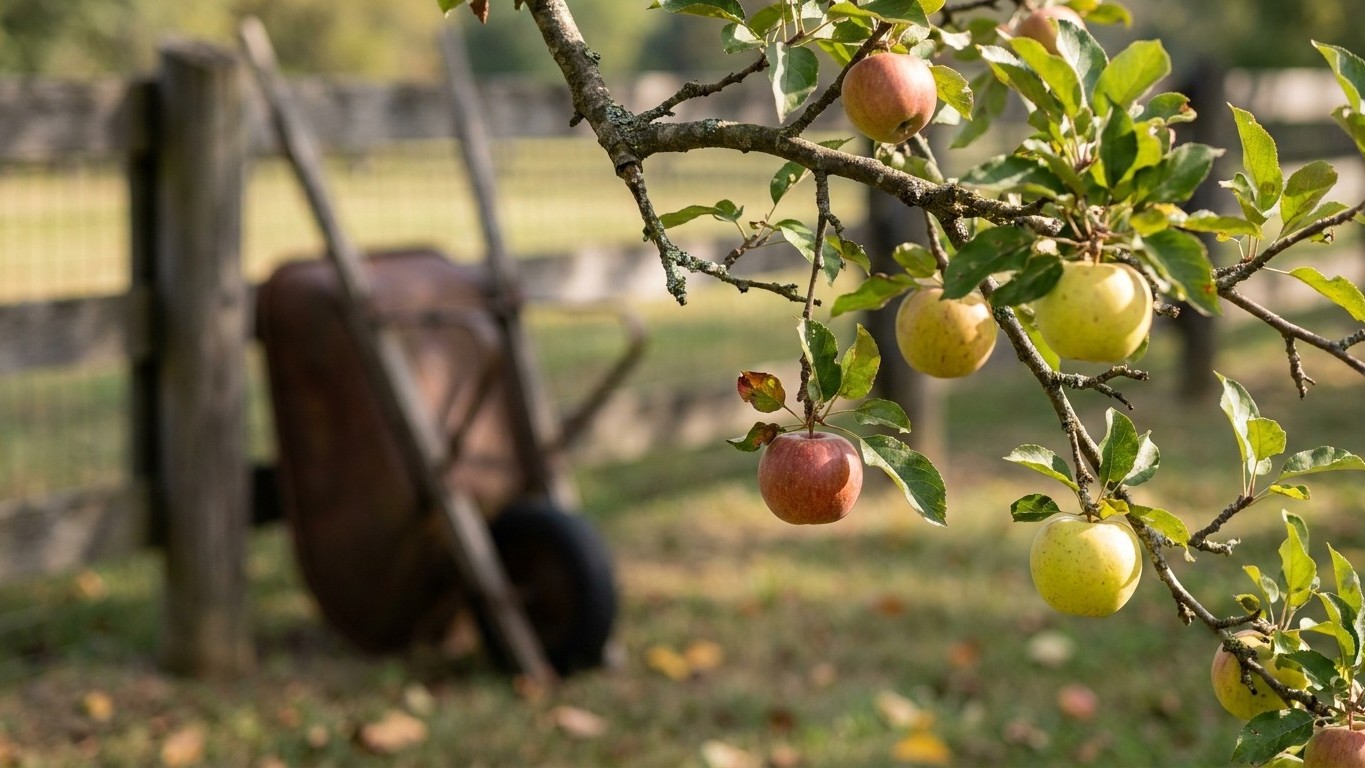

Yes — apples do well almost anywhere in Kentucky, and the tree you plant will very likely survive the winter here without any trouble. The bigger question is really whether it bears fruit, since one apple tree standing alone rarely sets a full crop no matter how well it handles the cold. So before you dig a hole, pick a variety rated for at least zone 6, then line up a second tree with a matching bloom time to pollinate it — that pairing decides your harvest far more than winter ever will.
Can you grow apples in Kentucky
Apples do well across nearly the whole state. The USDA Plant Hardiness Zone Map (2023 edition, based on 1991-2020 climate normals) puts Kentucky in zones 6a to 7a, a range that covers almost every apple cultivar sold by American nurseries. At the Louisville reference station, NOAA NCEI’s 1991-2020 climate normals put the coldest month’s average daily minimum at 26.8°F, which is mild enough that winter cold rarely kills a healthy, well-sited apple tree here. The bigger local variable is not whether the tree survives winter, but whether the site drains well and gets enough sun to ripen the wood before the growing season closes.
How the range shifts across the state
The 6a-7a span is a statewide figure, and it hides real differences on the ground. The Appalachian counties in eastern Kentucky sit at higher elevation and run at the cooler end of that range, closer to 6a, with a shorter growing season than the Bluegrass region or western Kentucky. Western and south-central parts of the state, at lower elevation, run closer to 7a and give fruit a bit more time to size up before fall. A grower working an orchard in the eastern hills is dealing with a meaningfully different climate than one near the Ohio River, even though both fall inside the same statewide hardiness band. Where winter cold is a real limiting factor, it is those higher ridges and hollows, not the state as a whole. Check your own county against the USDA map before ordering trees, and treat the Louisville figures as a reference point rather than a promise for your particular yard.
Which varieties suit this climate

Once a variety survives winter, the next question is whether it flowers well, and that comes down to winter chill rather than cold hardiness. Apple trees need a certain number of hours in the roughly 32°F to 45°F range over winter to break dormancy evenly in spring. Get that wrong and the tree still lives, but it blooms thin and ragged instead of all at once, which drags fruit set down with it. For a season-by-season breakdown of what your tree needs at each point in the year, see The Kentucky Apple Calendar, Stage by Stage. For a rundown of cultivars that reliably meet this chill requirement, see this guide to Kentucky apple Best varieties. Kentucky sits at the moderate-chill end of the country, the same range most mainstream nursery apples are bred for, which makes matching a variety here easier than in a lot of other states. A low-chill cultivar bred for the Deep South, the kind that shows up on a page like growing apples in Louisiana, would break dormancy too early in a Kentucky winter and expose its buds to a late freeze. A cultivar bred for a much longer, colder winter would sit dormant past the point where it should be waking up.
Varieties with a published hardiness range that fits
These cultivars are rated by their breeders or introducing nurseries for zones that include 6 and 7, and their bloom timing and disease resistance are printed on the nursery tag or catalogue page:
- ‘Liberty’ – rated zone 4-8, scab-immune, midseason bloom, harvests in early to mid fall.
- ‘Enterprise’ – rated zone 4-8, resistant to scab and tolerant of fire blight, blooms late, harvests late in the season.
- ‘Gala’ – rated zone 5-8, early to midseason bloom, harvests in late summer to early fall.
- ‘Honeycrisp’ – rated zone 3-8, midseason bloom, harvests in early fall, but wants excellent drainage.
- ‘Arkansas Black’ – rated zone 5-8, late bloom, harvests late and keeps in storage for months.
- ‘Grimes Golden’ – rated zone 5-8, an old heirloom out of the Appalachian region, midseason bloom, harvests in fall.
Treat this set as a starting point to cross-check against a nursery’s own zone rating for your specific county, rather than as a state recommendation.
Planting a pair that works here
A single apple tree, whatever the variety, rarely sets a full crop on its own. Apples need cross-pollination from a second tree that blooms at the same time and carries fertile pollen, and a few widely sold varieties, including ‘Jonagold’ and ‘Stayman’, carry sterile pollen and cannot pollinate anything else even though they need a partner for themselves. Skip those two unless you are already planting three trees.
Which pairs actually work
Among the cultivars that suit this climate, bloom time is what decides which pairs work in practice. ‘Liberty’ and ‘Enterprise’ overlap closely, both blooming mid to late in the season with fertile pollen, which makes them a straightforward pair for a Kentucky yard. ‘Gala’ and ‘Honeycrisp’ overlap in the early-to-mid window and pollinate each other reliably. Pairing an early bloomer like ‘Gala’ with a late one like ‘Arkansas Black’ is the mistake to avoid. Both are hardy here, but their bloom windows may not line up enough for consistent fruit set.
If a mature apple or a wild seedling already grows nearby and flowers around the same time as your new tree, that can serve as the pollen source too. Crabapples with a long bloom period are a common backup, and a neighbor’s tree within about a hundred feet usually counts, since bees carry the pollen. A few catalogues market certain apples as self-fertile, but even those set a heavier crop with a second tree nearby, so plan for a pair from the start rather than treating pollination as optional. Cool, wet weather during bloom can also keep bees from flying for a day or two, which is one more reason to have two or three trees working the same window instead of relying on a single good pollination day.
The frost that costs a crop here

The frost that actually costs a Kentucky grower a crop almost never happens in the dead of winter. It happens in spring, after the buds have already opened to pink or into bloom. At the Louisville reference station, NOAA NCEI’s 1991-2020 climate normals put the last spring freeze, the point by which a 32°F freeze has a 30 to 70 percent chance of still occurring, somewhere between March 24 and April 4. The National Weather Service office in Louisville notes that this urban station reads later in spring and earlier in fall than the surrounding rural county, so a rural orchard nearby should plan for a tighter, earlier window than the city figure suggests.
Why a late frost costs the crop, not the tree
A hard freeze once buds show pink or flowers have opened kills the flowers, not the tree. The wood, the leaf buds, and next year’s growth come through fine. What is lost is this year’s fruit, because a killed flower cannot set an apple even if the tree looks completely healthy two weeks later. That is the part beginning growers get wrong: a tree that leafs out normally after a late frost has not dodged the damage, it has already lost its crop before anyone noticed.
There is not much a home grower can do to protect a full-size tree from a hard freeze at bloom, short of running overhead irrigation or draping small trees with frost cloth overnight when a freeze is forecast during that window. The more reliable protection is timing: a variety that blooms later, once the local frost risk has mostly passed, sidesteps the problem instead of fighting it. Among the cultivars listed earlier, ‘Enterprise’ and ‘Arkansas Black’ bloom later than ‘Gala’ or ‘Honeycrisp’, which buys some margin in a spring that runs warm early and then drops back to freezing, the same pattern that catches orchards in neighboring states, including the apple orchards across Ohio that deal with a similarly late frost window.
The apple year in Kentucky
Kentucky’s apple calendar runs off the tree’s own stages, and each stage lines up loosely with the local frost dates rather than a fixed date on the wall.
Dormancy through bloom
- Dormancy (winter): prune while the tree is bare, shaping structure and removing dead or crossing limbs.
- Green tip (very early spring): buds swell and show a sliver of green, with low frost risk to the wood itself.
- Pink: buds show color but have not opened yet, usually landing close to the March 24 to April 4 freeze window at the Louisville reference station, so this is the stage to start watching the forecast closely.
- Bloom: flowers open and pollinators go to work. Any freeze here is the one that costs the crop, as covered above.
- Petal fall: petals drop, and by this point the flowers are usually past the worst of the season’s frost risk.
Fruit set through harvest
After petal fall, the tree shifts into fruit set and small fruitlets begin sizing up over the following weeks. This is when thinning matters: removing some of the small fruit by hand, leaving one per cluster, gives the remaining apples room to size up and cuts down on limb breakage later in the season. Harvest timing depends entirely on the variety, from late-summer types like ‘Gala’ to late-season keepers like ‘Arkansas Black’ that hang on the tree until closer to the first fall frost, which NOAA NCEI’s 1991-2020 normals put between November 2 and November 12 at the Louisville station. Growers farther east at higher elevation should expect that date to arrive earlier than the Louisville figure suggests.
Local help
For a variety list matched to specific Kentucky counties and current spray timing for scab, fire blight, and codling moth, the University of Kentucky Cooperative Extension Service is the right first call. Its county extension office directory connects you to the horticulture agent nearest your orchard. Bring a soil sample before you plant, since local extension offices run soil analysis and can flag a drainage or pH problem before it costs you a tree.
Common questions
Can apple trees handle Kentucky’s clay soil?
Most can, if the site drains within a few hours after a heavy rain. Standing water around the roots for more than a day or two is what actually kills an apple tree, not the clay itself, so raised planting mounds or berms are worth the extra work on a heavy site.
How many years before a new apple tree fruits?
It depends on the rootstock more than the variety. Trees on dwarfing rootstock typically start bearing a few apples within two to three years, while trees on standard, full-size rootstock usually take longer before they produce a meaningful crop.
Can I get away with just one tree if I don’t have room for two?
Not reliably. If space is the real constraint, some growers set a bucket of cut blossoms from a friend’s compatible tree near their own during bloom to bring pollen in, but a second tree, or a crabapple with overlapping bloom, is the more dependable fix.
My apple tree bloomed heavily but dropped most of its fruit in June. What happened?
That is most likely June drop, a natural thinning the tree does on its own when it has set more fruit than it can support, not frost or disease. It usually still leaves a workable crop on the remaining fruit.
Do I have to spray apples in Kentucky, or can I grow them organically?
Humid summers here make apple scab and cedar-apple rust common problems, since eastern red cedar, the alternate host for rust, grows throughout the state. Scab-resistant varieties like ‘Liberty’ and ‘Enterprise’ cut down on how much spraying is needed, but an untreated tree of a susceptible variety will likely show some disease most years.